Auto Giants Drive Innovation at CIIE as Smart Tech Reshapes Industry
The auto exhibition booths at the ongoing 9th China International Import Expo (CIIE) are packed day after day. A multitude of legacy automakers from Europe, the United States, Germany and Japan are showcasing innovations that bridge the past and future of the automotive industry.
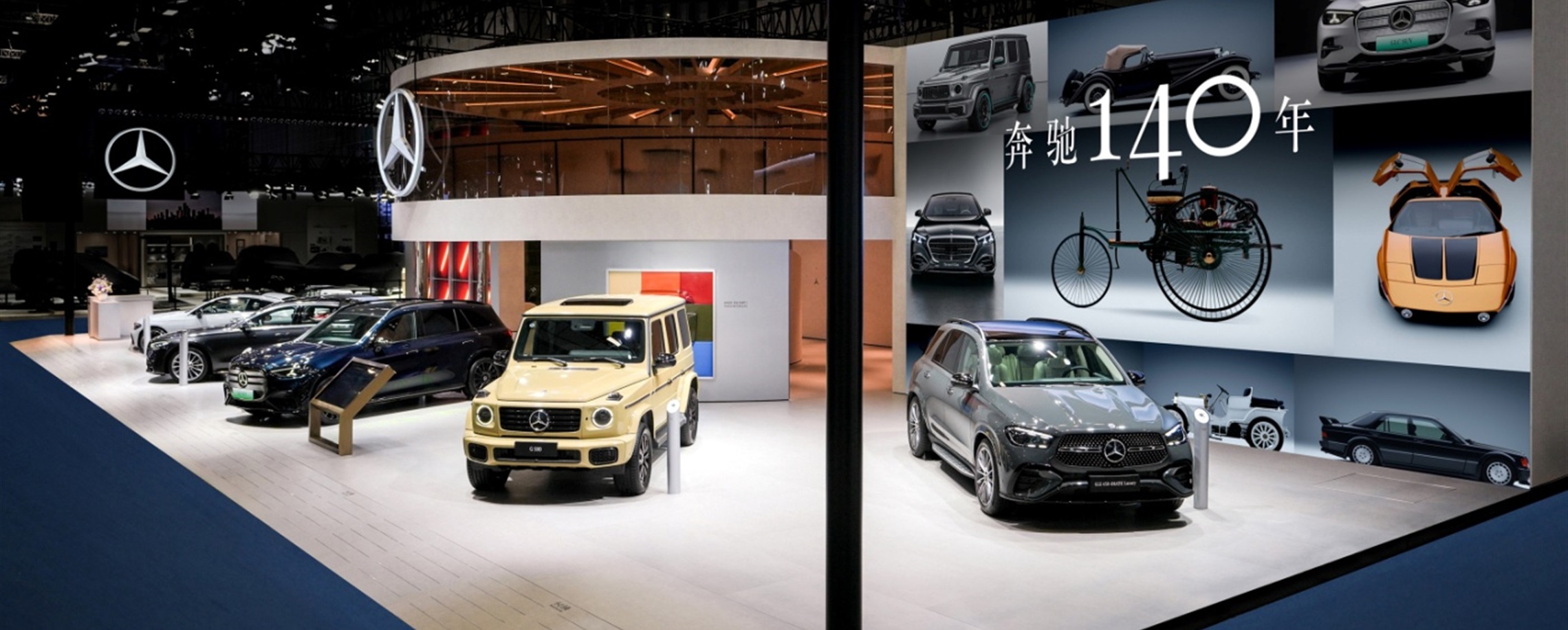
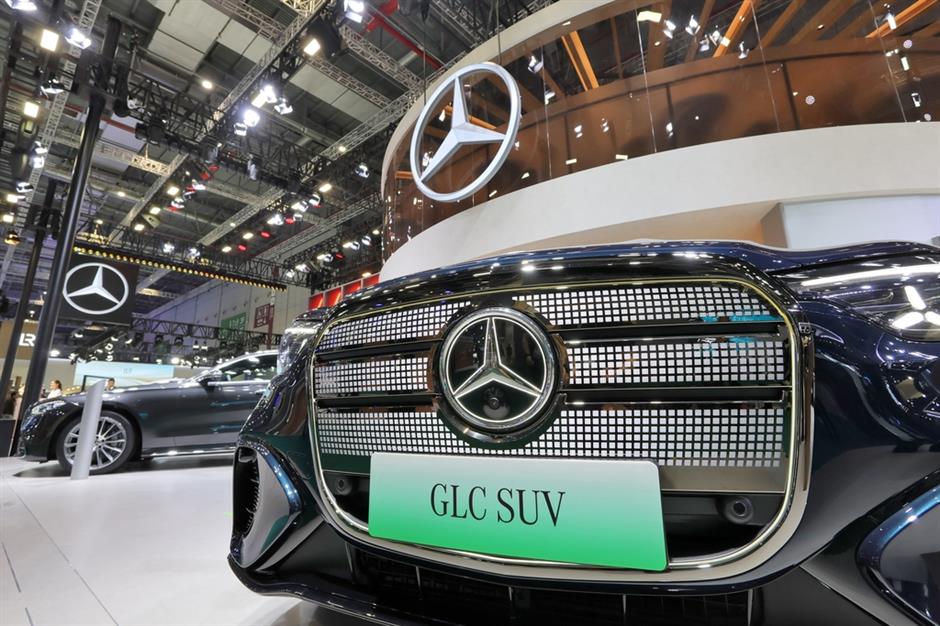
Take Mercedes-Benz for example. This marks the ninth consecutive year the German automotive veteran has participated in the grand event. As the automotive industry enters 140th year, the historic marque has brought its strategic reshaping toward deep intelligence and localization to Shanghai.
"China is not only one of Mercedes-Benz's most important markets, but also our core innovation base," said Oliver Thöne, member of the board of management of Mercedes-Benz Group.
At this year's CIIE, the new-generation Maybach S-Class debuted a high-end rear-seat entertainment system developed under the leadership of a Chinese team, which is slated for a global rollout. It also pioneered the application of an edge-side multimodal large language model jointly developed with Chinese partners.
Furthermore, Mercedes-Benz announced a partnership with Tongji University to conduct industry-academia-research joint studies in key cutting-edge fields such as driver assistance, artificial intelligence and new-energy vehicles (NEVs).
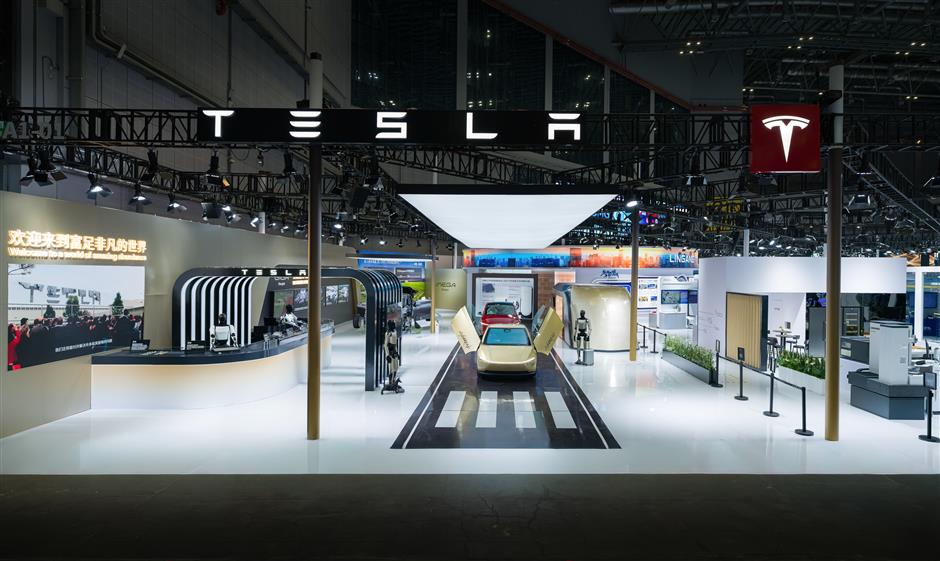
The deepening cooperation seen inside the CIIE venue is a microcosm of the global automotive industry seeking win-win outcomes through free trade. However, looking outward at the global macroeconomy, a chilling wind of anti-globalization and protectionism is blowing.
For instance, the European Union has imposed heavy tariffs on Chinese electric vehicle imports while restricting the export of hybrids; the US has also barred Chinese-made vehicles from entering its market. Consequently, "defending fair competition and breaking down trade barriers" has become a prominent topic at the Hongqiao International Economic Forum held alongside the CIIE, with the automotive sector serving as a focal point of this discussion.
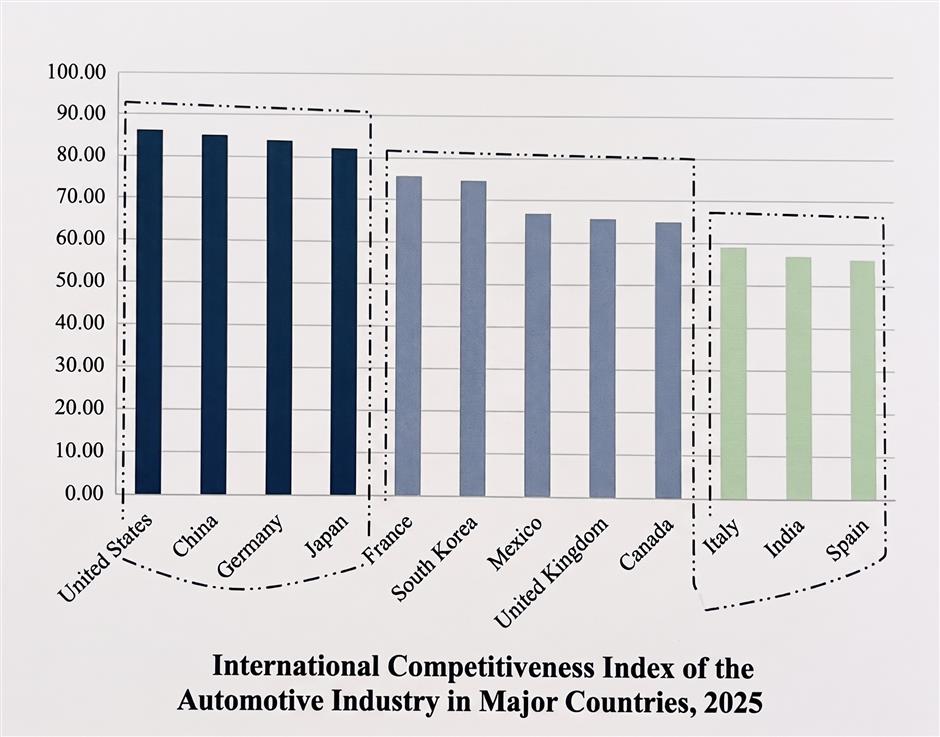
To understand the current intricate trade frictions, one must first look closely at the profound transformations the automotive industry is undergoing. At the Hongqiao Forum, the Shanghai Academy of Social Sciences released the "International Competitiveness Report of the Automotive Industry 2026," which maps out this historical trajectory.
"After more than 140 years of evolution, this transformation of automobile industry, centering on new energy, electrification and intelligence, has reshaped the product attributes of automobiles, turning them into 'mobile intelligent terminals'," said Gan Chunhui, president of the academy.
"Under this new landscape, traditional evaluation systems have become obsolete. Measuring a country's international competitiveness in the automotive industry can no longer be confined solely to production volume or export value; it requires a comprehensive strength evaluation covering five major dimensions: industrial foundation, technological innovation, market expansion, global resource allocation, and environmental support."
The report spans 41 countries and regions worldwide. Notably, under this five-dimensional evaluation system, the US, China, Germany and Japan form the global automotive industry's first tier, with China receiving exceptionally high marks in both technological innovation and global resource allocation.
This helps explain why, faced with the restructuring of the industrial landscape and the entry of an emerging powerhouse like China, certain nations have chosen to politicize economic and trade issues under the guise of security, introducing uncertainty into the automotive sector and beyond.
"What's happened now today, in this world in the last few years anyway, has been a lot of uncertainty in virtually all product lines; investment, and production take time. And with uncertainty of such type, even uninsurable uncertainty of the kind that we refer to as ambiguity, this is a distinct, deeply interrupting world trade," James Heckman, Nobel laureate in economics and a professor at the University of Chicago, told the forum.
"So I look forward to the fact that we can re-engage in a new era, where we find much more support for trade."
Faced with barriers, industry leaders have demonstrated an attitude of embracing competition. Addressing theories of a "Chinese NEV threat" raised by certain factions within Europe, Mercedes-Benz adopted a calm and objective stance.
"We believe as Mercedes-Benz, after 40 years operating (in China), that true and fair competition drives a better result," said Thöne. "So for Mercedes-Benz, the rise of the Chinese auto industry is something positive. It causes competitive forces which yield better results."
Meanwhile, Chinese automobile giant Geely put forward its own perspective at the forum.
"We believe that resolving differences should be based on WTO (World Trade Organization) multilateral rules, adhering to the core principles of fairness, competition and transparency. From the perspective of the WTO, they have the right to conduct investigations and take measures regarding dumping or countervailing duties, but we hope they will uphold principles of fairness and impartiality when exercising this power," said Chen Yimin, chief compliance officer of Geely Holding Group.
"In fact, during the previous countervailing investigation procedures, as one of the investigated enterprises, we had many queries, which we questioned and challenged accordingly."
At the same time, experts at the forum noted that in the face of complex geopolitical conflicts and regional differences in industrial costs, China's automotive industry must achieve a leap from "product export" to the "globalization of industrial capabilities." This requires companies to strengthen the commercialization of innovation achievements and build specialized clusters and value-chain service capabilities, thereby forging a solid industrial ecosystem advantage.
As the storm of anti-globalization intertwines with a new generation of industrial rules, the "going global" strategy of Chinese automakers urgently requires a logical restructuring. The traditional "trading mindset," which historically relied purely on selling goods for quick profits, appears extremely fragile, and even fraught with security risks, in today's complex overseas environments.
"Before venturing abroad, enterprises must deeply consider: Where to go, how to get there, who to partner with, and how to cooperate. The key to breaking through lies in learning how to establish deep connections and interest-sharing mechanisms with local core stakeholders," said Shao Yizheng, head of the International Industrial Collaboration Platform at the Hongqiao Overseas Development Service Center.
"Only by building a symbiotic and win-win deep cooperation system can we effectively defuse the hostility of trade protectionism, break through various barriers, and achieve true high-quality international expansion."
Editor: Liu Qi
In Case You Missed It...

 Oct 21, 2026