BYD Cracks Japan's K-Car Market, With More Chinese Carmakers on Its Heels
Since its official launch in late July, the BYD Racco, a pure electric K-car tailored specifically for the Japanese market, has secured over 1,800 orders, pushing the Chinese carmaker's total passenger vehicle deliveries in Japan past the 10,000 milestone and stamping its foot firmly on the home turf of some of the world's biggest brands.
The feat is not limited to sales figures alone. In the 2026-27 Japan Car of the Year awards announced earlier this month, the BYD Racco made history by taking a spot among the top 10 finalists.
Furthermore, the Automotive Researchers' and Journalists' Conference of Japan last week awarded the BYD Racco its "Import Car of the Year" award – a first for a Chinese carmaker.
Liu Xueliang, head of BYD Japan, said in a July interview with Kyodo News that the global adoption of electric vehicles is unstoppable. By entering the Japanese mini-car market, BYD is expected to send ripples across the stagnant waters of Japan's domestic auto sales.
"We are driven by a philosophy of offering localized technology and products wherever they operate," he said.
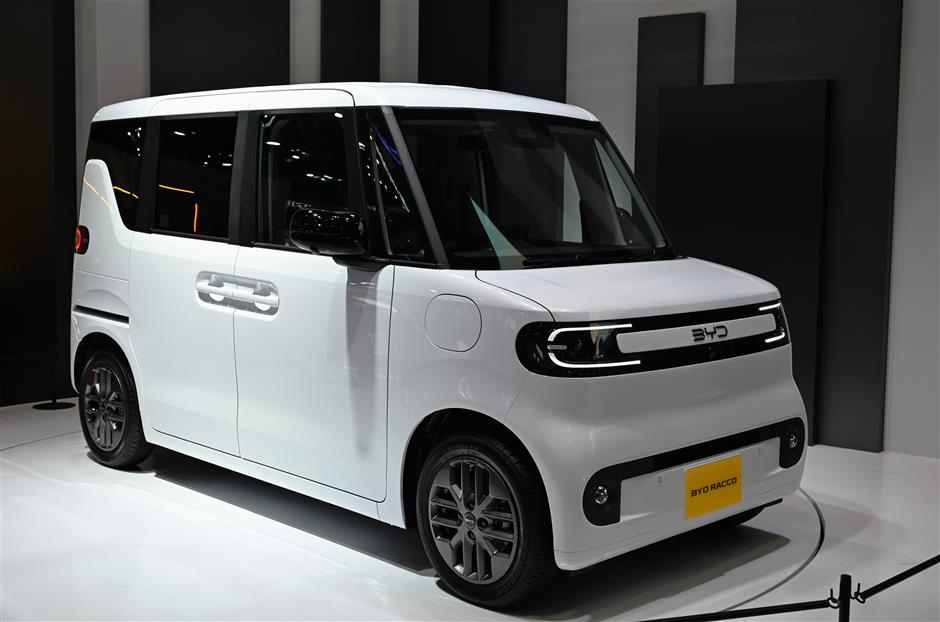
To fully grasp the Racco's success, one must understand the unique concept of the K-car, or "Kei car" in Japanese. Introduced by the government in 1949, it comes with strict government regulations: A K-car cannot exceed 3.4 meters in length, 1.5 meters in width or 2 meters in height, and its engine displacement is capped at 660 cubic centimeters, with maximum output of 64 horsepower.
In exchange for those limitations, lightweight K-cars receive exclusive yellow-and-black license plates and enjoy massive reductions in purchase and weight taxes. In addition, a K-car in many regions bypasses requirements for buyers to show proof of parking spaces required for regular sedans. Before the Racco arrived, this segment was heavily dominated by domestic giants like Suzuki, Honda and Nissan.
However, the transition of K-car models to electric power has been sluggish. In 2025, that segment accounted for only 2.8 percent of the market. This massive market with such a low electrification rate was seized on as a window of opportunity by Chinese electric carmakers.
BYD is not the only one targeting the market. China's Chery Auto has allied with Yueda Auto, Gotion and Japan auto-parts retailer Autobacs Seven and coating equipment developer Anest Iwata to launch a new electric K-car brand called EMTA. It's set to debut in Japan in spring next year.
Meanwhile, Guangxi Auto Group has also partnered with Japan's ASF to develop an electric commercial logistics K-car, targeting "last-mile" deliveries.
Japanese carmakers have been closing watching the encroaching competition.
"The entry of Chinese brands is a catalyst that will force Japan's domestic supply chain to accelerate its electric vehicle transition," Toshihiro Suzuki, president of Suzuki. Motor, said at the Japan Mobility Show last year.
The counterattack is on. Earlier this month, Suzuki launched its first pure electric K-car, the e-Sky, with a starting price of 2.1 million yen (US$13,800), undercutting the BYD Racco. Backed by a vast network of over 2,000 dealerships, the e-Sky amassed more than 4,036 orders in its first month.
Japan's subsidy policies naturally favor local players. While the BYD Racco qualifies for Japan's clean energy vehicle subsidies, it's entitled to a maximum of only 150,000 yen per vehicle. In contrast, domestic rivals like the Nissan Sakura, Honda N-One e: and the Mitsubishi eK X crossover can claim between 574,000 and 580,000 yen. For a lightweight electric vehicle priced at about 2 million yen, a subsidy gap of over 400,000 yen, more than 10 percent of the vehicle's total cost, significantly dilutes the Racco's price advantage.
While Japanese automakers are trying to mount a strong defense at home, they are also fighting a battle for market share on the Chinese mainland, where sales keep slipping. By September, the retail market share of Japanese cars in China had plummeted from a peak of 23 percent to just 10.7 percent.
Hybrid HEV models – self-charging petrol-electric cars that do not need to be plugged into a power outlet – that Japanese brands have long relied on are losing ground to plug-in hybrids from Chinese domestic brands. Additionally, Japanese vehicles suffer a generational gap in smart cabin features and advanced driver assistance systems compared with China's electric vehicles.
To reclaim lost ground, Japanese manufacturers are making painful pivots in strategy. Toyota and Honda are abandoning their traditional model of total product control, opting instead to deeply integrate Chinese-made electric architectures, smart cabin chips and driving algorithms into their upcoming vehicles.
They are also repurposing idle factories. Automakers like Nissan are transforming their Chinese joint-venture plants into global export hubs to ease financial pressure. Nissan launched the Frontier Pro plug-in hybrid pickup in Mexico last month, which is designed is designed and manufactured by Zhengzhou Nissan in Henan Province, marking Nissan's first China-developed vehicle aimed at the global market.
Toyota said it plans to manufacture its first-ever extended-range electric vehicle in China by April 2027. Its luxury arm, Lexus, will launch a new electric SUV in the fall of 2027, built at a new plant in Shanghai. This will be Lexus's first model developed and manufactured in China in over two decades.
In China, Japanese automakers are wading through a difficult period of restructuring. Whether combining Chinese technology with Japanese branding will stabilize their market share remains to be seen. Meanwhile, in Japan, while pioneers like BYD have cracked open the K-car market, breaking through deeply rooted local sales channels and protectionist policies will be a grueling test of endurance and localization.
Editor: Liu Qi
In Case You Missed It...

 Nov 16, 2026