Daily Buzz: 1 April 2026
Top News
Possible End to Iran War? Investors Seize Positive Signs
Investor sentiment on Wall Street turned positive amid signs of a possible end to the war in Iran. President Donald Trump has indicated to top aides that he's willing to end the war against Iraq even without reopening the Strait of Hormuz, the Wall Street Journal reported. An unconfirmed report said Iranian President Masoud Pezeshkian is open to ending the war, with guarantees. He said earlier the way to end the war is for the US to recognize Iran's legitimate rights, pay war reparations and secure international guarantees against future aggression. In New York, the S&P 500 gained 3 percent and the Nasdaq surged 3.8 percent. The price of Benchmark Brent was down 3.18 percent in late New York trading at US$104 a barrel.
Despite pockets of optimism, war rhetoric continued. Iran's Revolutionary Guards delivered a new threat, saying it may strike 18 US companies operating in the Gulf region, including Microsoft, Google, Apple, Tesla, Boeing and IBM. Trump again lashed out at Western allies, particularly the UK, that have been reluctant to join the war. The president said they will have to secure their own oil shipments through the Strait of Hormuz. "The US won't be there to help you anymore," he said. A day earlier, he threatened to obliterate electricity plants, oil infrastructure and desalination plants in Iran if the Strait of Hormuz wasn't opened and a peace deal remained elusive. Two-thirds of Americans surveyed in a new Reuters/Ipsos poll, said the US should end its involvement in war, even if goals are not achieved.
On the ground, an Iranian attack on a fully loaded tanker in Dubai Port caused a fire, with ship owner Kuwait Petroleum warning that it could lead to an oil spill in the Persian Gulf. Israel's largest oil refinery located in Haifa was hit for a second time, sparking a fire in an attack claimed by Lebanon's Hezbollah faction. Blasts were heard in Tehran from missile strikes that Israel claimed were military targets, blacking out part of the capital. Three UN peacekeepers were killed by Israeli strikes in southern Lebanon.
Top Business
Huawei Reports Higher Profit and Invests More in R&D
Privately-owned Chinese tech giant Huawei said 2025 net profit rose 8.6 percent from a year earlier to 68 billion yuan (US$9.8 billion). Revenue increased to 881 billion yuan from 862 billion yuan, in line with expectations. The company said it spent 192.3 billion yuan on research and development, with accumulated capital spending in that segment exceeding 1.4 trillion yuan in the past decade. It said it is focusing on fast development of tokens, the units of data processed by AI models, and expects China's AI-related industries to exceed 10 trillion yuan by 2030, amid booming demand for intelligence and AI infrastructure. Huawei said it will open its modular hardware, servers, motherboards and "super-node" to partners this year.
China Vanke's Loss Widens on Debt Problems
China Vanke, a former leader in the Chinese mainland property market now flying close to default, said its 2025 loss widened to 88.6 billion yuan (US$12.8 billion) from 49.5 billion yuan a year earlier, and nearly 6 billion yuan more than forecast. Revenue fell 32 percent to 233.4 billion yuan. The company, which has an estimated US$11 billion in onshore and foreign liabilities, has been seeking creditors approval for numerous delays in repaying maturing debt. A default could be the largest ever in China and set off a chain reaction across the banking sector. Vanke, like other property developers, was bitten by a liquidity crunch that began in 2021 and led to defaults by several developers. Vanke's largest shareholder, Shenzhen Metro, owned by the city of Shenzhen, has coughed up bailout loans in the past to stabilize Vanke, but that support has shown signs of waning. Vanke's gearing level, the ratio of debt to equity rose to 76.89 percent, up 3 percent from a year earlier. Vanke said it sold 10.25 million square meters of property last year, down 43 percent. Vanke shares have dived 50 percent in the past 12 months and 90 percent in the past five years, trading at 2.9 yuan (41 US cents).
Knowledge Atlas Widens Loss, Foresees Explosive Token Demand in 2026
Knowledge Atlas Technology, one of China's so-called "AI Tiger" companies, said its 2025 loss widened to 4.72 billion yuan (US$674 million) from 2.96 billion yuan a year earlier. The company, rebranded from Zhipu in China and to Z.ai outside China, said revenue surged 132 percent to 724.3 billion yuan. The company is considered the third-largest Chinese mainland player in large language models. It was the first earnings report since its initial public offering in Hong Kong in January that raised US$558 million. Chief Executive Zhang Peng said in a conference call with analysts that he expects explosive demand in tokens, the units of data processed by AI models. The company's self-developed OpenClaw-style token subscription plan, launched earlier this month, has garnered more than 400,000 subscribers. Zhang said company is gaining pricing power for its AI services, which will boost its revenue and profit.
The company, founded at Tsinghua University in 2019, received about US$3 billion in startup investments from Alibaba, Tencent, Meituan and Xiaomi, in addition to funding from Saudi Arabia. Last year, the company released three GLM series models, with the GLM 5 language model was unveiled in February 2026. The company's application programming interface business platform now serves more than 4 million paying customers, including some of the largest Chinese technology companies.
UBTech Narrows Loss as Humanoid Robot Sales Surge
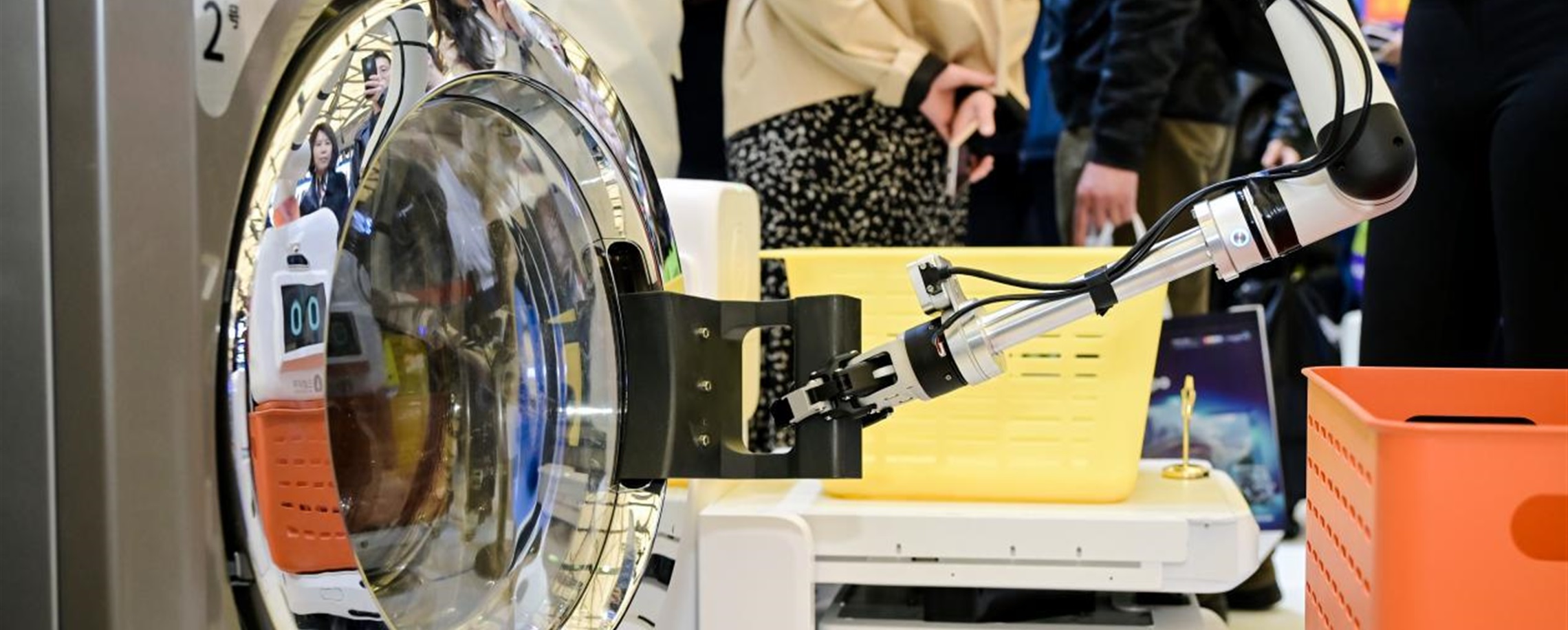
Shenzhen-based UBTech Robotics, a leading player in embodied humanoid robots, narrowed its 2025 loss attributable to shareholders to 715 million yuan (US$104 million) from 1.1 billion yuan a year earlier. Revenue rose 53.3 percent to 2 billion yuan, fueled in part by a 22-fold rise in sales of consumer-related robots used in pool cleaning, lawn mowing, vacuum cleaners and pet care. The company said it achieved annual production capacity of over 6,000 full-size embodied intelligent robots last year, leading the global industry in order volume. Last April, in the world's first humanoid robot half-marathon, a robot developed in tandem with Beijing Humanoid Robot Innovation Center crossed the finish line first. The company unveiled its Walker S2 robot in 2025, the world's first humanoid robot capable of replacing its own batteries.
Economy & Markets
China Factory, Non-Manufacturing Sectors in Growth Mode
China's manufacturing and services sectors climbed in March after contracting in the first two months of the year and despite the Middle East war that sent energy prices higher and disrupted some supply chains. The official manufacturing purchasing managers' index for March rose to 50.4, its fastest pace in a year, according to National Bureau of Statistics data. A reading above 50 indicates growth; a reading below shows contraction. The latest figure beat economists' forecasts and was 0.1 point below the reading a year earlier. Production and new orders sub-indices expanded, while raw materials inventory, employment and delivery time remained in contraction. The index for non-manufacturing, which spans activity in construction and services such as tourism, rose to 50.1 from 49.5 in February.
China Insurance Profits Surge in 2025
China's top five listed insurers reported stronger-than-expected earnings for 2025, with combined net profit reaching 425.3 billion yuan (US$61.6 billion), up 22.4 percent from 2024, according to Jiemian. Investment gains from equity investments rose, boosting returns on surging stock markets. China Life's public equity holdings exceeded 1.2 trillion yuan, while Ping An's equity share climbed to 19.2 percent. Total investment yields for China Life, New China Life and Ping An rose about 6 percent. On the liability side, life insurance channels improved efficiency, and new business value rose double-digits across the board. Profitability was further enhanced by a shift to dividend-based policies, which now account for roughly half of first-year premiums at China Life and Tai Ping.
Eight Chinese Brokers Surpass Profit Milestone
At least eight Chinese securities firms posted net profit above 10 billion yuan (US$1.45 billion) in 2025, up from 5 billion yuan last year, Jiemian said. Citic Securities led with 30.1 billion yuan, followed by Guotai Haitong at 27.8 billion yuan and Huatai Securities at 16.4 billion yuan. GF Securities, China Galaxy, China Merchants Securities, East Money and Shenwan Hongyuan also joined the top tier. Two brokers narrowly missed the 10 billion yuan mark – CICC reported 9.8 billion yuan and China Securities, 9.4 billion. The results reflect a rebound in trading and investment revenue across the sector.
Corporate
Chagee Teahouse Chain Q4 Profit Plunges on Restructuring
China's Chagee, a leading premium tea drinks chain sometimes called the "Oriental Starbucks," reported fourth-quarter profit plunged 95 percent to 33.9 million (US$4.9 million) as revenue dropped 11 percent to 2.97 billion yuan. Same-store sales declined 25 percent on restructuring and slower new product roll-out. For the three months, the Nasdaq-listed company turned to an operating loss of 35.5 million yuan from an operating profit of 642.5 million yuan a year earlier on adjustments in share-based compensation and business model changes. The Chengdu-based company had 7,453 teahouses at the end of 2025, 91 percent of them in Chinese mainland. Chagee operates on a franchise model, with franchisees accounting for 82 percent of revenue. The company said it entered Indonesian, US, Vietnamese and Philippine markets last year, increasing its overseas network to seven countries. Founded in 2017 with a name drawn from traditional Chinese opera, Chagee made its mark by transforming traditional tea culture into a modern lifestyle experience. Chief Executive Zhang Junjie told analysts that mainland online food-delivery price wars had a negative effect on outlet traffic.
Metallurgical Corp 2025 Profit and Revenue Sink
Metallurgical Corp of China, a leading construction contractor and engineering company that builds steel, railway, urban transport and other major infrastructure, reported profit for 2025 tumbled 80 percent to 1.3 billion yuan (US$188 million). Revenue fell 17 percent to 455.4 billion yuan on industry headwinds, major asset divestments and operations restructuring, but the company maintained a leading global position in metallurgical construction. Revenue from signed engineering contracts, a principal earnings driver, sank 19 percent and overseas revenue slid 12 percent. The company cited geopolitical conflicts, increasingly stringent standards and negative public sentiment as factors causing disruptions and delays to ongoing projects and lower profit margins in its overseas business. Major contracts last year included a coking project in Hebei Province, a solar and wind power hydrogen project in Xinjiang Autonomous Region and a solar project in Oman. The company is the listed core subsidiary of state-owned China Metallurgical Group, which became one of China's biggest resources conglomerates after its merger with Minmetals in 2015.
Divided Performance for Chinese Traditional Medicine Makers
Tong Ren Tang, one of the largest traditional Chinese medicine companies, reported a 22.1 percent drop in 2025 net profit attributable to shareholders to 1.19 billion yuan (US$165 million) as revenue slid 7.2 percent to 17.3 billion yuan. The group is one of the oldest brands in traditional Chinese medicine, founded in 1669 by an imperial court physician. To attract younger customers, the company in 2020 added coffee and tea services in some of its pharmaceutical outlets.
Meanwhile, Yunnan Baiyao, another pioneer in tradition medicine that grew out of a pill created by Qu Huanzhang in 1902 to treat wounds, reported a record profit of 5.1 billion yuan in 2025, up 8.51 percent from a year earlier, thanks to rising profit margin of its products, including its well-known principal Baiyao brands, aerosols and toothpastes.
ZXMoto Shares Surge on Motorcycle Championship Wins
Shares in Hongchang Technology, an investor in Chinese motorcycle maker ZXMoto, surged 20 percent on Tuesday after a rider on a ZXMoto bike won double victories at the Superbike World Championship in Portugal. It was China's first-ever win on the circuit. The success also boosted other motorcycle-related shares, including QJMotor and Choho Manufacturing, which also rose to daily limits.
BYD Eyes Overseas Sales of 1.5 Million Cars
BYD, China's largest electric vehicle maker, said this week it is confident of reaching its goal of 1.5 million cars sold overseas. It reported car exports surged 140 percent last year to more than 1 million, and said the foreign market could eventually account for about half its business. The company posted a bigger-than-expected profit decline in 2025, hurt by softer domestic demand and escalating competition.
Editor: Yao Minji
In Case You Missed It...

 Mar 31, 2026