Chinese Mergers, Acquisitions Surge in Search for Efficiency, Markets
China's corporate sector posted a 30 percent increase in mergers and acquisitions last year both at home and abroad as the government encouraged consolidation to raise business efficiency and expand markets. The trend is forecast to continue this year though risks remain for the unwary.
The transaction value of China-related M&A in 2025 rose to US$350 billion, with overseas deals surging 80 percent to US$20 billion, according to consulting firm Roland Berger.
"Strong growth in China's M&A market is not just a simple matter of quantity," said Neil Wu, a partner of Roland Berger. "A previous model of short-term arbitrage relying on capital leverage has been gradually replaced by more prudent and strategy-driven deals, which have become the mainstream."
Companies in sectors such as green technology, digital technology and high-end manufacturing are among those looking to mergers and acquisitions to create stronger business structures, improve their value and expand markets.

Swiss-based investment bank UBS has been a leading advisor in the process. Last year, the Chinese M&A market was the most active in Asia, said Samson Lo, co-head of merger and acquisition advisory for UBS in the Asia-Pacific region.
Among the headline M&A deals in 2025 was the merger between Guotai Junan Securities and Haitong Securities, which created the US$230-billion brokerage powerhouse Guotai Haitong Securities (stock ticker: 601211.SS) – the second-largest securities firm in China.
Also on the domestic front, China State Shipbuilding Corp (600150.SS) merged with China Shipbuilding Industry to create a 700-billion-yuan (US$97billion) company that controls as much as 21 percent of the competitive global industry.
Overseas, Chinese appliance maker Midea Group (000333.SZ) acquired the environment division of Swiss firm building products supplier Arbonia in a deal valued at 760 million euros (US$885 million).
Chinese miners, too, have been active in M&A. Mining multinational giant Zijin (601899.SS) spent US$1.2 billion last year to acquire Kazakhstan-based RG Gold, adding to its portfolio of foreign mining assets. Back home, the Longyan-based company took control of western Chinese lithium producer Zangge Mining in a US$1.8 billion deal.
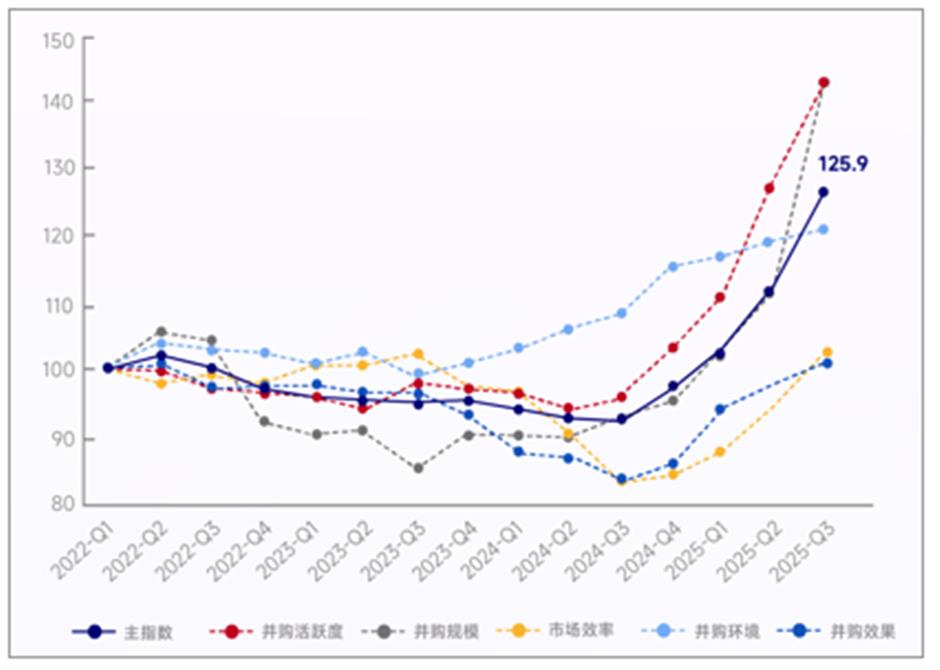
"Chinese firms are showing strong interest in expanding overseas despite current risks associated with heightened geopolitical tensions," Lo said. "Mergers and acquisitions are a fast route to expansion."
Chinese companies eager to expand global competitiveness are looking for takeover targets with business synergies and strong markets.
However, Julie Hao, a partner of international tax and transaction services at consulting firm EY, said mergers and acquisitions are not without risks.
"Many Chinese companies are running headlong into more stringent regulatory controls, even hurdles, abroad," she said, which makes the future harder to predict if controls tighten further.
One high-profile case of a foreign takeover gone sour is Jiaxing-based Wingtech (600745.SS)'s purchase of the Dutch chipmaker Nexperia from Philips in 2019. Prodded by US restrictions on foreign chipmakers, the government of the Netherlands last year took over administrative control Nexperia amid a dispute between the parent company and its subsidiary over management and other issues. The bitter wrangling has continued for months, with a Dutch court decision still pending.
More recently, Defu Technology (301511.SZ), a maker of thin copper foil vital in production of printed circuit boards, said it is scrapping its 174 million euro plan to acquire Circuit Foil Luxembourg from Volta Energy Solutions after the Luxembourg government put unacceptable conditions on the sale. The restrictions limited the Jiangxi-based company to only a minority stake, with no veto power over management decisions.
"Chinese companies wanting to expand into a foreign market need to be thoroughly knowledgeable about the country where they want to do business," Hao said. "It's important to be tuned in rather than just expect to roll in and take over."
Roland Berger's Wu said one ideal method for Chinese companies to expand overseas is to invest as part of a consortium.
"Joint investment in the M&A markets can help companies more readily identify opportunities and manage risk more efficiently," Wu said.
He added, "The diversification and cross-regional nature of growing M&A activities will drive Chinese companies to integrate more deeply into global industrial chains and increase their international profile at a faster pace."
Arbonia Climate may be a good example. Following acquisition of the Swiss unit, Midea integrated the purchase with the Italian brand Clivet that it already owned to form MBT Climate Alliance. Prior to the acquisition, Arbonia Climate posted 2023 sales of about 577 million Swiss francs (US$730 million), employed more than 3,000 people and operated its business across multiple European countries. The consolidation is optimizing resource allocation across the heating, ventilation and air conditioning sector in the European market and expanding globally.
In Case You Missed It...

 Sep 30, 2026



![[Weather] Typhoon Champi Closes Shanghai Attractions, Disrupts Weekend Events](https://obj.shine.cn/files/2026/10/23/f76ff132-9477-4587-8eed-3b9812ed7f4f_0.jpg)