Shanghai's Position as Global Financial Hub Gets Fresh Stimulus: Lujiazui Forum
A batch of new financial policies were released at the 2026 Lujiazui Forum, with the aim of helping Shanghai strengthen its position as a global financial center and consolidate China's map to open up further.
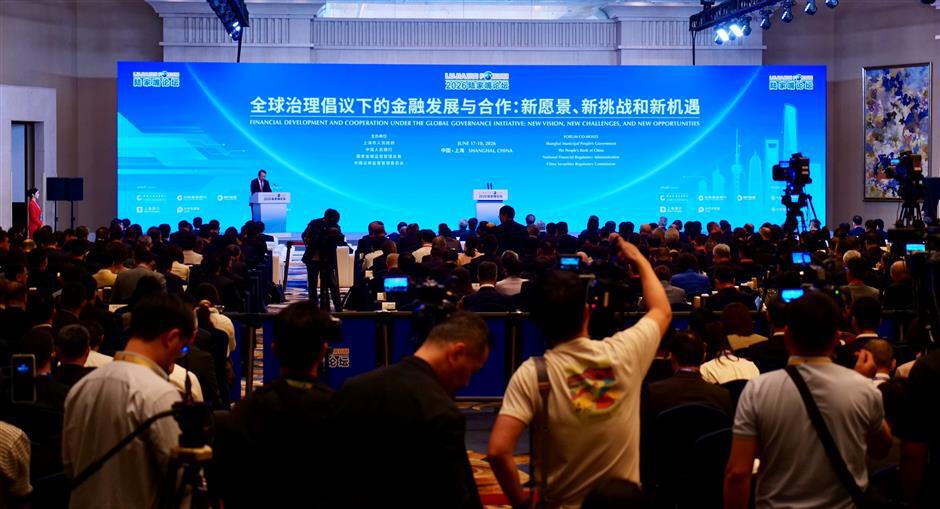
Pan Gongsheng, governor of the People's Bank of China (PBOC), the central bank, unveiled six measures at this year's forum, held under the theme "Financial Development and Cooperation under the Global Governance Initiative: New Vision, New Challenges, and New Opportunities."
● Improve the short-term interest rate operational framework: Based on the ad-hoc overnight repo and reserve repo facilities, the central bank will set the applicable seven-day reverse repo rate plus or minus 25 basis points, narrowing the fluctuation band from 70 basis points to 50 basis points. It also expands the toolkit for open market operations, and launches overnight reverse repo instruments in due course to better align with short-term liquidity demand of the banking system.
● Introduce a Renminbi repo facility for foreign and international monetary authorities: Overseas central banks, monetary authorities, international financial institutions, sovereign wealth funds and other eligible entities may obtain RMB liquidity from the PBOC via repurchase transactions backed by high-grade bonds such as Chinese government bonds. This will facilitate RMB liquidity management and RMB asset allocation by overseas central banking institutions.
● Launch a pilot program for offshore RMB foreign exchange trading in the China (Shanghai) Pilot Free Trade Zone. Six banks, namely Industrial and Commercial Bank of China, Agricultural Bank of China, Bank of China, China Construction Bank, Bank of Communications and CITIC Bank, have been authorized to conduct offshore RMB foreign exchange trading via the China Foreign Exchange Trade System (CFETS) within the Shanghai FTZ.
● Explore a liquidity backstop for non-bank financial institutions as a macroprudential tool under stressed market conditions: When systemic stress emerges in bond and other markets, conventional liquidity channels are disrupted, and a large number of institutions face liquidity crises that could trigger systemic risks, the PBOC will provide emergency liquidity to non-bank financial institutions via swap arrangements. This policy balances the goals of safeguarding stable financial market operations and preventing moral hazard in financial markets.
● Roll out the Action Plan for Developing Offshore Finance in Shanghai's Endeavor to Build an International Financial Center: The plan will improve institutional frameworks covering business rules, risk management and business environment tailored to offshore finance, and steadily advance offshore financial businesses, including FTZ offshore bonds, offshore trade finance services, and an international trade and finance hub.
● The Interbank Market Data & Reporting Repository officially opens for operation.
Wu Qing, chairman of the China Securities Regulatory Commission, also released a set of important policies that will shape China's capital market.
● Expand the application of STAR Market's fifth set of standards to the artificial intelligence sector.
● Support IPOs on the STAR Market for "hard-tech" enterprises, including those engaged in quantum technology, bio-manufacturing and embodied intelligence.
● Further deepen the reform of the ChiNext board in an orderly manner and ramp up support for new-type consumption and modern service industries.
● Fully leverage the fast-track review mechanism for mergers, acquisitions and reorganizations, and actively remove bottlenecks and hurdles in M&A implementation.
● Expedite the revision of institutional rules, including the Measures for the Registration Administration of Securities Issuance by Listed Companies, and accelerate the launch of shelf offering and other mechanisms.
● Support eligible Hong Kong-listed companies to conduct domestic listings.
● Support the launch of active ETFs (Exchange Traded Funds) on the Shanghai and Shenzhen stock exchanges.
● Launch a pilot program for commercial real estate investment trusts (REITs).
● Roll out a package of measures to support the standardized and sound development of small- and medium-sized fund houses, with appropriate inclinations in product layout, business access and other aspects.
● Strictly investigate and penalize illegal and irregular acts such as hyping hot topics and concepts under the guise of technology, as well as market manipulation and insider trading.
● Issue guidelines on the standardized development of AI in the capital market in due course.
● Intensify law-based crackdowns on irregularities, including illegal stock recommendation, rumor-mongering and unlawful trading activities conducted via AI.
● Accelerate research on and launch the pilot of RMB foreign exchange futures.
● Support Hong Kong to launch trading of 5-year RMB treasury bond futures in the near term.
● Proactively support foreign capital to set up new wholly-owned or joint venture securities, fund and futures institutions in China.
● Encourage licensed foreign-funded institutions to participate in the expanded pilot of fund investment advisory business.
● While supporting law-based and compliant cross-border investment and financing activities, crack down on all types of cross-border illegal and irregular acts in accordance with the law.
Zhu Hexin, deputy governor of the PBOC and director of the State Administration of Foreign Exchange, noted that SAFE will support Shanghai in carrying out pilot programs for more flexible foreign exchange settlement under trade.
● Implement a pilot scheme to facilitate outbound investment with cross-border reinsurance income and roll out policies such as centralized fund operation and management for multinational corporations, so as to boost the efficiency of institutional integrated innovation.
● Further streamline foreign exchange administration for outbound direct investment and external debts, optimize rules governing foreign exchange loans and cross-border equity incentives, and issue a new batch of qualified domestic institutional investor (QDII) quotas.
● Further open up the securities issuance market, align the opening-up rules for securities trading markets with international norms, advance the integration of opening channels, institutional optimization and unification of rules, and elevate the two-way opening up of financial markets.
Editor: Liu Qi
Popular Reads
Shanghai's Position as Global Financial Hub Gets Fresh Stimulus: Lujiazui Forum
Food-Delivery Price War That Served Up One-Yuan Coffee Faces New Curbs in China
Ride-Hailing Driver Permanently Banned After Dozing Off Six Times While Relying on Assisted Driving