WorldSkills Competition Raises the Visibility and Value of Vocational Skills, Benefiting Students, Industries
Is a four-year university degree still worth the time and money? In America, college costs and anxiety about AI replacing office work are giving vocational training a stronger pitch.
In China, the case for technical skills reaches deep into industrial policy. The ongoing WorldSkills Competition in Shanghai is a demonstration of how vocational training can produce positive outcomes for both students and the business sectors that need their talents.
Looking at China's high-end manufacturing, people tend to picture engineers or other highly trained experts. Less visible are the army of technicians who may not have college degrees but are essential in the installation, calibration and maintenance of equipment that keeps production running.
"Advanced equipment does not create new value by itself," said Fan Haobin, a labor economics expert of the Shanghai Academy of Social Sciences. "It has to be installed, calibrated, tested, connected and maintained."

That connection helps explain why Beijing increasingly treats vocational education as a key cog of its industrial strategy. Investing in advanced factories also means training the people who can make them productive.
Speaking at the opening of the WorldSkills Conference in Shanghai on September 23, Chinese Premier Li Qiang said China would "keep pace with industry's evolving needs, deepen the integration of industry and education, and strengthen cooperation between schools and enterprises."
But vocational training requires confronting a traditional educational hierarchy that prizes academic study above all else. The gaokao, China's national college entrance examination, is the most visible gateway to academia. But an earlier examination, the zhongkao, or high school entrance examination, shapes which path students take: academic or vocational.
"My parents want me to go for a master's degree, but I'm leaning toward getting some skills training," Terrance Zhang, a recent graduate of a second-tier Chinese university, told China Biz Buzz.
"It feels like my job will be more secure if I have some real-world skills that can't be replaced by AI. At the same time, it feels like one also has to have a master's degree now, since everyone has a bachelor's degree."
Zhang is one of many young Chinese who feel the urge to load up on practical skills. Chinese media, including People's Daily and Yicai, reported in early September that a trend is emerging among newly graduated university students to enroll in vocational schools. It's a sort of insurance policy in an uncertain and rapidly changing world of employment.
On a national policy level, that change has been underway quietly since 2022, when Chinese authorities revised the Vocational Education Law to give it an official status alongside academic education.
Legally, China's laws and regulations have never barred vocational students from higher education. Progression routes existed before the 2022 revision of China's Vocational Education Law. Nor did that revision abolish the distinction between academic and vocational schooling. But it sought to make the vocational route more valuable and more navigable.
Such an ambition rests on economic considerations. A student's decision about vocational education can eventually affect an employer's ability to run sophisticated machinery. Education policy becomes part of the infrastructure supporting industrial investment.
Beijing is trying to build that capacity at scale. A government initiative covering 2025-27 calls for more than 30 million subsidized training slots across priority areas that include advanced manufacturing, the digital economy, low-altitude aviation and transport. The policy also calls for closer connections between job requirements, training, skills assessment and employment services.
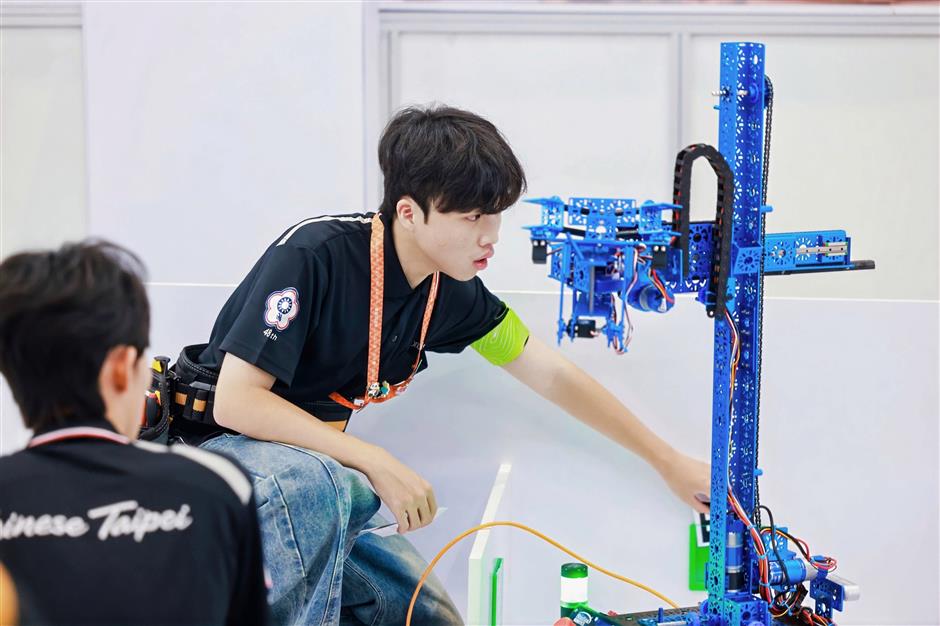
Those connections are on display in Shanghai this week. WorldSkills 2026 runs from September 22–27, with competitions spanning traditional skills such as cookery, floristry, carpentry and beauty therapy to more advanced realms of intelligent security, unmanned aerial systems and software testing. Even for traditional skills like retail, the competition tests participants' ability to use digital tools to help organize inventory and boost sales.
The program offers a practical view of the occupations behind familiar industrial policies: someone has to maintain the high-speed trains, configure security systems, keep drones operating safely and identify software failures.
A competition among exceptional young talent cannot measure the readiness of an entire workforce. It can, however, make technical expertise visible and give students and parents a more concrete, positive picture of what a skilled career involves.
The harder test comes afterward.
Does skills training lead to jobs that actually utilize qualifications? Can a technician advance without having to leave technical work for management? Those are the questions that frame family choices.
The US faces similar questions and is also expanding support for vocational pathways. In 2025, legislation enacted the Workforce Pell Grants for eligible short-term, skills-training programs.
China's distinctive strength lies in its ability to align educational pathways with the needs of its large, high-end manufacturing base. Its challenge is to change the mindset that university diplomas are the only key to successful careers and ensure that vocational training leads to lasting, good-paying jobs where people can feel they make a difference.
Editor: Yao Minji
In Case You Missed It...

 Sep 26, 2026


Popular Reads

Xi Arrives in Washington for State Visit, Greeted by Trump at Airport
Chinese Stock Markets Slip as Investors Holiday-Proof Their Investments

WorldSkills Competition Raises the Visibility and Value of Vocational Skills, Benefiting Students, Industries