Chinese Stock Markets Slip as Investors Holiday-Proof Their Investments
Chinese stock markets closed lower in a trading week abbreviated by the onset of a big holiday season, when investors tend to position their portfolios against possible global market shocks when home markets are closed. Chinese mainland markets were closed on Friday for the Mid-Autumn Festival, but Hong Kong remained open. The seven-day National Day holiday in China begins on October 1.
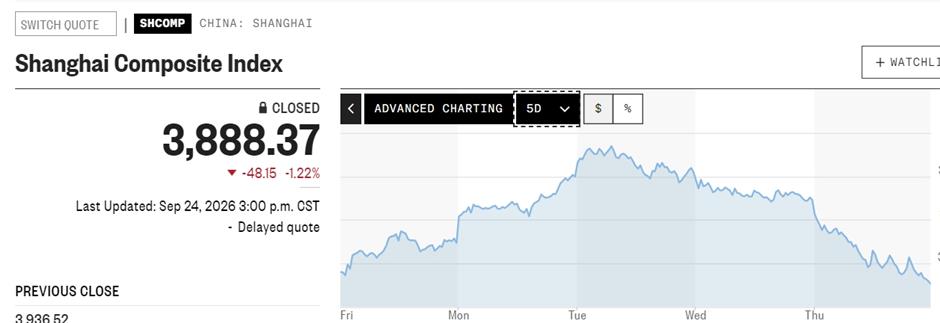
The benchmark Shanghai Composite Index lost 1.2 percent on Thursday, and the Shenzhen Component Index retreated 2.3 percent. The tech-heavy ChiNext in Shenzhen slumped 2.7 percent, while Shanghai's Nasdaq-style STAR Market 50 Index lost 2.4 percent.
The Hang Seng Index in Hong Kong closed down 1 percent on Friday.
"Markets, as usual, suffered another selloff ahead of the holidays," said Huang Wenjing, an analyst with China International Capital Corp.
Shares in Shanghai-listed ChangXin Memory Technologies (CXMT), China's largest maker of dynamic random-access memory chips, tumbled 4.1 percent on Thursday, leading Chinese chipmaker Cambricon lost 1 percent and humanoid robot maker Unitree edged down 0.6 percent after a sharp fall of 3.9 percent on Monday.
In Hong Kong trading, Qingdao-based Ligent Technologies fell 2.7 percent on Friday after a Tuesday listing debut that saw its shares rise 4.6 percent. Tech heavyweights Alibaba slipped 1.5 percent and Tencent lost 0.4 percent. Smartphone and carmaker Xiaomi tumbled 2.6 percent, and e-commerce giant JD.com was down 1.8 percent. AI companies MiniMax shed 1.4 percent and Z.ai, also known as Zhipu, lost 0.8 percent.
Despite some volatile performance, the market outlook remains positive with the value of initial public offerings both on the Chinese mainland and in Hong Kong set to exceed 2025 totals soon, according to a report by consulting firm Deloitte.
"IPO markets in China have seen notable accelerations, with a sharp rise in the number of new listings," said Alvin Tse, a capital markets service leader at Deloitte China. "The strong momentum is driven by ongoing market reforms, coupled with the successive launch of several high-profile IPOs."
Shenzhen-based Kinwong Electronic, a printed circuit-board maker, priced its Hong Kong IPO on Friday to raise HK$5.1 billion (US$650 million) to expand capacity and meet AI-driven demand. The shares are expected to start trading on Monday. The company is among four Chinese firms seeking to raise up to a combined HK$14.35 billion through separate Hong Kong listings. The others are RoboTechnik Intelligent Technology, Red Avenue New Materials and Direct Drive Tech.
But the Deloitte report said Hong Kong is on track to lose its 2025 crown as the biggest IPO market in terms of value, ceding the top spot to the Nasdaq, which hosted the mega debuts of SpaceX and SK Hynix this year. As of Thursday, 116 companies started trading in Hong Kong this year, raising an aggregate HK$387 billion (US$49 billion), while the Nasdaq hosted 85 new listings valued at US$143 billion.
Elsewhere in Asia, Japan's Nikkei jumped 1.3 percent on Friday, wrapping up the week with a gain of 2 percent. South Korea's Kospi was up 0.9 percent on Wednesday, before closing on Thursday and Friday for a holiday.
Wall Street markets rallied on Friday, as investors ignored rising US Treasury bond yields, benchmark Brent crude futures remaining above US$100 a barrel and no end in sight to the wars in Iran and Ukraine. The broad S&P 500 and Nasdaq indexes each rose 0.5 percent. Bond market drama continued, with the benchmark 10-year Treasury bond yield rising to its highest level since 2007 and the 30-year yield surging to its highest since 2004, amid expectations of a second Federal Reserve rate hike this year. Higher yields raising borrowing costs for governments, companies and consumers.
Editor: Yao Minji
In Case You Missed It...

 Sep 26, 2026


Popular Reads

Xi Arrives in Washington for State Visit, Greeted by Trump at Airport
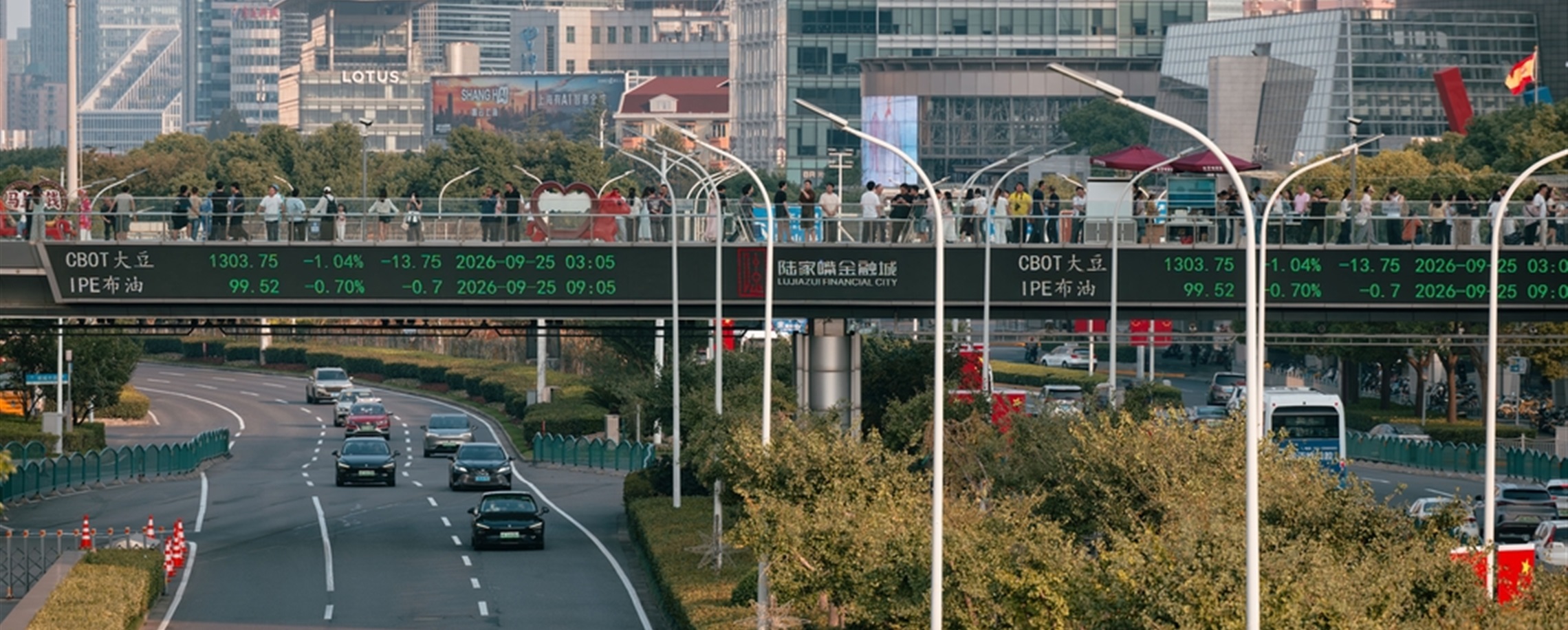
Chinese Stock Markets Slip as Investors Holiday-Proof Their Investments

WorldSkills Competition Raises the Visibility and Value of Vocational Skills, Benefiting Students, Industries