Coke or Pepsi? How Brand Prestige Shapes the AI Models We Trust
Late last year, a strange game took over TikTok. Users posted two photos of the same ordinary street. One version carried real location tags, maybe in a suburb in Ohio or a block in Krakow. The other carried a single tag: Tokyo. The photos were identical. The reactions were not.
Users in Japan swooned over the "Tokyo" version and scrolled past the original. The media tagged the result the "Japan effect," which refers to the fact that a verdict arrives even before the eyes finish their comparative assessment.
I admit I chuckled at first over these videos. Then, last week, I caught myself involved in a similar game. I have subscriptions for both OpenAI's ChatGPT and Anthropic's Claude, and running the same prompt through both has become a small daily ritual. When I was looking for an illustration for a previous piece I wrote on AI, I typed the identical request into GPT and Claude and sat back waiting for a response. Even as the screen was still loading, I noticed that I had already picked the Claude response as my choice. My "preference" had arrived ahead of the evidence, the way "Tokyo" arrives ahead of the street view.
I know the source of this algorithm behavior. It comes from the Internet. Spend an hour on tech Twitter or Reddit and you absorb the folklore without reading a single evaluation. ChatGPT is the mass-market default, the tool your uncle uses to write birthday poems. Claude is the connoisseur choice of programmers and novelists. There is a whole genre of memes built around this. A meme is just a location tag for a product, and by the time I open my two apps each morning, one of them is already wearing the "Tokyo" effect.
Psychologists have documented the mechanics of such bias for half a century, and the experiments read like pranks. In 2004, neuroscientists ran the "Coke versus Pepsi" challenge inside a brain scanner. Tasted blind, the colas split people down the middle. Once the Coke label appeared, preferences swung and the brain's memory regions lit up with them. Later, researchers pulled the same trick with wine. With two identical bottles, pleasure circuits lit up for one of wines when the test audience was told it cost US$90 dollars instead of US$10.
Newer studies extend the pattern to AI. Identical news headlines were rated a few points less accurate when labeled "AI-generated," even when a human had actually written them. In one legal experiment, people preferred a machine's advice over a lawyer's when the source of advice was hidden, but that advantage vanished upon disclosure.
None of this proves that my Claude preference is imaginary. It proves something more useful: If a label can lower expectations before evaluation begins, a prestigious label can raise them. An expectation about the output, delivered before the output arrives, is part of what every premium AI brand sells.
The reason this matters now is that AI scoreboards have stopped giving a single answer. On July 16, Beijing-based Moonshot released Kimi K3, a 2.8-trillion-parameter system billed as the world's largest open-weight model, one whose internals the company promised to publish by July 27. Downloading a model of that scale and realistically running it are different propositions.
Within hours, K3 took first place on Arena.ai's Frontend Code Arena, a leaderboard where thousands of humans vote blind on real coding tasks. K3 finished ahead of Anthropic's Claude Fable 5 and OpenAI's GPT-5.6 Sol. But on the main text leaderboard, K3 sat mid-table, while on one widely used aggregate index the top four models, two American and one Chinese among them, sit within a few points of each other.
The lesson is not that every frontier model is now equal. It is that the concept of "best" changes with the task, while a brand's reputation travels unchanged from one task to the next. The scoreboard splits its verdict. The tag never does.
The original "Japan effect" was the West romanticizing an Asian tag: Slap "Tokyo" on a photo of Ohio and Ohio turns beautiful. In AI, the arrow points the other way. Here in China, and across much of the world, it is the Silicon Valley tag that casts the glow.
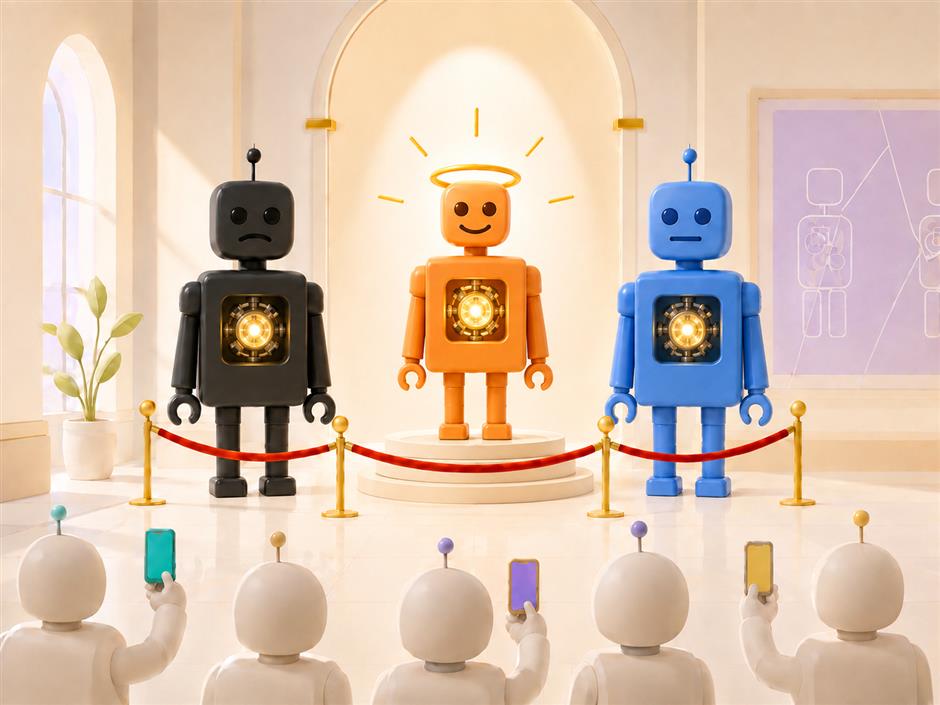
A model from a celebrated American lab arrives pre-trusted, wrapped in mystique it did not have to earn that morning, while a Chinese model that beats it on a blind leaderboard arrives naked and must prove everything. I should be careful here because the discount applied to a Chinese model is not always irrational.
Buyers also weigh privacy policies, uptime, documentation, integrations, safety behavior and company support. American models may enjoy a premium on those grounds. My argument begins after differences are priced in: prestige can still change what users believe they see in otherwise comparable outputs, and it taxes the challenger model with burden of proof.
Silicon Valley's mystique may get help from scarcity, intentional or not. Anthropic's most capable tier is not for sale to the public at all, and its flagship is priced at the ceiling of the market. In June, when the US slapped a barrier on foreign nationals accessing Anthropic's two newest models, the company couldn't verify every user's nationality in real time, so it suspended access to everyone everywhere for nearly three weeks. However valid the government's national security rational for its decision, later rescinded, the incident showed how AI has become so formidable that it caused intervention in Washington.
OpenAI plays a quieter version of the same game, releasing its newest flagship first as a gated preview for a small circle of vetted organizations. A 1975 experiment predicted the effect with a jar of cookies. Cookies from a nearly empty jar were rated tastier than identical cookies from a full one, and tastiest of all when the jar had just gone from full to empty before the taster's eyes. Anthropic's Fable 5 is the cookie that came back. Of course it tastes better now.
Once a model's capability approaches parity on a task, the remaining contest rests on reputation, and reputation is earned in public. Live in the blind arenas, where the "Japan effect" cannot vote, and then do the unglamorous work of transparency, stability and documentation that turns familiarity into trust.
Limited access can backfire when people suspect it is staged, and a brand premium in a converging market must be backed by reliability, or buyers will learn to peel off the tags. Anyone who pays for these AI tools can remedy the situation. Same prompt, two windows, names hidden, score first, peek after. Judge the street, not the tag. I owe myself a proper test after last week. This time I will cover the names before the screen finishes loading.
(The author is a master's student majoring in journalism and communication at Shanghai Jiao Tong University.)
Editor: Liu Qi
In Case You Missed It...
 Aug 11, 2026
![[Quick News] Shanghai Metro Back to Normal Tomorrow As Dolphin's Warning Drops to Blue](https://obj.shine.cn/files/2026/08/10/37eb55db-7030-4c5d-9f54-67ac2ebc4ac0_0.jpg)
![[Quick News] Shanghai Metro Back to Normal Tomorrow As Dolphin's Warning Drops to Blue](https://obj.shine.cn/files/2026/08/10/1f1f7c88-216b-48c9-9afe-928d967cab95_0.png)