I Coded My Way Out of the Grip of Unwanted Algorithms. Can Everyone?
I tried quitting YouTube, but life without it felt strangely empty. It's where I learn, where I follow the news, where half my curiosity lives.
The problem was that every time I opened it for one video, an algorithm that does not have my best interests in mind decided what I saw next, and 40 minutes would vanish into shorts I never asked for. Facebook Reels ran the same trick on its app.
However, instead of walking away from such platforms, I asked a different question: What if I could keep YouTube and evict the algorithm? This year, I did something that would have been unthinkable for me two years ago – I built my own tools to do exactly that. Not just one tool, but a small stack of them.
I am not a web developer. My coding background is basic Python and R, not JavaScript, so the extension architecture that Chrome and Firefox expect was foreign to me. But I described what I wanted to an AI system in plain language, the way I would explain a problem to a colleague, and within an afternoon I had a working tool. Then I built another.
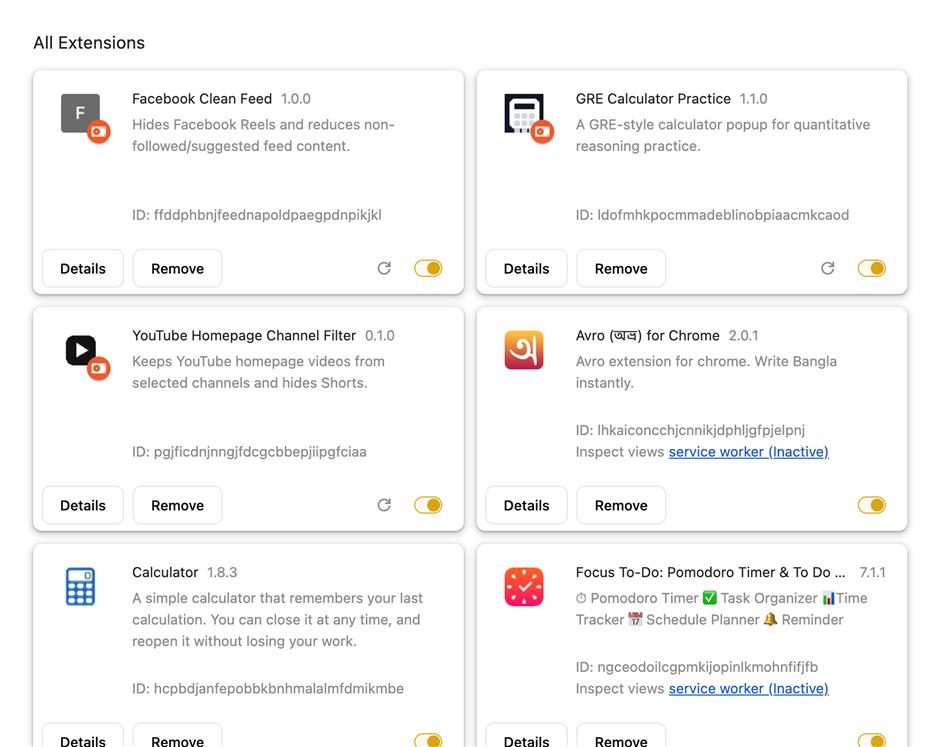
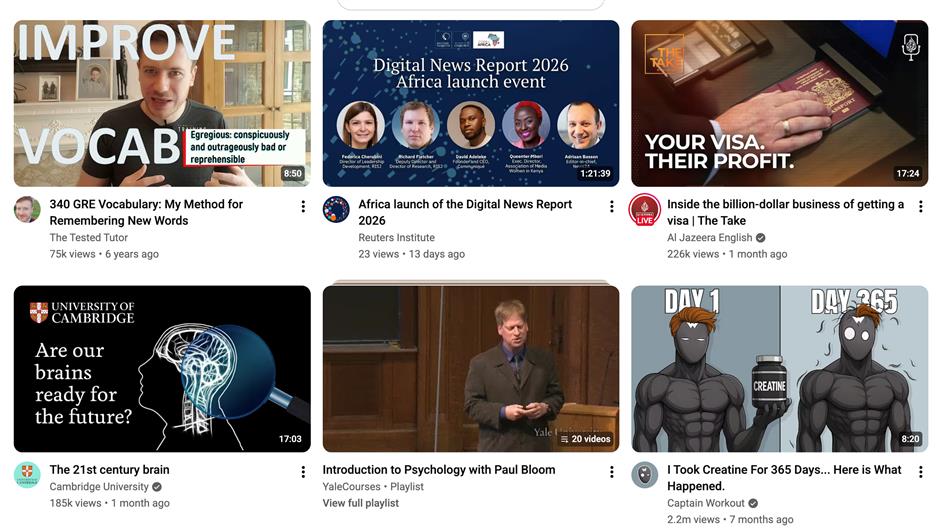
My browser now runs a Facebook extension that hides Reels and cuts down on suggested content from accounts I don't follow. A YouTube extension now restricts my homepage to channels I choose and strips out unwanted shorts entirely.
I also built a small calculator because I am studying for an exam and wanted to practice on something that looks like what I will actually use on test day. None of this required a computer science degree. It required a clear idea, patience, and a conversation.
This practice now has a name: vibe coding – a term coined by AI researcher Andrej Karpathy and named 2025 Word of the Year by Collins English Dictionary. You describe what you want in natural language, and an AI system writes the code. What used to sit between an idea and a working product, teams of developers, weeks of planning and a budget now collapses into a conversation.
Before, my relationship with these platforms was one-dimensional. They decided what I saw, and I could complain or quit, but I couldn't edit the terms. Vibe coding gave me a third option. I rewrote the terms myself.
Before I understood any of this, I had already spent plenty on subscriptions I could not fully justify, and just as often avoided apps I actually wanted because the price tag felt wrong for what they did. MacroFactor was one of the ones I paid for anyway, before I knew a tool like it was something I could build myself. I have not bothered to cancel it. But a separate workout app that asked for US$30 a year just to let me create more than a couple of routines, I refused, and built my own instead.
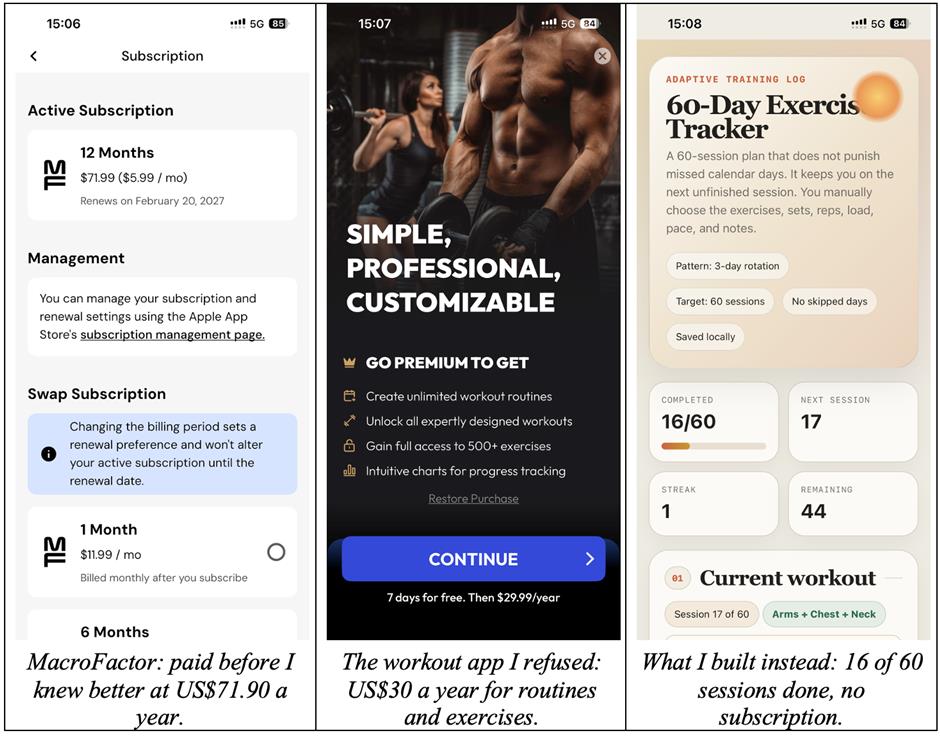
Instead, I asked an AI system to help me build my own training log. It is just an HTML file, connected to the internet through Netlify. That's it! It is not as polished as the app I refused to pay for, but it does exactly what I need. The difference between the two examples is timing: one subscription outlived my ignorance; the other never got the chance.
None of this was effortless, and I do not want to overstate how smooth it was. Getting an AI system to build something correctly usually takes many rounds of back and forth, not one clean prompt that produces a finished tool. The skill is not in writing code. It is reading carefully what the AI proposes, catching what it misunderstood and telling it precisely what to fix next.
People who struggle with vibe coding are usually struggling with that conversation, not with programming itself. The tools themselves are not expensive to run. None of mine needed a frontier model; a mid-tier system handled all of them. The only recurring cost is the AI subscription itself, about US$20 a month.
It would be easy to stop here, on a happy note, and many articles on vibe coding do just that. The individual is empowered. Power shifts from the platform to the person. Anyone can build now. I believed a version of that while I was building my tools. But I keep returning to that phrase "anyone can build now" because when I look closely at what building actually required of me, the word "anyone" starts to fragment.
Consider the US$20 a month. That's about US$240 a year, and it has to be paid in hard currency to a foreign company. Across South Asia, where I am from, the annual cost that supposedly empowers anyone can amount to a month or more of a typical person's salary. For me it is a manageable line in my budget. For a great many others, the entry ticket alone is the obstacle before a single prompt is written.
Then consider language. The whole premise rests on the ability to describe what you want in plain language, but the models do not understand every language equally. One of the AI systems that started this boom was trained on text that was about 93% English, leaving every other language to share the remaining 7%.
The performance gap follows that imbalance closely. So, the better you can write and understand English, the better your outcomes. Researchers describe this simply as a "rich-get-richer effect." My prompts work well partly because I write them in fluent English. Someone describing the identical tool in a lower-resource language would get a weaker result for the same request.
So the tool sold as the great equalizer demands exactly the two things: hard currency and English fluency. It does dissolve the hierarchy between those who can code and those who cannot. I am, awkwardly, proof of both halves at once. I am from South Asia, the region where the democratization story is supposedly aimed, but I built these tools from a well-resourced university in Shanghai, paying in dollars and thinking in English.
None of this means the door is closed to everyone but the privileged. Here in China, the picture already looks more crowded than the English-first story suggests.
Bao Linyi, a classmate at Shanghai Jiao Tong University, built a full content management system during an internship, front end and back end, using a generative AI model to handle product documentation and generate demos – the kind of build a small engineering team would once have owned.
Alongside foreign tools, home-grown Chinese models are maturing fast and lowering the cost further, which changes the calculation for hundreds of millions of people. The barrier is not the concept of vibe coding; it is whether a capable model exists within your language and budget limitations.
Li Xueqing, an associate professor at Shanghai Jiao Tong University, told me, "In China, as home-grown language models mature and the cost of coding drops, a growing number of ordinary users are starting to build their own web tools for everyday needs. This is the democratization of technology. People who never studied programming or who lack the resources to access it can now generate their own tools through AI."
But, she added, "The shift places a clear demand on the user's own judgment and capacity to express what they want. The tool is only as good as the problem you can articulate, and the result is only as sound as your ability to tell whether it is right."
That last point stayed with me. Even for those who can pay and who can prompt, the tool hands back exactly the quality of thinking input. It does not supply judgment. My own tools are low stakes; if my workout log miscounts a session, nothing breaks. But a tool built in the same casual way to decide something real about someone's health, finances or social life deserves the care a trained engineer can give it. So the divide this technology opens isn't only about who can afford the subscription or who writes fluent English; rather it is also about who has been trained to question a result rather than accept it.
I open YouTube now and my homepage holds what I actually chose. That much is real, and I did build it myself, one conversation with an AI at a time. But I would rather be honest about the size of the process than sell it. A tool that lets me reshape my own digital life is a genuine gift. A tool that lets anyone do the same is a different and larger ask.
(The author is a master's student majoring in journalism and communication at Shanghai Jiao Tong University.)
Editor: Liu Qi
In Case You Missed It...
![[Hai Guide] A Full Spectator Guide to 2026 Rolex Shanghai Masters](https://obj.shine.cn/files/2026/09/29/03c5fbca-2b79-478a-ac69-47815adceda1_0.jpg)
 Sep 30, 2026
![[Hai Lights] Big Guide to This National Day Holiday (Part II): Music, Fireworks and Live Performances](https://obj.shine.cn/files/2026/09/29/fc9a61ae-cb1f-47c4-bfcb-51ae731b90cd_0.jpg)