The 'Intelligent Employee' Has Arrived. Are Companies Ready?
The Nexus: Context & Cases
This column features professors from School of Management Fudan University. We intend to bridge the gap between academic rigor and market volatility by delivering frontier case studies and forward-looking insights directly from our leading researchers.
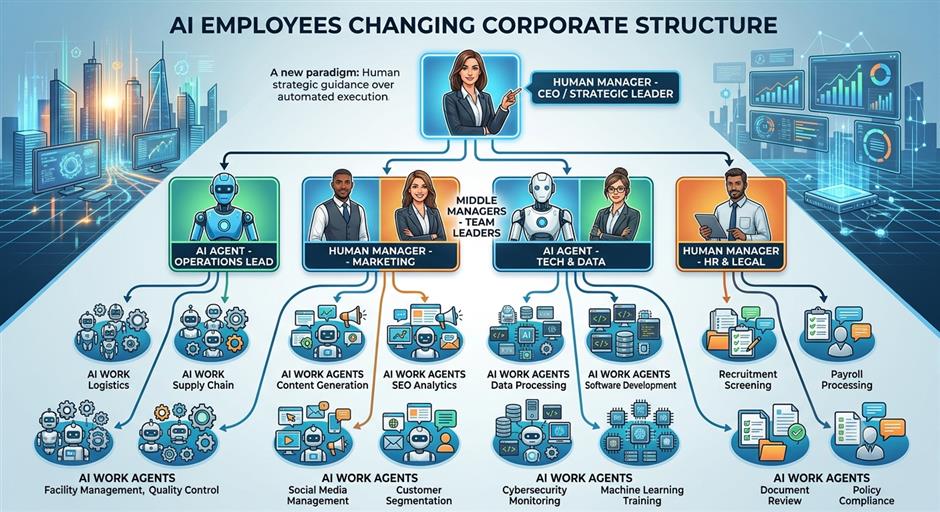
For decades, the standard playbook for corporate growth was unyielding: Scale up headcount, deepen specialization and multiply layers of management. But as we navigate 2026, an inflection point is underway. The corporate world is transitioning from the legacy of "people managing people" toward a collaborative ecosystem of humans and artificial intelligence. The "intelligent employee" has arrived, and it is fundamentally rewriting the architecture of productivity.
The maturity of large-scale AI models is catalyzing an individual-centric paradigm shift in how work is executed. Historically, entrepreneurship required an team to mitigate a founder's natural limitations in finance, legal issues, compliance and operations. Today, advanced models allow a single operator to seamlessly assume multiple professional personnel layers.
By absorbing traditional "coordination costs" – the friction of managing fragmented, cross-functional dependencies – AI is freeing visionaries to focus entirely on core strategy, radically lowering the barrier to entry for new ventures.
This shift does not imply that the division of labor will vanish overnight. Rather, it will become far less fragmented. When an individual can command an entire, self-contained unit of work via an AI system, corporate architectures gain unprecedented elasticity.
However, organizations must avoid a historical trap. As with the advent of the steam engine, electrification and the early internet, breakthrough technologies often take over a decade to yield large dividends. The bottleneck is rarely the technology; it is in organizational inertia.
Let's call it the "advanced tech, lagging organization" trap. If companies merely deploy AI as an isolated writing assistant or an analytical plug-in, they will achieve only localized, incremental improvements. True structural alpha is unlocked only when an organization completely redesigns its workflows and hierarchies around the inherent traits of the technology.
The first wave of generative AI acted primarily as an oracle -- a sophisticated, reactive consultant capable of synthesis and recommendation. The current frontier has evolved toward autonomous AI agents. These are proactive, multi-agent collaboration systems capable of contextual judgment, tool invocation and complex, multi-step workflow execution.
In these environments, different agents execute highly specialized tasks, such as automated accounting or contract analysis, and are orchestrated by an underlying model that assigns objectives autonomously.
This introduces an entirely new governance challenge. As autonomous agents scale up within an organization, leadership must redefine traditional boundaries of authority, liability and system transparency. Management is no longer a linear exercise in human oversight; it is the curation of a hybrid human-machine network.
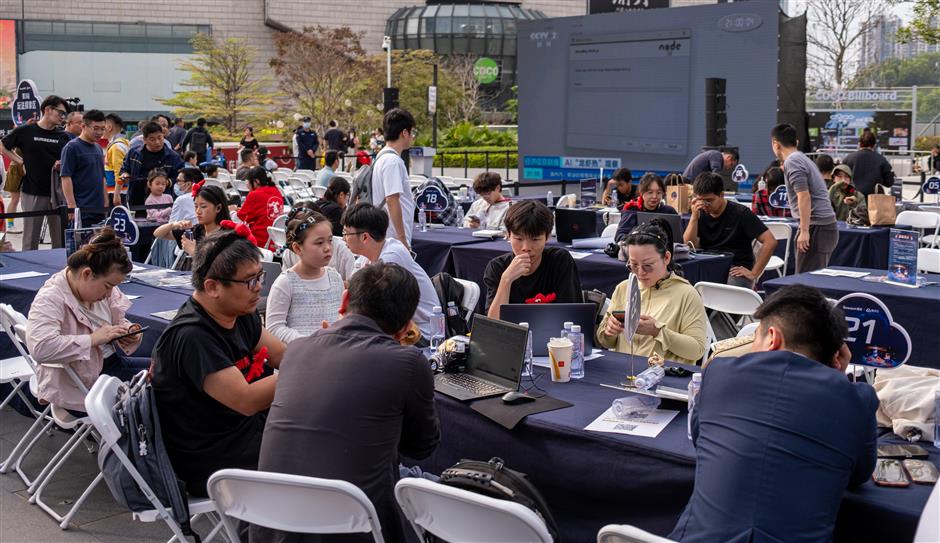
As this shift takes root, the broader macroeconomic and business environment is experiencing three structural dislocations: restructuring content value, reconcentration of distribution channels and the premium on verifiable trust. Let us examine each.
Restructuring of content value comes into play as users increasingly bypass traditional information gateways, like search engines and curated platforms, to receive synthesized answers directly from AI models, and as the economic incentive for original content creators breaks down. Over the long term, this risks starving the data ecosystem of high-quality, primary source material that models rely on.
The reconcentration of distribution channels refers to large language models emerging as the ultimate traffic bottlenecks. In an ecosystem where autonomous agents serve as the primary interface for consumer choice, companies must completely rethink discovery. Success is no longer about being found via legacy search engines; it is rather about ensuring that services are accessible through third-party AI agents.
The premium on verifiable trust refers to truth, a premium asset becoming scarcer in an era of infinite, synthesized content generation. The cost for users to verify authenticity is skyrocketing, making trusted, immutable brands more critical than ever. Conversely, new vectors of corporate warfare, such as data-poisoning attacks designed to distort a competitor's model outputs, threaten to destabilize information security.
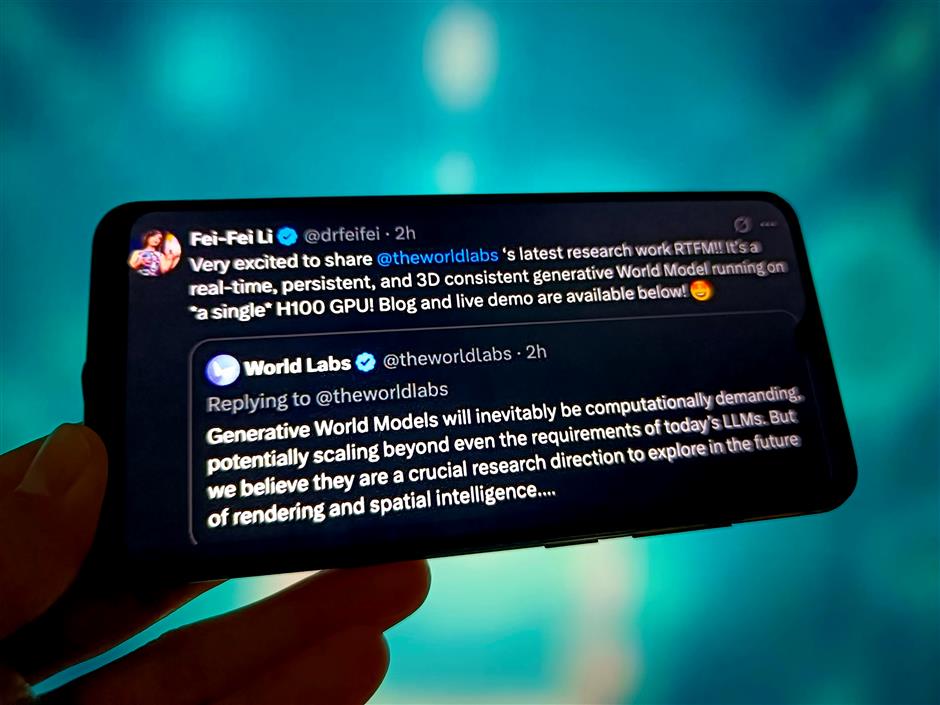
To fully realize the transformation underway, AI is rapidly moving beyond natural language, which remains a highly abstract, symbolic description of our reality, toward so-called "world models." By integrating multimodal inputs across vision, acoustics, and spatial dynamics, AI is developing the "spatial intelligence" required to reason, plan and execute within physical and complex simulated environments.
A prime indicator of this trajectory is the emergence of pioneering platforms like Marble, developed by Stanford Professor Li Feifei's World Labs startup. Powered by multimodal world models, these architectures can generate high-fidelity, persistent 3D worlds from minimal text or visual prompts. In Li's framework, spatial intelligence represents the definitive theme of the coming AI decade.
This research directly intersects with the frontiers of embodied intelligence, robotics, and autonomous driving. These high-stakes operational environments demand flawless environmental comprehension, long-horizon causal prediction and strict physical consistency – qualities that traditional text-based models cannot replicate.
Ultimately, AI does not inherently guarantee a more efficient or equitable world; it simply restructures the mechanics of production and value distribution. As leaders integrate these systems, they must remain anchored to a foundational technical truth – current AI architectures remain fundamentally probabilistic engines driven by statistical pattern matching. They operate without genuine emotion, self-awareness or deep cognitive grounding.
Left unguided, multi-round agentic dialogues can experience contextual drift, and complex reasoning pipelines remain highly susceptible to plausible-sounding "hallucinations." AI is a multiplier of human capability, not a replacement for human accountability. The organizations that thrive in this new epoch will be those that strike a flawless balance between the precision of machine execution and the critical, grounded judgment of human oversight.
(The author is assistant dean at Fudan University's School of Management, and chair of Department of Information Management and Business Intelligence.)
Editor: Yao Minji
![[Health Byte] Shanghai's First Bad Breath Clinic Opens in Huadong Hospital](https://obj.shine.cn/files/2026/05/25/0cc5059c-33fe-41d9-9efd-e5e8339dec54_0.jpg)


![[Explainer] China Visa-Free Entry Explained: FAQs on Eligibility, Rules and Stay Duration](https://obj.shine.cn/files/2026/05/25/ab25b6fd-8014-4709-b3e1-07fc9acadcfb_0.jpg)
