War Beyond Borders: How the Iran War's Impact Reaches Faraway Shores
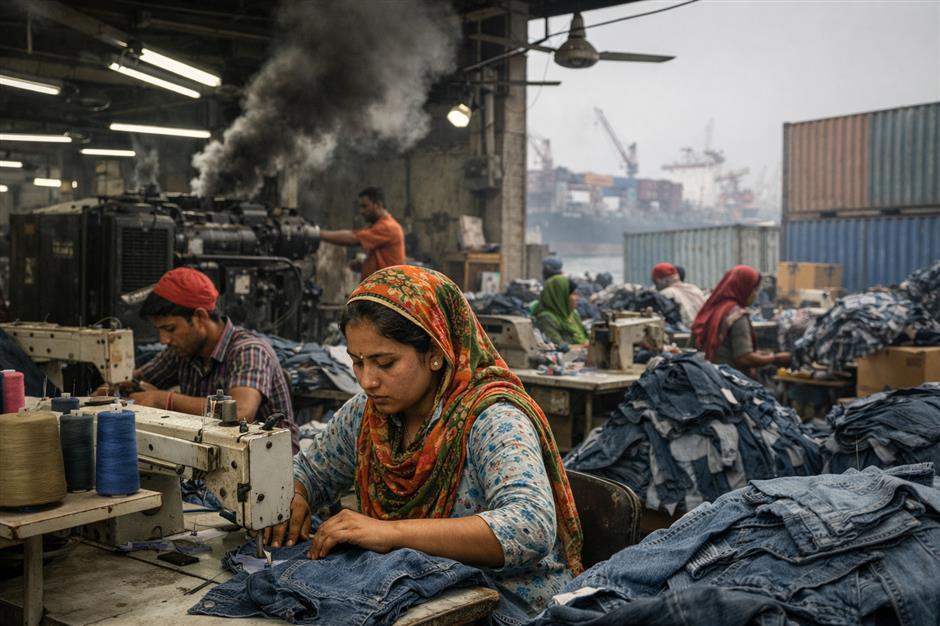
A war fought thousands of miles away is now being felt on the factory floors of Dhaka, Karachi, Tiruppur and Colombo in Bangladesh. The escalating tensions between the United States and Iran, though geographically centered thousands of miles away, are producing far-reaching economic consequences, and among the most exposed are South Asian ready-made garment makers, a regional pillar of export earnings.
This unfolding situation highlights a deeper reality of today's global economy: Geopolitical conflicts are no longer confined by borders. Their impact travels swiftly through supply chains, markets and consumer demand. For export-dependent economies, such shocks are not merely temporary disruptions; they can lead to systemic challenges.
At the heart of the current crisis is the energy shock as Iran essentially closes the Strait of Hormuz, through which 20 percent of the world's oil and natural gas passes, mostly bound for Asia. Energy supply disruptions in the Gulf have raised prices and sent maritime shipping and insurance costs skyward.
For South Asia, where countries rely heavily on imported energy, this translates directly into rising production costs. In the ready-made garment, energy costs are not incidental. Textile production requires uninterrupted power for spinning, dyeing, and finishing processes. In Bangladesh, persistent gas shortages have already constrained industrial output.
Many manufacturers are increasingly dependent on diesel-powered generators, significantly raising operational costs. The result is not only inflationary pressure but also declining reliability. In a global industry where timely delivery and consistency determine competitiveness, energy instability undermines supplier credibility.
In Pakistan, the textile industry has long suffered structural energy deficits. It's now facing additional strain from rising import costs and currency volatility. Sri Lanka, still recovering from a severe economic crisis, remains highly vulnerable to increased energy costs, and India, while more diversified, is not immune either.
Added to that, synthetic fibers used in the garment industry are derived from petrochemicals. Rises in petroleum product prices, freight charges and insurance premiums are heightening geopolitical risks. Even basic logistics have become more complex and costly. For an industry built on cost competitiveness, these cumulative pressures are pushing many manufacturers toward a breaking point.
Bangladesh offers a particularly telling example. Its ready-made garment sector accounts for roughly 80 percent of export earnings and has been the cornerstone of its economic transformation over the past three decades. However, this success has also created structural vulnerability. As input costs rise – from fuel to raw materials and transportation – the sustainability of the low-cost, high-volume export model comes under pressure.
At the same time, demand in key export markets is deteriorating. The US, EU and UK – primary destinations for South Asian garments – are beset with inflationary pressures linked to global instability. As consumers reduce discretionary spending, apparel retailers are scaling down orders.
This creates a "double squeeze" for exporters: rising costs on one side, declining revenue on the other. Manufacturers in Bangladesh and elsewhere report growing instances of order cancellations and price reductions that fail to cover elevated production costs. The imbalance in bargaining power between global buyers and local suppliers becomes especially evident during such crises.
The implications extend beyond immediate economic indicators. A sustained decline in export earnings can put pressure on foreign-exchange reserves, complicate national economic management and limit fiscal policy options. At the industrial level, factories operating on thin margins may be forced to reduce output or shut down entirely, affecting millions of workers.
More broadly, the crisis underscores the geopolitical dimension of economic vulnerability. For smaller, export-oriented economies, global conflicts are not distant events; they directly reshape domestic economic realities. Limited diversification, heavy reliance on imported energy and dependence on a narrow set of export markets reduce economic resilience and policy flexibility.
Across South Asia, vulnerabilities are uneven but interconnected. Pakistan and Sri Lanka face acute economic constraints, while India benefits from a larger domestic market and a more diversified industrial base. Yet even India cannot fully shield its export sectors from global demand fluctuations and rising input costs.
This interconnectedness also presents an opportunity. Strengthening regional cooperation could enhance supply chain resilience, reduce costs and create new avenues for growth. At the same time, diversifying export markets beyond traditional Western destinations would help mitigate demand-side risks.
In the short term, governments must prioritize energy security through diversified sourcing and targeted support for key industries. Financial measures, including credit facilities and temporary subsidies, may be necessary to help exporters navigate the currently stormy waters.
Over the longer term, however, the lesson is structural. Building resilience will require diversifying industrial bases, investing in renewable energy and moving up the value chain. For Bangladesh and its regional peers, the challenge is not only to withstand current disruptions, but to adapt to an increasingly uncertain global environment.
Unless these structural vulnerabilities are addressed, future geopolitical crises will continue to cause export instability across borders – one disrupted production line at a time.
(Professor Sk Tawfique M Haque is director of the South Asian Institute of Policy and Governance at North South University in Bangladesh. Simon Mohsin is a political and international affairs analyst.)
Editor: Liu Qi
In Case You Missed It...

 Mar 18, 2026