How China Empowers the 2026 World Cup Without Playing in It
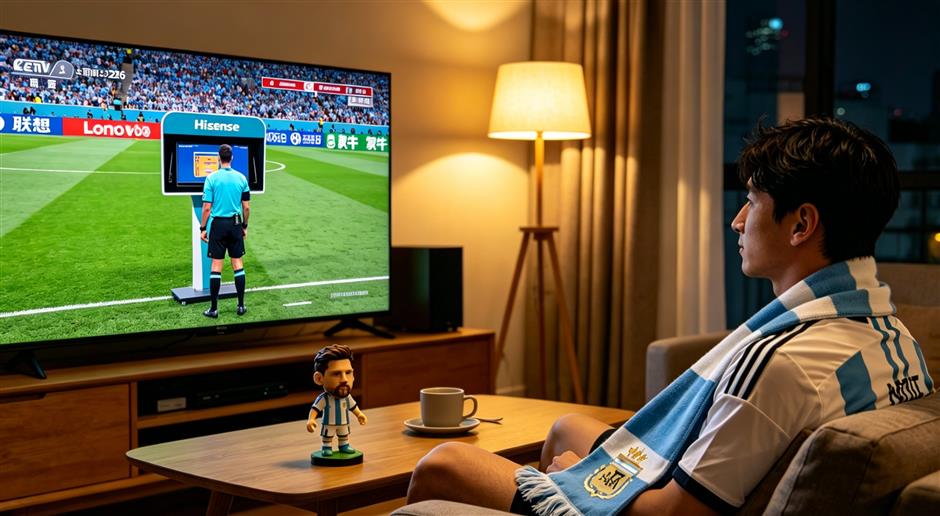
Picture this scene. It's 9am on June 17. In a Shanghai apartment, a football fan settles in front of his TV to watch Argentina's first match in the 2026 FIFA World Cup, played against Algeria in a US stadium. His shoulders are draped in an Argentina fan scarf made in Yiwu, one of the world's largest wholesale markets, and a Lionel Messi toy on the coffee table in front of him was produced in another Chinese city just 300 kilometers to the south. When a goal in the game is reviewed, the referee in the "video assistant referee" room analyzes the footage on a display from China's Hisense. And all around the stadium in Kansas City, billboards advertise Chinese brands like Lenovo and Mengniu.
The only thing missing from this scenario is a Chinese player on the field.
China's men's national football team, now ranked 94th in the world, has not qualified for the World Cup since 2002 and will miss a sixth consecutive tournament when the US, Canada and Mexico co-host the 48-team, 104-match tournament this summer.
But where performance on the pitch fails, Chinese businesses seizing the opportunity of global sports zeal have not. From Yiwu themed keychains to AI systems analyzing match data, they are scoring big in the business of sport, making their commercial footprint ever more ubiquitous.
This year's World Cup is a case study in how China, the world's second-largest economy, can supply, sponsor and technologically underpin a major global sports event without participating in it.
Yiwu, a city in Zhejiang Province once dismissed as the world's "bargain bin," has transformed itself into a high-speed, creative supply chain that reacts quickly to global trends.
According to customs data, the city exported 2.3 billion yuan (US$323 million) in sporting goods and equipment in the first two months of 2026, a year-on-year increase of 39 percent. Last year, Yiwu sports exports rose 20 percent to 11.65 billion yuan.
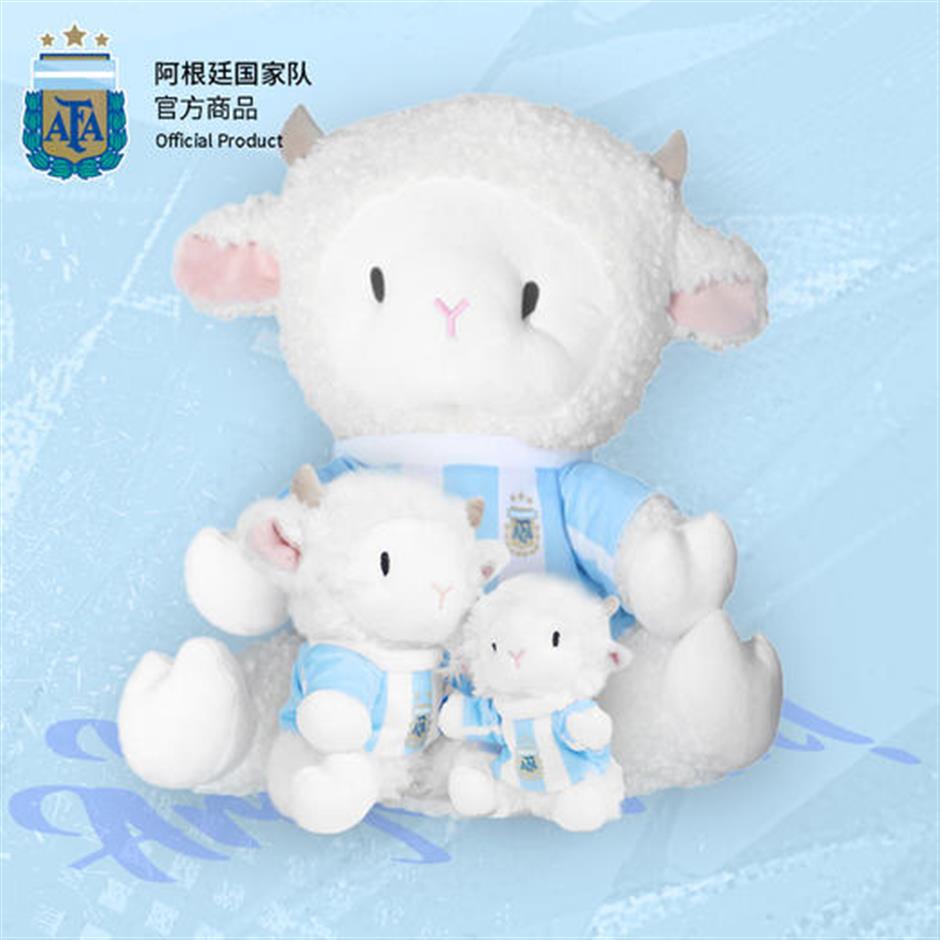
Sport gear manufacturers in Yiwu, like All Star Partner, have moved beyond simple replicas, securing licensing agreements with eight national teams and major clubs to produce everything from Messi toys to themed nail art and pet jerseys. Luo Tianle, the company's Yiwu head, said the firm releases 20-30 new designs weekly and ships several container loads a day at peak times.
Even for traditional manufacturers like Lin Daolai, owner of Yiwu Huyue Arts & Crafts, which produces silicone wristbands, the World Cup is a massive logistical boost. Lin recently fulfilled orders for two million officially licensed wristbands while maintaining a stockpile of one million more for fans of the top 10 teams.
The volume of goods passing through Yiwu feeds into the Yiwu Index, a pricing and sales indicator that tracks exports from the city and is monitored by economists as a gauge of real-time global trade demand.
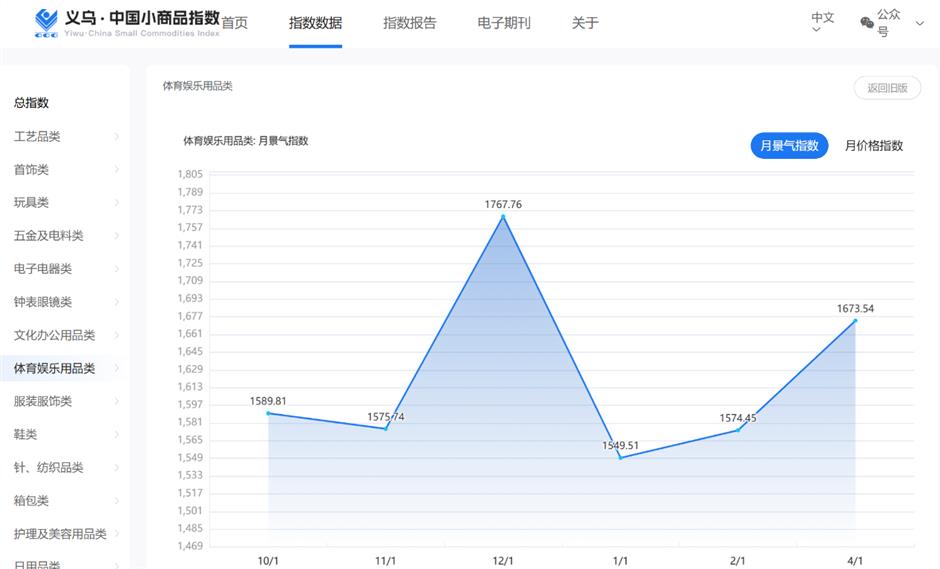
The Yiwu China Small Commodities Index tracks the World Cup cycle in precise detail. Its sports and entertainment goods category recorded 1,590 in October 2025, dipped marginally to 1,576 in November, then spiked to a peak of 1,768 in December as overseas buyers placed large-volume orders.
The index fell to 1,545 in January following the completion of bulk shipments, before recovering to 1,574 in February and climbing to 1,674 by April. Merchants including Lin attribute the rebound to pre-tournament "small-order, fast-response" replenishment, with buyers increasingly switching to air freight for last-minute demand.
China's corporate presence extends beyond merchandise. Of the 2026 World Cup's 15 announced global partners and sponsors, three are Chinese: technology giant Lenovo, consumer electronics goods maker Hisense and dairy company Mengniu. FIFA, the football governing body, said it expects the 2026 event to deliver the highest sponsorship revenue ever for a stand-alone sporting event.
The nature of Chinese sponsorship has shifted from brand profile-building to technical integration.
Lenovo serves as FIFA's official technology partner, providing an AI super-agent for match analysis, an AI video enhancement system for referees and a 3D digital human visualization system. Lenovo's sports and entertainment director Santiago Manso said 28 mobile scanning booths will be deployed at team hotels to generate one-minute, full-body digital avatars for every player. Stored in FIFA's database, these avatars reconstruct offside rulings with centimeter-level precision for broadcast audiences.
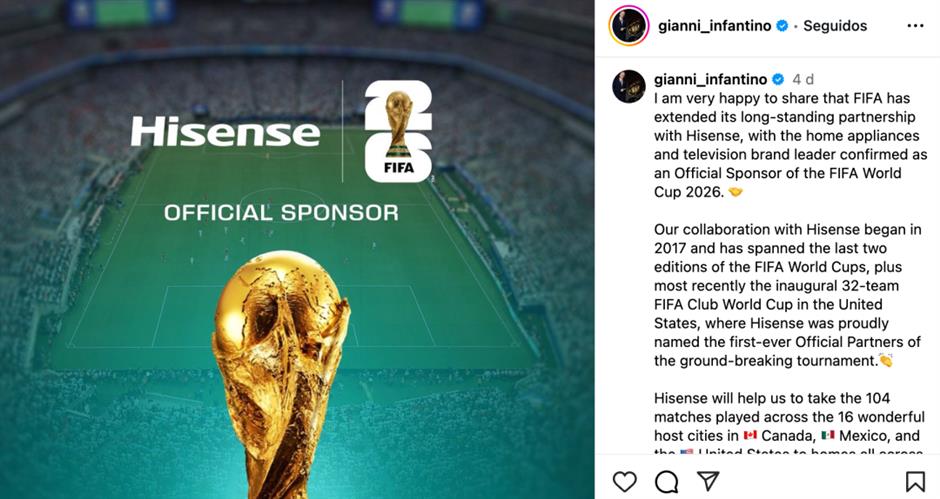
Hisense, meanwhile, is the official video assistant referee display partner. Its new 2026 RGB MiniLED TV will be installed in video operations room, providing visual infrastructure for officiating decisions. This marks Hisense's third consecutive World Cup sponsorship. The company also provided referee-assistant displays for the 2024 European Championship and the 2025 Club World Cup.
Hisense's sponsorship strategy has coincided with significant commercial expansion. Hisense Visual Technology, the listed television arm of Hisense Group, owns the Hisense, Toshiba and Vidda brands. Last year, its overseas revenue reached 29 billion yuan, rising 4.6 percent from a year earlier and accounting for more than half of total revenue.
Yutong, a Chinese bus manufacturer, supplied 1,500 vehicles for the Qatar tournament, including 888 electric models – the first large-scale deployment of Chinese green transport at a major global sporting event.
The 2026 World Cup has required no new stadiums, but the tournament in Qatar in 2022 did. For that event, China Railway Construction built the Lusail Stadium – the first Chinese contractor to design and build a FIFA Category 4 venue. The stadium was later featured on Qatar's 10-riyal banknote.
Chinese firms are now applying that expertise globally, with projects including the National Football Stadium in Serbia and sports infrastructure in Africa.
Editor: Liu Qi
In Case You Missed It...
![[Weather] Get Ready for Summer's Wettest Typhoon as City Issues Dolphin Alert](https://obj.shine.cn/files/2026/08/08/e1bb6628-b6a8-4d45-9f48-1a224feee23b_0.jpg)
 Aug 8, 2026
![[Weather] Get Ready for Summer's Wettest Typhoon as City Issues Dolphin Alert](https://obj.shine.cn/files/2026/08/08/754a369b-f2c1-4425-8b9f-2c1a4c11244b_0.png)
![[SH Transit] China Eastern Extends Free Refund Window For Domestic Flights: How Does It Compare?](https://obj.shine.cn/files/2026/08/07/5100d160-20be-4b0c-a721-a277761a6286_0.jpg)
![[Quick News] Work From Home, Metro Closures, Expected Red Alerts](https://obj.shine.cn/files/2026/08/09/81db6dcd-7734-4f06-876a-772254caed62_0.jpg)
![[Weather] Shanghai Bears Brunt of Rain, Wind as Typhoon Dolphin Makes Landfall](https://obj.shine.cn/files/2026/08/09/78f7e76c-2da3-4a70-af37-a0d89800f42b_0.jpg)