China Stock Market Rallies Nipped by Flare-Up in Iran War Hostilities
In a now familiar pattern, China's stock market investors this week vacillated between hope and pessimism on an end to the war in Iran and the reopening of the oil conduit Strait of Hormuz, with oil prices hovering around US$100 a barrel.
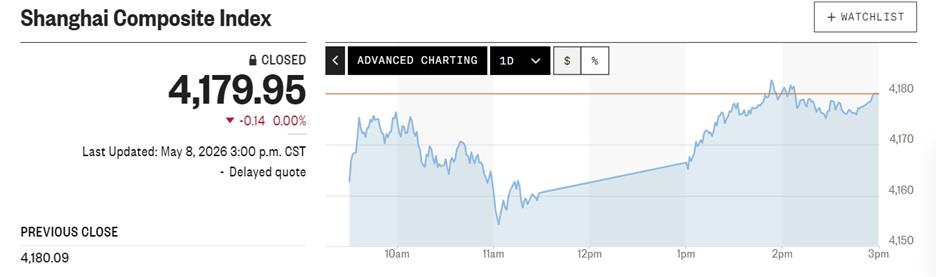
The benchmark Shanghai Composite Index rose 1.65 percent in the three trading days following the Labor Day Holiday. But on Friday, it closed flat after a flare-up of Middle East tension nipped two days of rallies.
The Shenzhen Component Index advanced 3 percent for the week but lost 0.5 percent on Friday. The tech-heavy ChiNext board posted a 3.24-percent weekly gain despite a 1 percent pullback on Friday, and the Hang Seng in Hong Kong added 2.4 percent for the week, despite a 0.87-percent decline on the last trading day.
"People have turned impatient, yearning for a certain answer to when normal oil supplies through Hormuz will resume," said Liu Chenmin, an analyst GF Securities. "In addition, investors are looking at corporate first-quarter results to decide which shares to buy, sell or retain."
The traditional "sell in May and go away" market adage may not apply to tech-related shares, which have been market stars, Liu added.
Shares in BeOne Medicines, a Sino-US company involved in developing cancer therapies rose 0.9 percent in Hong Kong after reporting first-quarter net income surged 22-fold to US$227.4 million on a 35 percent increase in revenue to US$1.5 billion.
Macao casino and hotel operator SJM Holdings fell 4.3 percent after the company reported it turned to a first-quarter loss of HK$62 million (US$7 million) from a year-earlier profit following the closure of all its satellite casinos under new market regulations.
Hong Kong-listed China Eastern Airlines rose 2.1 percent on Friday after China's three biggest carriers announced no rise in May fuel surcharges on domestic routes, despite ongoing spikes in global jet-fuel prices.
Declines in Chinese mainland markets on Friday were led by domestic chipmakers, which have been star performers so far this year. AI chip startup.Cambricon ended down 5.6 percent after a record-breaking week earlier when its share prices rose to the priciest Class A share.
Across Asia, South Korea's Kospi led weekly rallies with record closes driven by chipmakers Samsung Electronics and SK Hynix on strong demand for AI chips.
Japan's Nikkei slipped 0.2 percent on Friday after touching a record high a day earlier in a trading week abbreviated by holidays. Toyota Motor fell 2.2 percent after reporting a 49 percent slump in its fiscal fourth-quarter operating profit.
On Wall Street, the S&P 500 index gained 2.3 percent this week, closing at a record high, and the Nasdaq rose 4.5 percent to a record on upbeat technology earnings. US investors have largely priced the war in Iran into stock prices, though they remain cautious about its outcome.
In Europe, the Stoxx600 index fell 0.7 percent amid Trump administration threats of higher tariffs if the EU parliament doesn't ratify a trade agreement with the US by July 4.
Global oil prices, which have gyrated with each new development in the Middle East conflict, ended the week above US$100 a barrel. Benchmark Brent crude futures closed at US$101.29 a barrel, after dropping to as low as US$96 earlier in the week.
Editor: Yao Minji
![[Health Byte] Men's Sexual Organs, and Cancer](https://obj.shine.cn/files/2026/06/18/0c2a70ff-f6e4-4d36-8f1a-74e041b8e435_0.jpg)