Chinese Stocks Weather Volatility in Tech Shares to Post Gains
Amid volatility in global tech shares, China's stock market managed to post weekly gains on resilience in the technology sector.
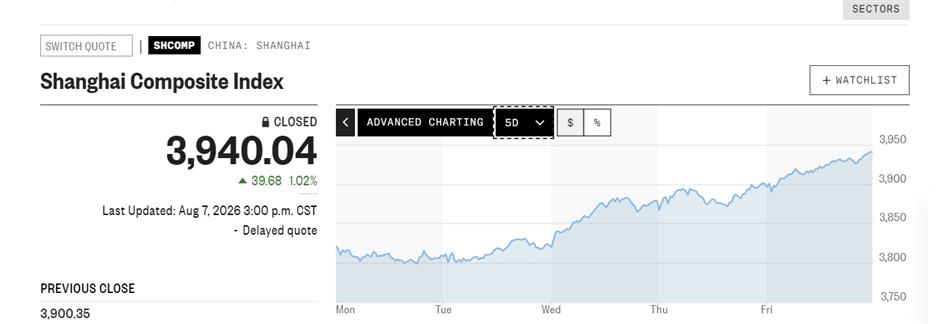
The benchmark Shanghai Composite Index rose 2.8 percent in the past five trading days, with a 1-percent gain on Friday. The Shenzhen Component Index expanded 5.4 percent for the week, and the tech-focused ChiNext jumped 6.5 percent. The Star Market 50 index, which is tilted towards tech firms, surged 6.6 percent.
"Tech shares continued to be volatile in many markets but Chinese tech shares seemed to be more resilient this week," said Wu Huimin, an analyst with Sinolink Securities. "Investor sentiment has turned tolerant in China, with technology companies showing they have a lot to offer."
Next week, Hangzhou-based humanoid robot maker Unitree will start taking subscriptions for its widely watched 6.1-billion-yuan (US$904 million) Shanghai initial public offering, pricing its shares at 150.80 yuan. IPO sponsor Citic Securities predicted the company's valuation will be around 56 billion yuan within six to 12 months of its listing. Backers of the company include Tencent, Meituan, DeepSeek, China National Petroleum, China Southern Power Grid and China Telecom.
Changxin Memory Technologies (CXMT), the world's fourth-largest maker of dynamic random-access memory and the largest listed chipmaker in China, rose 1 percent on Friday. The shares, which began trading on July 27 after a US$8.6 billion IPO, will be added to the widely watched MSCI China All Shares Index on August 10.
The outlook for tech shares is dogged by escalating rivalry between China and the US. Washington recently added foreign-made advanced robots to a list restricting sales in the US, which could impact leading exporter Unitree. The US is also reportedly drafting a ban on imports of new models of Chinese data center components, leading to volatile performance of Zhongji Innolight, the world's largest producer of optical transceivers, which lost 7 percent on Wednesday but managed a 2-percent weekly gain.
Hong Kong's Hang Seng Index rose 0.5 percent on Friday but lost 0.8 percent for the week, largely on fears of strengthened controls over offshore financial returns. Beijing and Hangzhou authorities have started to apply personal income tax rates of 20 percent on returns from Hong Kong insurance policies, including dividend payouts and interest earned on prepaid premiums, hitting global and Chinese mainland insurers with business in the city. Ping An Insurance lost 3.9 percent this week, and China Life Insurance was down 2.4 percent.
Elsewhere in Asia, South Korea's Kospi declined 5.1 percent this week with continued selloffs in shares of the nation's two biggest chipmakers of Samsung Electronics and SK Hynix. Japan's Nikkei gained 1.9 percent for the week despite a loss of 0.12 percent on Friday.
On Wall Street overnight, the S&P 500 index rose 0.6 percent on expectations that weak jobs figures will give the Federal Reserve reason to keep rates on hold rather than raising them to address inflation. The Nasdaq gained 1.3 percent after a volatile week in tech shares, largely focused on the escalating investment in AI development. For the week however, the Nasdaq added 5.2 percent, and the S&P 500 was up 3.6 percent.
In Europe, the Stoxx600 index rose 0.3 percent on Friday.
Editor: Yao Minji
In Case You Missed It...
 Aug 8, 2026
![[Weather] Cute Name, Fierce Bite: Shanghai Braces for Dolphin Impact](https://obj.shine.cn/files/2026/08/07/799415fe-f8f1-42ec-9127-b69cc6efa28f_0.jpg)



![[Weather] Cute Name, Fierce Bite: Shanghai Braces for Dolphin Impact](https://obj.shine.cn/files/2026/08/07/7b52529a-238a-473d-879e-d015c7386d1a_0.gif)
