Algorithmic Revolution: How Shanghai's AI Brain is Redefining Manufacturing
Deep inside a massive precision machining plant, thousands of cutting tools once rested in silent order along storage racks tens of meters high.
Historically, assembling the right set of tools for a single custom metal component with over a hundred intricate features was a grueling endeavor. Even the most veteran master technicians spent weeks cross-referencing dozens of blueprints to select each tool by hand. A single miscalculation in length, rigidity, or clearance could trigger a devastating collision on the high-speed machining floor, costing tens of thousands of dollars in losses.
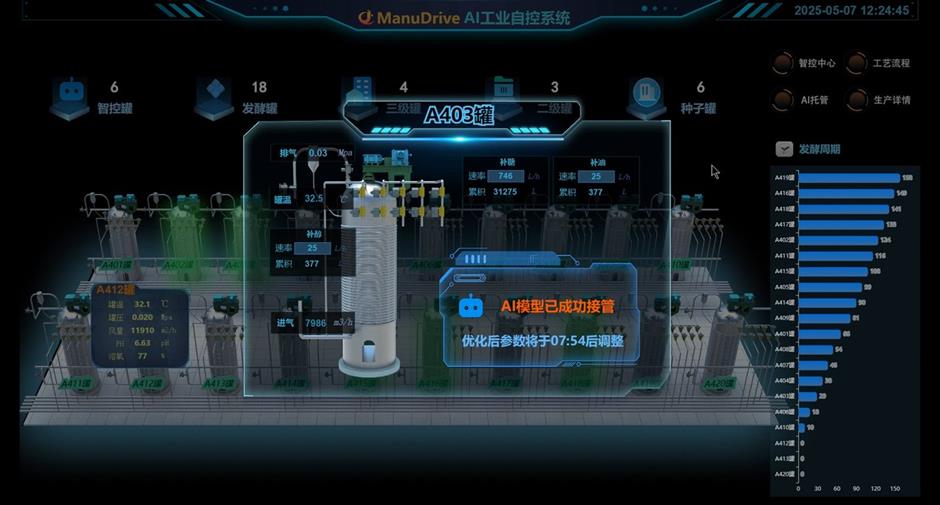
Today, this pain point of traditional manufacturing is being erased. The industry is shifting from weeks of manual tool selection to artificial intelligence-generated solutions in less than 10 minutes. This shift is being driven by ManuDrive, an industrial large language model (LLM) developed by the Artificial Intelligence and Micro Structure Laboratory, also known as AIMS-Lab, at Shanghai Jiao Tong University.
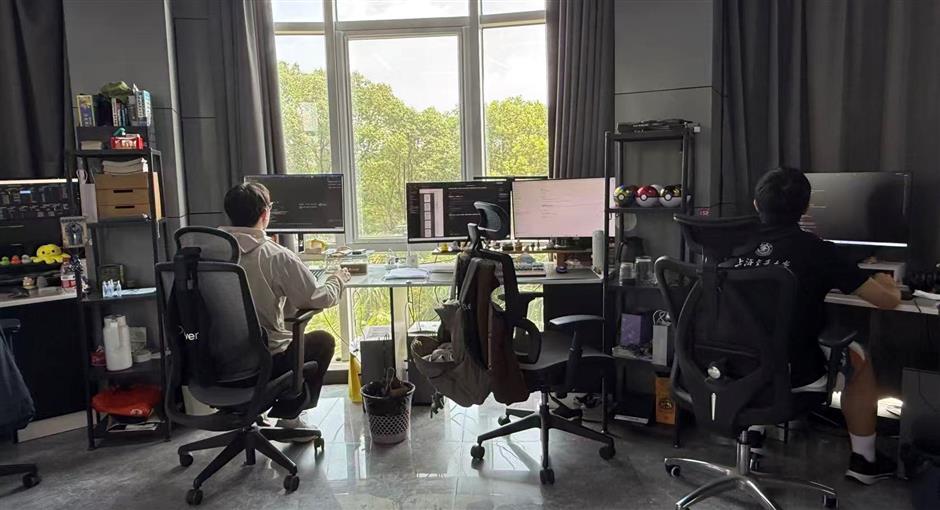
Operating with a team of under 100 people, the lab has already empowered hundreds of industrial production lines across China to boost efficiency through AI.
"The greatest challenge in manufacturing is that a master technician's experience cannot be easily replicated, and experience-based productivity growth has hit a hard physical ceiling," explains Professor Li Jinjin, director of the laboratory.
ManuDrive was built to shatter that ceiling.
The team encapsulated complex AI algorithms into flexible, modular building blocks. For instance, an AI monitoring system can be packaged into 30 to 40 distinct modules, ranging from automated data labeling and batch image processing to sensor signal reception and waveform-to-sequence data conversion. While individual modules are smaller than full AI agents and cannot resolve complex issues on their own, combining them enables rapid deployment across virtually any industrial scenario.
As the team dives deeper into different factory environments, they continue to expand this toolkit. To date, they have constructed a system of 127 modules derived from algorithms published in over 200 academic papers.
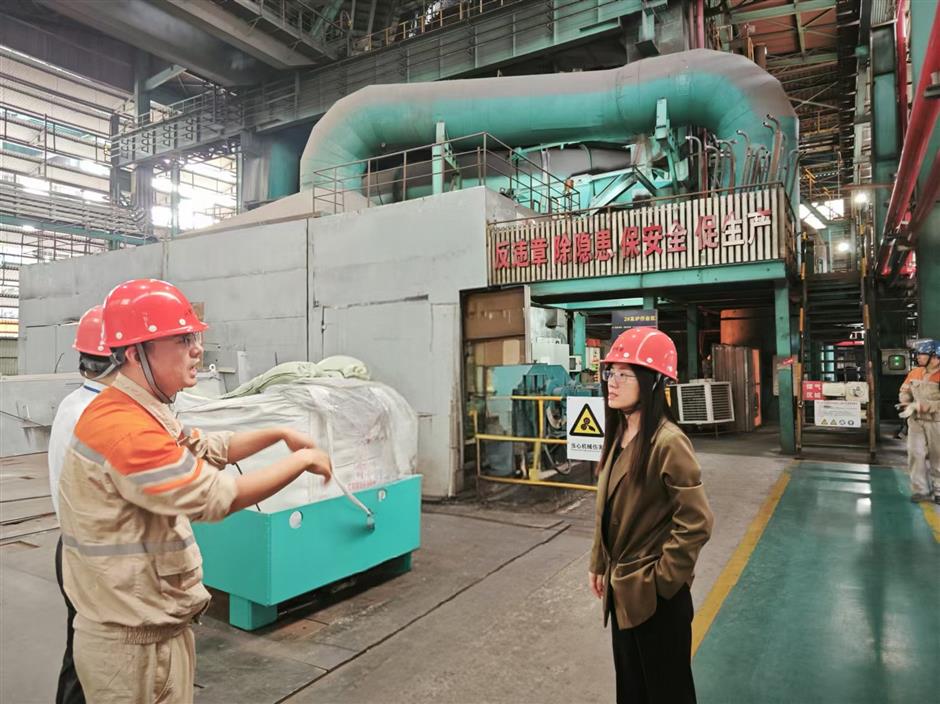
Simultaneously, the lab trains Forward Deployment Engineers (FDEs) and dispatches them directly to customer factory floors to bridge the gap between AI models and real-world business workflows.
"FDEs don't sit in air-conditioned office towers writing codes. They are tactical operatives deployed to the frontlines of industry nationwide and around the globe," Li said. "Acquiring industrial AI capabilities on the ground is far from comfortable."
One of the team's triumphs took place at the Chuanning Biotechnology in Yili, northwest China's Xinjiang Uygur Autonomous Region. Li led her team into the remote region, spending nine months embedded with factory engineers. They lived, ate, and slept on site, writing code on makeshift beds set up over discarded trash bags.
"In the first phase, the AI mapped and digitized the master technicians' implicit knowledge. In the second, it utilized continuous microsecond-level real-time control to search for global optimal solutions, ultimately surpassing the performance limits of human experience," Li elaborated.
Even for an industry leader like Chuanning Biotechnology, operating massive 500-ton fermentation tanks standing four to five stories tall yielded less than 5 tons of final active product, a conversion rate under 1 percent from total raw material input.
Deploying ManuDrive broke through these historic operational limits. In just one month, the AI boosted fermentation yield by 5 percentage points, exceeding the plant's cumulative yield growth over the past five years. For a listed company generating roughly 600 million yuan (US$84 million) annually, every 10 percent efficiency gain delivers 60 million yuan in direct bottom-line value.
"The collaboration between AI and master technicians records the evolution of AI from mimicking human experience to surpassing it," said Dr Chen Jianhao, a member with the AIMS-Lab. "Instead of using standard LLMs to predict words, we embedded conservation of mass and physical constraints directly into the underlying mathematical expressions. This eliminates AI hallucinations at the root, delivering an extreme precision rate of over 99 percent."
Behind Professor Li's team stands strong policy support. Shanghai recently launched targeted initiatives to back "AI + Manufacturing."
Recognizing that small and medium-sized companies often hesitate to digitize due to high barriers and steep costs, Shanghai's policy framework offers substantial financial support.
Here are some examples: up to 20 million yuan in grants for breakthroughs in vertical industrial models, physical AI and industrial agents, such as text-to-3D component design; up to 40 million yuan in subsidies for enterprises renting intelligent computing infrastructure; up to 20 million yuan in direct subsidies for flagship "AI + Manufacturing" model enterprises and smart factories that create scalable, full-process transformation templates across industries.
To build the talent pipeline, Shanghai has also recently launched a FDE training program. Targeted at corporate technical leads, operational heads and executives, the initiative features a tiered learning structure centered on practical execution. Trainees bring their own real-world operational bottlenecks to class, working through demand analysis, customized development, and on-site validation.
This policy framework is being closely watched and emulated by other provinces. By combining government support with market mechanisms, Shanghai has significantly lowered the financial entry barrier for digital transformation.
"Transformation projects that once required tens of millions of yuan in upfront capital can now be executed through an incremental profit-sharing model under municipal support," said Li. "If the AI generates an extra 100 million yuan in profit, the company and the team share the added gain. This completely removes the financial risk for manufacturers."
The value of Shanghai's manufacturing models extends well beyond domestic efficiency gains; it lies in exporting advanced industrial intelligence to the global economy.
"Every nation has its existing industrial base, and our ultimate goal is to generate new growth out of that existing capacity," she observed. Driven by agencies such as the National Development and Reform Commission, Shanghai's industrial AI is accelerating its global expansion.
Thailand's conglomerate Charoen Pokphand Group has already established deep technical cooperation with the AIMS-Lab through its subsidiary, CP Biotech. The partnership is actively introducing these industrial models to production lines both within China and overseas.
To help manufacturing plants in developing nations overcome productivity bottlenecks, ManuDrive is adopting the same incremental profit-sharing model used with Chinese enterprises, allowing international partners to scale output and share the economic value created.
Editor: Liu Qi
In Case You Missed It...

 Aug 24, 2026
![[CNS Survey] Shanghai Healthcare Survey: International Community](https://obj.shine.cn/files/2026/08/21/108102a8-f58e-4fe8-a2fe-88638d0caf6b_0.jpg)