Buried in Chinese Corporate Earnings Reports Is an Emerging AI Dividend
The most revealing AI figures don't necessarily come exclusively from AI companies. They are also starting to surface deep inside the earnings of manufacturers whose core businesses aren't generally considered connected to artificial intelligence.
Chinese appliance giant Midea offers an unusually measurable example.
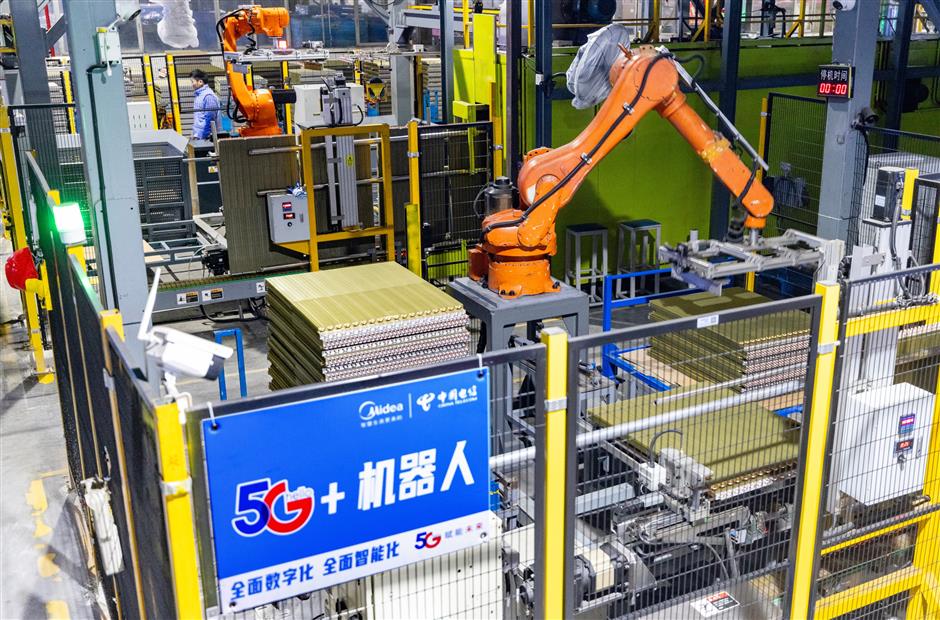
Its first-half results led with numbers analysts expected from a US$60 billion appliance maker: Revenue rose 3.5 percent to 261 billion yuan (US$38.8billion) and net profit edged up 1.7 percent to 26.4 billion yuan. The company is benefiting from the AI infrastructure boom through its cooling and thermal-management businesses. That's obvious AI connection.
Several paragraphs down, however, was a more telling number. Midea said its employees had built more than 20,000 AI agents across research and development, manufacturing, supply chain, sales and after-sales services, cumulatively saving more than 9 million work-hours and cutting costs by over 450 million yuan.
That figure, however, begs perspective. The claimed AI savings barely cover the increase in profit. If the estimate is accurate, that suggests AI may so far be doing more to offset other cost pressures than to generate excess returns.
That caveat matters, but so does the signal. The AI deployment by a manufacturer is now becoming quantified. It suggests the AI race needs two scoreboards: one for computing scale and one for deployment scale, which measures how extensively intelligence gets absorbed into factories, banks, warehouses and machines enough to lower costs, shorten cycles and raise asset utilization.
The US leads decisively on computing scale. China's distinctive strategy is to expand computing power while pushing diffusion across a much broader industrial base.
Midea is unusually granular, but not alone.
Giant appliance maker Haier Smart Home also highlighted AI agents in its interim results, reporting 93 percent year-on-year growth in monthly active users of agent functions in its Smart Home app, with no attached cost figure.
Ping An insurance said average daily AI token consumption rose from roughly 30 billion at the end of 2025 to more than 120 billion by June, alongside faster underwriting and claims processing.
Midea estimates economic output, Haier measures adoption and Ping An measures usage. None proves that AI drove overall earnings, but together they suggest AI is moving into ordinary corporate operations beyond the tech sector.
The same is happening in the US. GE Vernova told investors on an earnings call that it had 13 AI process transformations underway, planned to double that number to save tens of millions of dollars annually. That is forward guidance, not a realized figure, and deserves some modicum of skepticism.
US automotive supplier Lear's broader IDEA transformation program, built partly on Palantir's Foundry and AIP platforms, generated more than US$30 million in savings in the first half of 2025, though Lear does not attribute the full amount specifically to AI.
These disclosures expose a measurement problem. There is no standardized accounting definition of an "AI saving." Companies use different baselines, mix AI with broader automation programs and rarely disclose whether implementation, software and computing costs have been deducted.
That makes cross-company comparisons difficult. But dismissing the numbers entirely would create the opposite problem: missing a trend simply because accounting standards haven't yet caught up with it.
Computing is not deployment. The financial story of AI remains dominated by infrastructure spending. Amazon, Microsoft, Alphabet and Meta have issued guidance pointing to over US$700 billion or more in combined 2026 capital expenditure. Reuters calculated that Microsoft, Meta, Oracle, Amazon and Alphabet had disclosed about US$1.1 trillion in future AI leasing commitments, much of it related to data-center capacity.
The American AI boom can, therefore, look like one enormous infrastructure cycle: chips to servers, servers to data centers and data centers to power.
Those numbers tell us a great deal about how much capital is being committed to creating intelligence. They tell us less about how efficiently the rest of the economy is absorbing it.
China has its own computing race. Alibaba has committed more than 380 billion yuan over three years to cloud and AI infrastructure, while intelligent-computing capacity is expanding through both corporate investment and state-coordinated infrastructure.
But China is also explicitly treating diffusion as part of its AI policy.
The 2026 Government Work Report calls for expanding intelligent-computing clusters while accelerating intelligent agents and commercial-scale AI applications across key industries.
That does not mean the government created Midea's 20,000 agents. The effect is more indirect: build infrastructure, open operating systems and reduce barriers to adoption.
Nor is the distinction simply American computing versus China deployment. GE Vernova and Lear clearly show that American companies are deploying, too.
The more interesting question is whether China's enormous industrial base gives it another route to AI scale. Once AI moves beyond data centers, the definition of AI infrastructure expands to: chips → computing → electricity → cooling → networks → sensors → robots → industrial equipment → factories.
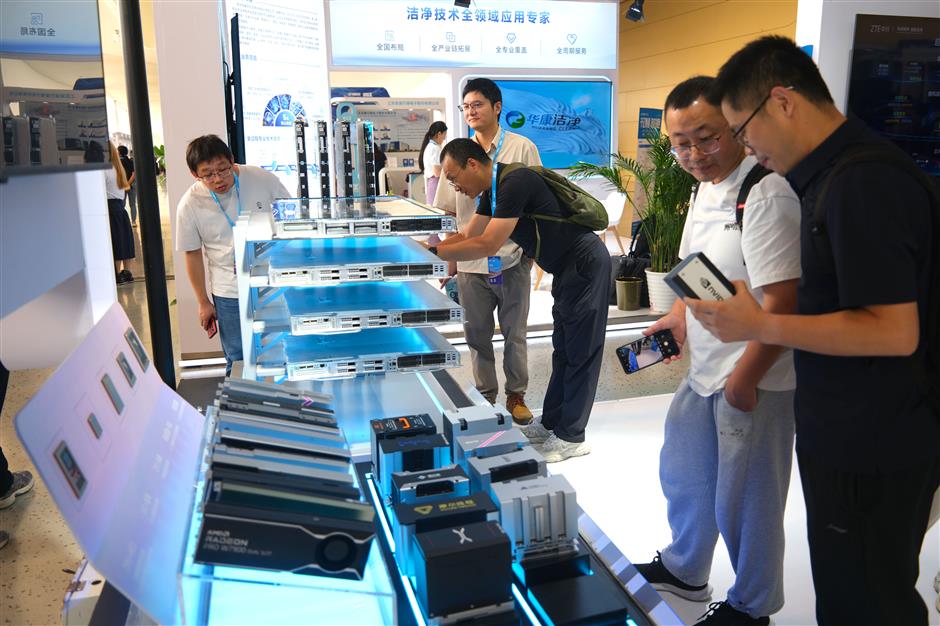
A data center needs cooling systems, transformers and energy storage. An AI-enabled factory needs machine vision, industrial networks and robotics. Autonomous driving in mining still requires vehicles and communications equipment. AI logistics still requires warehouses.
China provides large chunks of that physical chain.
Midea itself captures the interaction unusually well. On the one hand, it sells cooling and thermal-management equipment into the data-center boom. On the other, it is deploying thousands of AI agents inside its existing operations.
AI therefore creates two potential dividends for industrial companies: new demand for the physical equipment needed to build an AI economy, and productivity gains from applying AI to businesses that already exist.
The second dividend is easier to miss because it does not necessarily appear as "AI revenue." It may show up as lower inventory, fewer work-hours, faster product development or better utilization of an existing factory.
That's why Midea's 450-million-yuan figure matters even if it barely matches Midea's profit increase.
The numbers are still too inconsistent and small compared with companies' overall revenue to declare a winner, but they may tell us about where AI is now and how its economic impact will eventually be measured.
The first AI scoreboard was model performance, the second was capital expenditure and a third is emerging: how effectively companies convert intelligence into productivity.
For now, every company is keeping score by its own rules and quantitative figures for AI productivity remain elusive, but the trend of calculating this emerging AI facet is underway.
Editor: Liu Qi
In Case You Missed It...

 Sep 4, 2026