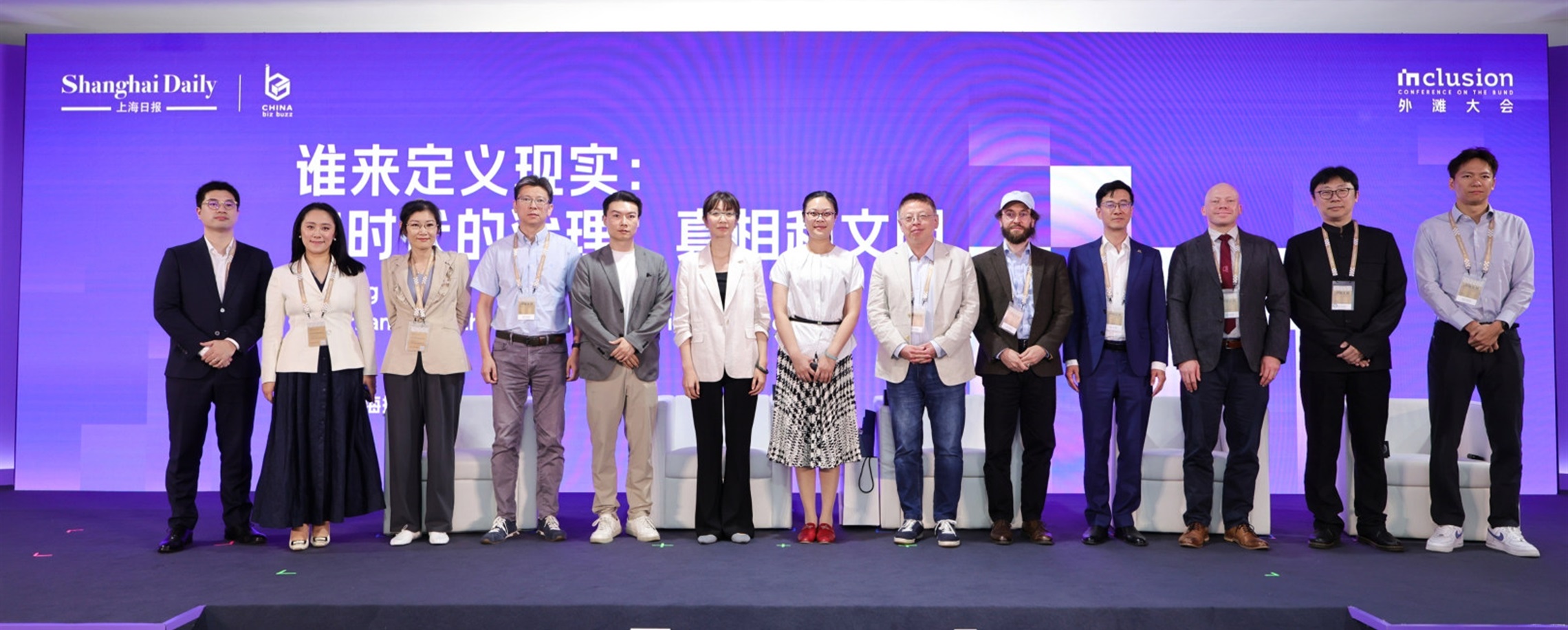
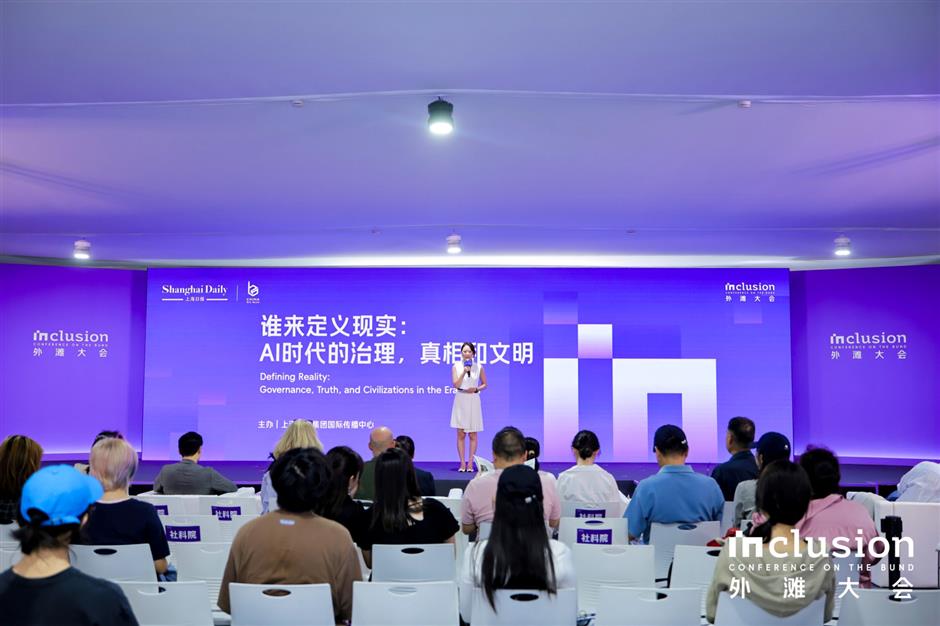
Defining Reality: Governance, Truth, and Civilizations in the Era of AI
Many artificial intelligence-related questions, tangled with excitement, worries, fears and eagerness, arise as more people grow accustomed to living lives intertwined with AI.
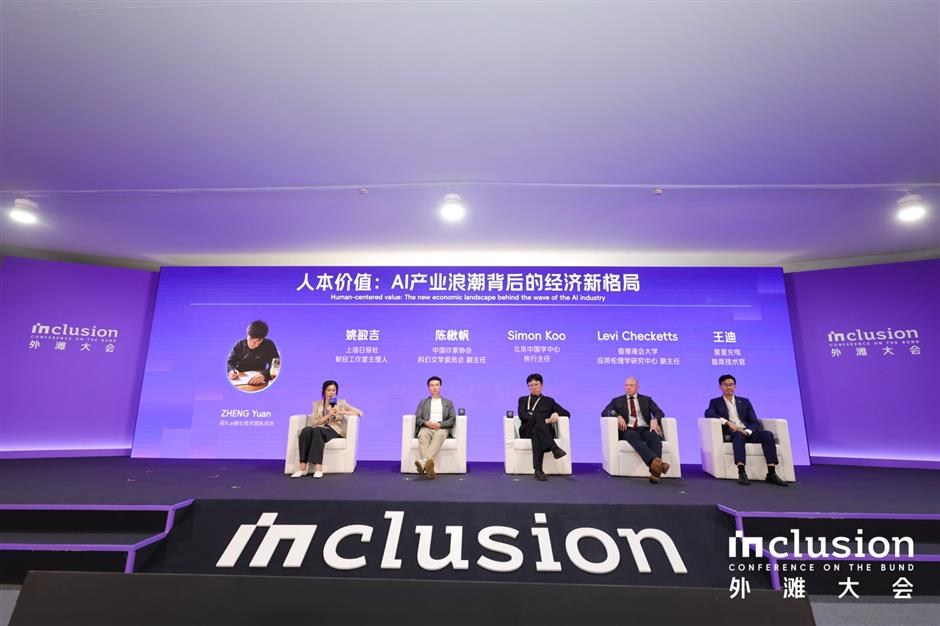
As this technology increasingly shapes how we perceive, judge and act, what should we delegate to AI? And what must remain human? These are the two questions raised at a forum co-organized by Shanghai Daily on Saturday during the Inclusion Conference on the Bund. Themed "Defining Reality: Governance, Truth and Civilization in the Era of AI," the forum brought together philosophers, computer scientists, writers and industry practitioners from China and the United States to adopt a cross-cultural and interdisciplinary perspective.
"While AI can handle tedious work and boost efficiency, entrusting more judgments, choices and actions, machines may gradually deprive humans of opportunities to practise such capabilities, leading to 'deskilling' and even eroding our capacity for independent judgment and accountability," said Paul Scherz, director of Notre Dame-IBM Technology Ethics Lab at the University of Notre Dame, during his keynote speech at the forum. "It is the flip side of AI 'empowerment.'"
Another keynote speaker Bai Tongdong from the School of Philosophy at Fudan University revisited fundamental assumptions about "intelligence", "humans" and "values" in the AI era through the lens of Chinese philosophy, especially Confucianism.
"Although modern AI demonstrates growing prowess in language, computation and specific tasks, this does not mean it possesses 'intelligence' in the same sense as humans. What truly merits inquiry, instead, is how advances in AI compel us to rethink what it means to be human," Bai said.
Renowned science fiction writer Chen Qiufan presented a non-fictional, grounded assessment of artificial intelligence in his address "Who Writes the Future? – Science Fiction, Human Subjectivity and the New AI Reality." One of China's early writers experimenting with AI-assisted literary creation, he once embraced human-AI collaboration wholeheartedly. At the forum, however, he stressed that rather than letting AI set the creative direction, humans should actively challenge outputs produced by machines.
Levi Checketts, associate director of the Center for Applied Ethics at Hong Kong Baptist University, extended AI ethics beyond models themselves to capital, wealth distribution and the real economy. He examined capital concentration behind Silicon Valley's AI boom and its social repercussions, raising a more pragmatic question: Should AI ethics merely constrain algorithms, or must it also examine who reaps the benefits and who bears the costs once technology enters the economy?
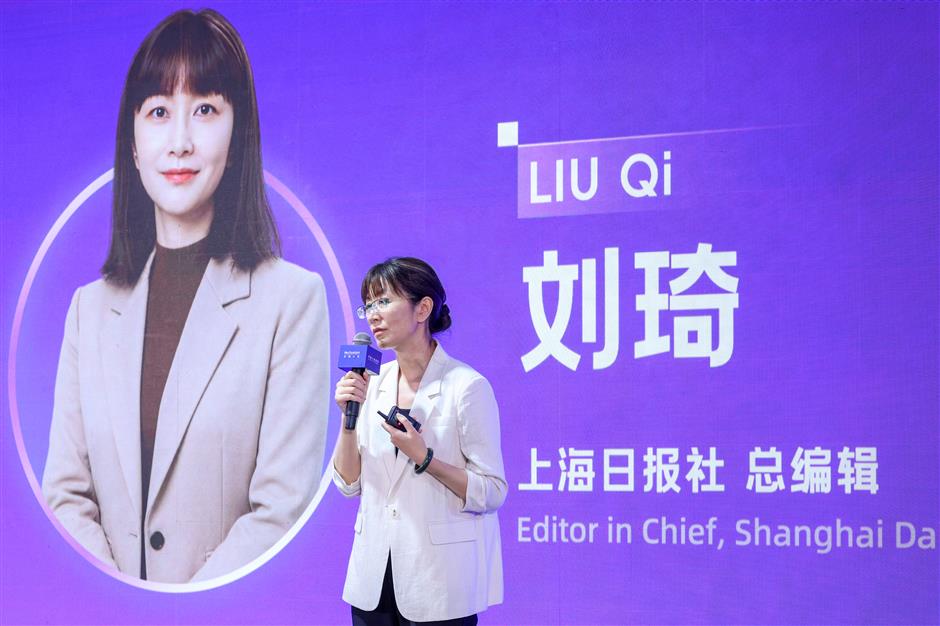
This forum goes beyond debating what AI can and can't do. It strives to clarify what humanity ought and ought not to uphold in the intelligent age. Liu Qi, editor-in-chief at Shanghai Daily and one of the forum's organizers, said that for media organizations, AI empowers editors and journalists to parse massive volumes of information and raise content production efficiency.
"Yet journalism stands on intangible, hard-to-quantify qualities: a spirit of scepticism, contextual awareness, a sense of accountability, and the courage to question whether a seemingly airtight answer holds true," Liu said.
"When AI is capable of observing, reasoning and even acting, the pressing inquiry evolves from 'what technology is capable of' to 'what technology ought to do'... Beneath this lies an even more fundamental proposition: who has the authority to define reality?"
She posed the question to AI and got an open answer that "lies remain lies even if they are increasingly disguised."
For this reason, the forum carried foundational significance for the future development of numerous industries worldwide.
Under diverse economic and cultural contexts, humanity may not arrive at a universal, standard answer. Still, people need to build spaces for dialogue, enabling exchange between varied practical experiences, identifying areas for consensus, acknowledging legitimate differences worth preserving, and constructing a forward-looking intellectual framework for global digital civilization.

Editor: Wang Xiang
In Case You Missed It...
 Sep 12, 2026
![[SH Transit] More Flights, Faster Security: What Changed at Shanghai Airports This Summer](https://obj.shine.cn/files/2026/09/11/de0cf59b-4696-4c8a-bd6f-e2969da1a6bf_0.jpg)
![[Movers & Shakers] Nick Brown of FlowCycle Is Creating Bali in SH](https://obj.shine.cn/files/2026/09/11/34d53c76-ca94-417b-8777-83f87610b85d_0.jpg)