AI-Powered MRI Enables Non-Invasive Preoperative Prediction of Deadly Colorectal Cancer Subtype
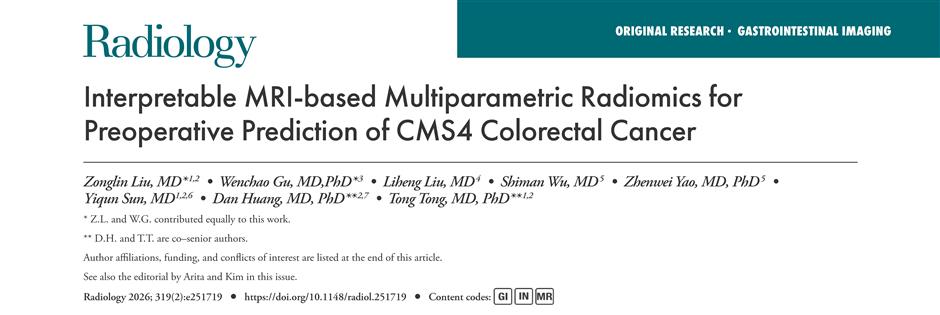
A new artificial intelligence-driven imaging tool can accurately identify the most aggressive subtype of colorectal cancer through routine preoperative MRI scans, offering a non-invasive solution to a longstanding clinical dilemma, according to a multi-center study published in Radiology, a top-tier journal on radiology.
Led by Dr Tong Tong from the Fudan University Shanghai Cancer Center, the research team developed an interpretable multiparametric radiomics model to preoperatively predict the Consensus Molecular Subtype 4 (CMS4) of colorectal cancer. The breakthrough enables radiology to shift from visual anatomical observation to non-invasive molecular decoding of tumors, paving the way for personalized precision treatment for colorectal cancer patients.
CMS4 is widely recognized as the most lethal and treatment-resistant subtype of colorectal cancer. Characterized by high invasiveness, it tends to trigger early metastasis and shows poor response to conventional chemotherapy and immunotherapy.
Clinically, CMS4 stratification currently relies solely on postoperative genetic testing, making it impossible for clinicians to identify high-risk patients and optimize treatment plans before surgery. This diagnostic lag has long hindered precise early intervention for colorectal cancer.
To address this critical gap, the research team analyzed magnetic resonance imaging (MRI) data from 253 colorectal cancer patients. Leveraging advanced radiomics technology, the team extracted massive invisible quantitative features from routine contrast-enhanced MRI images and established a predictive scoring system named MRC4s.
Traditional MRI mainly serves anatomical evaluation, but it will play an increasingly important role in tumor molecular subtyping and treatment decision-making in the future.
Research team led by Dr Tong Tong from the Fudan University Shanghai Cancer Center
Validated in multi-center real-world cohorts, the model achieved high accuracy in distinguishing CMS4 tumors from non-CMS4 subtypes. Clinical data showed that patients identified as CMS4-positive by the artificial intelligence (AI) model have nearly six times higher risks of tumor recurrence and metastasis than other patients.
Different from conventional "black-box" AI medical models that only generate results without clear mechanisms, the study realized interpretable AI prediction by revealing the biological basis behind imaging features.
This groundbreaking innovation upgrades preoperative colorectal cancer evaluation from traditional morphological assessment to molecular-level diagnosis. By shifting CMS4 subtype identification from invasive postoperative genetic detection to non-invasive preoperative MRI screening, the technology fundamentally optimizes the entire treatment workflow, experts said.
With this new tool, clinicians can formulate individualized treatment strategies preoperatively. Patients at high risk of CMS4 subtype can receive intensified targeted therapy and rigorous postoperative follow-up plans in advance to curb tumor progression. Meanwhile, low-risk patients can avoid unnecessary overtreatment, reducing drug side effects and preserving their quality of life.
Editor: Fu Rong


![[Hai Guide] The Inner Ring Road Is Getting Repaired – Here's Where You'll Feel It](https://obj.shine.cn/files/2026/06/18/e218b933-1d0c-41a9-990e-ff9215f35807_0.jpg)
