Shanghai Marathon Participants Briefed by Medical Experts Ahead of Race
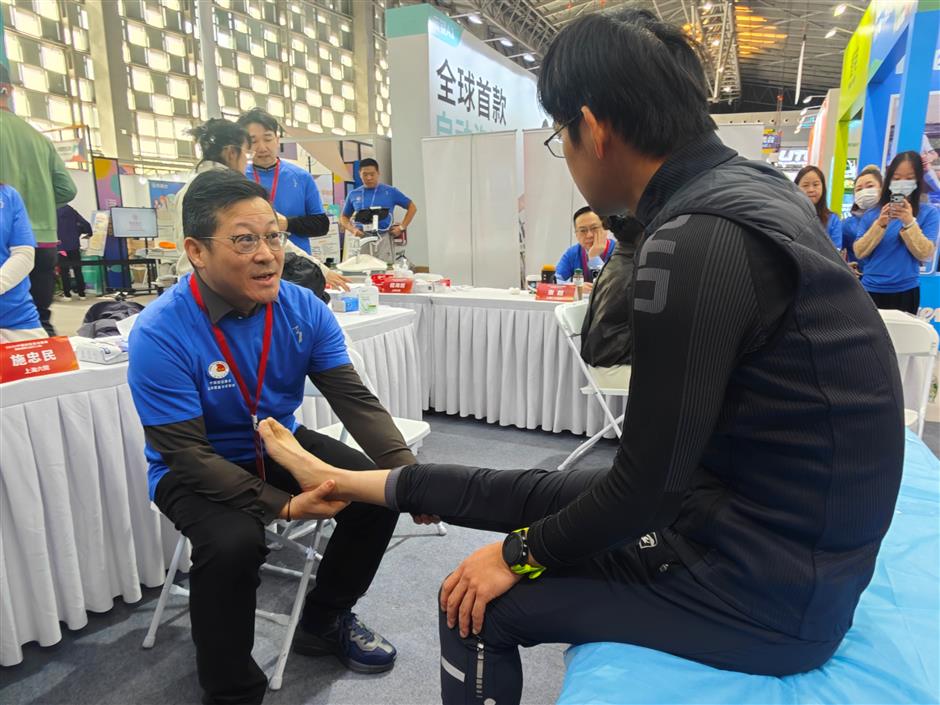
Local orthopedics have been giving lectures and advising runners ahead of the Shanghai Marathon on Sunday at the Shanghai World Expo Exhibition & Convention Center.
The talks involved a shift from passive treatment of injured runners to prevention of sports injuries.
Marathoners received gait evaluation, ankle disease diagnosis and sports injury prevention and control advice from Shanghai Sixth People's Hospital's ankle and rehabilitation specialists.
"Marathon is a popular sport, but many runners have misconceptions about training and competition. Running improperly and wearing the wrong shoes can all have an impact on runners' ankle and knee performance and even cause injury. We offer them customized instructions to ensure they can complete the marathon safely and smoothly," said Dr Ma Xin of Shanghai Sixth People's Hospital, a leading ankle surgery specialist.
The Chinese Athletics Association officials praised the practice, which combines athletics and medicine to protect runners before competition, and called for spreading the Shanghai model to other cities.
The Shanghai Sixth People's Hospital's medical team will monitor runners during the Shanghai Marathon, hospital officials said.
Tips for before, during and after the race
Pre-race guidance for runners in Shanghai Marathon
1, Equipment preparation: Shoes and insole gear
Selection of running shoes (Core basis: arch type + exercise habits)
Quickly judge the arch of the foot: wet feet step on blank paper, no/less arch contact of the footprints means high arch (select shock-absorbing running shoes)
The arch of the foot fully shows means a low arch/fat foot (select action-controlled running shoes); somewhere in between - normal foot (select stable running shoes)
Key principles: wear new shoes 1-2 weeks before the race (avoid grinding feet during the race); alternately wear 2-3 different models of running shoes (reduce the risk of injury by 37 percent )
Insoles and protective gear (targeted protection)
Insole: for those with sore arch, choose the style with talus pad (relief pressure on the plantar fascia); for those with Achilles tendon discomfort, add a 1/8-inch heel pad
2, Pre-competition training: Load management and ability activation
Load control (avoid excessive fatigue)
Upper intensity limit: gradually reduce the training intensity 2 weeks before the competition (reduce by 50 percent in the last week)
Sports combination: high-impact (running) and low-impact (swimming, cycling) alternately (for example: running for 2 days + swimming 1 day)
3, Warm-up activation: Wake up the exercise system (must be done during match days & pre-match training)
Dynamic stretching (avoid muscle tension caused by static stretching)
Calf muscles: bow step and press the legs (straighten the hind legs and do not lift the heels), 30 seconds each on the left and right x 3 groups
Plantar fascia: standing posture and then the foot slowly steps on the top of one arch, 15 times x2 groups
Knee joint: walk with legs left high (keep your knees as high as possible), 30 seconds x 2 groups
4, Sports injury prevention: Protection of key parts
Ankle protection
Avoid wearing new socks before the race (select cotton + elastic materials to reduce the risk of blisters); Apply vaseline before the race to easy-to-wear parts (heel, foot, toe side)
Achilles tendon protection
One week before the competition, avoid long-term foot-moving movements (such as climbing stairs); soak your feet in warm water for 10 minutes every night (promote blood circulation and relieve Achilles tendon fatigue)
If there is slight soreness in the Achilles tendon, cold compress can be applied (wrap an ice pack with a towel for 15 minutes each time, twice a day), and avoid using anti-inflammatory drugs to affect tissue repairing
Knee joint protection
Running posture adjustment: avoid excessive heel striking
Pre-race supplement: appropriate intake of amino sugar (starting 2 weeks before the competition, once a day) to assist in protecting articular cartilage
One day before the game and the race day:
1, The day before the game
Equipment confirmation: running shoes, socks, numbered cloths (pin them in advance), protective gear (try them on once)
Diet: mainly use carbohydrate for dinner (such as rice and noodles), avoid spicy and greasy food (reduce the burden on the intestines and stomach); drink less water 1 hour before going to bed
2, Early morning on the race day
After getting up: simple dynamic stretching (5 minutes) + eating an easily digestible breakfast (such as bread + eggs + warm water, finish them 1.5 hours before the race)
30 minutes before the game: activate the calves + soles again (repeat the warm-up action), go to the toilet
3, During the race
Do not run by your full force at the beginning but by 70 to 80 percent of the force and improve the force gradually until the body adapts.
Have some water and sweets during running and stop running if feeling sick. It is important to stop running and go for medical professionals if the ankle starts to show continuous pain.
4, After the race
Dry the body and wear warm and loose clothes. Do not stop at once but do slow movement for minutes. Do not drink too much water. You can drink some water when the heart beat and breath return to normal level.
If feeling nausea or dizzy, please visit the medical stations immediately.
Do not eat and drink too much soon after the race. Do not have a bath immediately after the race. You can wait for at least 30 to 60 minutes and have a warm bath with temperature lower than 40 degrees Celsius until your heart beat and breath return to normal level. You can go back to normal life 12 hours after the race.
Editor: Liu Xiaolin
In Case You Missed It...
 Apr 1, 2026