Daily Buzz: 31 March 2026
Top News
Trump Renews Threat to Obliterate Civilian Infrastructure in Iran
US President Donald Trump warned on Monday that the US will "completely" obliterate Iran's electricity-generating plants, oil wells, oil facilities on Kharg Island and possible water desalination plants – sites it has previously avoided – if Tehran doesn't "immediately" reopen the vital Strait of Hormuz to reach a peace deal "shortly." Destruction of civilian infrastructure, under international law, is considered a war crime. Trump said the US is in talks with Tehran, citing progress, but indicated impatience with the pace. Iran said no talks are underway and called the US 15-point plan to end the war "excessive and unreasonable."
Trump earlier told the Financial Times that he would like to take control of Iran's oil as he weighs up a possible ground invasion of Kharg Island, which handles 90 percent of Iran's crude oil exports in the Persian Gulf. Ground troops might also be deployed to seize control of Iran's stocks of enriched uranium – a risky venture. Trump likened the idea to the US seizure of Venezuela's oil industry after attacking the South American country in January. "Maybe we take Kharg Island, maybe we don't. We have a lot of options." But he conceded a takeover of the island would mean a US presence there for some time.
It wasn't clear whether Trump was serious or just posturing to force progress in talks with Iran and bolster Washington's negotiating position. Benchmark Brent crude remained at high levels, trading around US$114 a barrel. Stock markets in Japan and South Korea, nation's heavily dependent on Gulf oil, tumbled on Monday. The Asian exception was the benchmark Shanghai Composite Index, which posted a 0.2 percent gain.
Cosco Cargo Ships Seek Safe Exit From Persian Gulf
Two container ships linked to China's state-owned Cosco Shipping Corp made a second attempt to exit the Persian Gulf through the Strait of Hormuz after earlier turning back for unexplained reasons, Bloomberg News reported. Iran has been permitting a trickle of traffic through the state, mostly from countries it deems "friendly." Pakistan earlier said several of its ships have been guaranteed safe passage.
US Eases Cuba Blockage to Allow Russian Oil Tanker
The US loosened its embargo on oil shipments to Cuba, allowing a Russian tanker carrying what was called "a humanitarian shipment" of 100,000 tons of crude oil to dock on the island. It came after US President Donald Trump said he had "no problem" with a Russian tanker delivering fuel to Cuba in an abrupt about-face from earlier comments. The delivery will be welcome in a nation brought to its knees by the cut-off of traditional oil supplies from Venezuela after a US attack there in January seized the nation's oil industry. Widespread power outages have been reported across Cuba in recent weeks.
Top Business
AgBank, Bank of China Post Profit Gains, Lower Net Interest Margins
Agricultural Bank of China, the world's second-largest bank by assets, posted 2025 profit of 292 billion yuan (US$42.2 billion), up 3.3 percent from 2024, beating forecasts. Operating income rose 1.9 percent to 725.1 billion yuan. Its net interest margin, a key gauge of profitability, fell to 1.28 percent from 1.42, and the non-performing loan ratio slipped to 1.27 from 1.3. Its year-end assets totaled 48.78 trillion yuan. The bank has been expanding from its origins as a rural lender into broader services that include technology, aged care and green finance nationwide.
Bank of China, the world's fourth largest bank, which was originally founded primarily to handle foreign exchange and international finance, posted 2025 profit of 257 billion yuan billion), up 2.1 percent from a year earlier. Operating income rose 4.28 percent to 659.9 billion yuan. Net interest margin slipped to 1.26 percent from 1.40 percent, and the non-performing loan ratio fell to 1.23 from 1.25. Bank assets on December 31 stood at 38.4 trillion yuan.
The bank's listed Hong Kong arm posted 5 percent growth in profit to HK$40.1 billion (US$5.1 billion) as strength in wealth management offset a 67 percent rise in bad-debt provisions related to the mainland's property slump. The impaired loan ratio rose to 1.14 per cent from 1.05. Net operating income rose 8 percent to HK$77 billion, and net interest margin slipped to 1.4 percent from 1.46 percent.
PetroChina Profit Declines, Clean Energy Revenue Rises
Beijing-based PetroChina, Asia's largest oil and gas producer, reported 2025 profit fell 4.5 percent from a year earlier to 157.32 billion yuan (US$22.76 billion), weighed down by lower international crude oil prices before the Iran war started this year. Revenue dropped 2.5 percent to 2.86 trillion yuan. Sales of crude-oil products rose 3 percent; gasoline products decreased 2.2 percent. The natural gas and new energy segments were the primary growth drivers for the company, hedging against the 14.6 percent drop Brent crude prices that impacted oil earnings. The gas segment increased 4.5 percent to revenue of 619.5 billion yuan, with operating profit up by 12.6 percent. In the new energy segment, output from wind and solar power surged 68 percent, and downstream new materials production surged 63 percent.
During a conference call with investors and analysts, President Dai Houliang said only about 10 percent of the company's crude oil and natural gas imports flow through the Strait of Hormuz, so its oil and gas operations will continue stably. He added that the company implemented a supply-chain risk plan last year. Looking ahead, the company highlighted risks, with trade protectionism and geopolitics increasing uncertainty in the global economy. PetroChina said it will seek increases in oil and gas reserves and output, upgrade refining and chemicals, and promote the transition to clean energy, among other goals. The company last year took over three natural gas storage facilities from its controlling shareholder state-owned China National Petroleum in a 40 billion yuan deal to enhance its supply chain. A subsidiary of PetroChina operates the West-East Gas Pipeline in China.
China Eastern, Southern Airlines Benefit From Overseas Visitors
Shanghai-based China Eastern Airlines narrowed its 2025 loss to 1.6 billion yuan (US$236 million) from 4.2 billion yuan a year earlier as China's visa-free entry policies pushed up international passenger numbers 21 percent. Revenue in the year rose to 139.9 billion from 132.1 billion a year earlier. Domestic passenger numbers rose 6.7 percent. The carrier said it operated a fleet of 826 aircraft at the end of the year. Jet fuel, maintenance, catering, marketing and airport-related costs increased 5 percent to 143.5 million yuan. The carrier's brand influence ranked seventh in the world last year.
China Southern Airlines turned to a profit of 855 million yuan in 2025 from a year earlier loss of 1.8 billion yuan as revenue rose 4.6 percent to 173 billion yuan. Domestic passenger numbers rose 4.8 percent and international numbers surged 20 percent. Operating expenses, which include jet fuel, maintenance, catering, marketing and airport-related costs, rose 3 percent to 177 million yuan.
Memory Prices Plunge After Surge
After months of steep gains, memory chip prices have sharply reversed, with both Chinese and global markets seeing rapid declines since late March. Analysts credit the drop to new memory-efficient AI technologies from Google and Nvidia. In China, mainstream 16GB DDR5 modules have fallen to around 700 yuan (US$101) from a peak of 1,000 yuan in December, while 32GB kits dropped about 27 percent in a month to roughly 2,200 yuan. Vendors reported abrupt price cuts, with some 16GB modules losing over 100 yuan in a single day, reflecting weak demand after earlier price spikes damped consumer purchases. Secondary market data shows similar trends, with average DDR4 prices down by about 80 yuan week on week and DDR5 prices also edging lower. On international markets, major US retailers have slashed DDR5 prices by up to US$100 per kit, with high-end models seeing particularly sharp declines. The downturn weighed on memory-related stocks, including US-based Micron Technology, which closed down 10 percent in New York on Monday. Despite the pullback, prices remain elevated after surging as much as 90 percent this year, driven by booming AI data center demand.
ZXMoto Vrooms to World Fame in Motorcycle Championship Victories
Little known Chinese motorcycle manufacturer ZXMoto made headlines after two victories over the weekend in the World Supersport category at the Portuguese round of the Superbike World Championship. It's China's first-ever win. French motorcycle racer Valentin Debise, riding ZXMoto's 820RR-RS finished 3.685 seconds ahead of the second-runner. The Chongqing-based company is named after its founder Zhang Xue, a 39-year-old former motorbike repairman born in a remote village in Hunan Province. Zhang founded ZXMoto in 2024. In January, he said the company finished a fundraising round of about 90 million yuan, raising its estimated value to 1.1 billion yuan. Analysts say that value will certainly rise after the victories and reflects a shift in industry focus from cost-based competition to technology-driven development.
Country Garden Turns to Profits after Three Years of Losses
Country Garden Holdings, China's largest property developer by sales between 2017 and 2022, reported a "book profit" after three years of record-breaking losses. The profit is a result primarily of its massive debt restructuring, while its core business of large-scale residential projects across lower-tier cities continued to shrink in a cooling market. The company reported a 38.7 percent drop in revenue to 154.9 billion yuan (US$22.41 billion), but turned from a loss of 35.15 million yuan in 2024 to a 1.62 billion yuan profit. Its offshore debt restructuring in December reduced nearly 100 billion yuan of debts. Analysts say the turnaround is a positive sign for the company, and it is key to watch whether Country Garden, greatly relieved of debt burden, can progress further.
Seres Reports Steady 2025 Revenue Amid High-End EV Push
Chinese electric vehicle maker Seres recorded a net profit of about 5.9 billion yuan (US$827 million) in 2025, edging up 0.18 percent year-on-year. While bottom-line growth was modest, total revenue surged 13.6 percent to 164.9 billion yuan. This top-line expansion was heavily fueled by strong demand for its premium Aito brand, developed in conjunction with tech giant Huawei, which delivered 426,000 units and drove a 28.2 percent increase in gross profit.
A landmark Hong Kong listing radically transformed the company's balance sheet, cutting its debt-to-asset ratio by 16 percentage points and swelling cash reserves past 48 billion yuan. Instead of maximizing immediate earnings, Seres heavily reinvested its capital. The automaker poured more than 12 billion yuan into research and development, while an 11.5 billion yuan strategic stake in Huawei's Yinwang deepened its supply chain integration, solidifying its competitive edge in the market.
Headquartered in Chongqing, Seres has rapidly transformed into a new energy vehicle powerhouse, largely driven by its 2021 alliance with Huawei. Together, they co-developed the Aito brand, lending Seres' manufacturing prowess with Huawei's industry-leading autonomous driving and smart cabin technologies.
Economy & Markets
Yuanjie Rises to Chinese Mainland's Second Most-Valuable Share
Shares in Shanghai-listed Yuanjie Semiconductor Technology, a Chinese maker of laser chips for optical communications, have become the second-highest in value on mainland markets after skyrocketing nearly ninefold in the past year, the South China Morning Post reported. The integrated device manufacturer, whose share price trails only Kweichow Moutai on the Shanghai exchange, is pursuing a listing on the Hong Kong exchange. Founded by a Tsinghua University graduate in 2013, the company producers laser chips used in the optical heart of high-speed data transmission, serving data centers, 5G systems and fiber access networks. External sales last year ranked the company as the sixth-largest laser chip provider globally. The company last week said 2025 revenue rose 138.5 percent to 601 million yuan (US$87 million) and it turned to net profit of 191 million yuan from a year earlier loss of 6.1 million yuan.
IQiyi Confidentially Files for Listing in Hong Kong
IQiyi, the Baidu-backed "China Netflix," confidentially filed for a listing with the Hong Kong Stock Exchange on Monday. Reports from late 2025 said the company aims to raise about US$300 million from the listing. It was listed on the Nasdaq in New York in March 2018.
Is Hong Kong Facing an IPO Crunch?
Hong Kong's surge in initial public share offers that hit a four-year high last year is beginning to encounter headwinds, potentially slowing momentum and raising the stakes for a wave of big share sales in the pipeline, Bloomberg News reported. Listings in the first three months raised more than US$13 billion, largely on January totals. But the mood has soured as regulators warn of staff shortages and the quality of paperwork, Beijing rolls out restrictions on some Chinese companies seeking Hong Kong listings, and the cash market suffers a squeeze on the war in Iran. Companies waiting in the pipeline with major IPOs include the AI chip unit of Baidu and agricultural technology group Syngenta. Hong Kong's securities watchdog has recommended limiting the workload of lead investment bankers to five active deals at a time.
Corporate
Fosun International Posts 'Unprecedented' Loss
Shanghai based conglomerate Fosun International reported a 2025 loss of 23.4 billion yuan (US$3.4 billion), on a revenue decline of 9.7 to 173.42 billion yuan. The company called the loss "unprecedented" in its 30-year history. It noted that the losses came not mainly from deteriorating operating fundamentals, but rather the result of non-cash impairment provisions, and reduced value of goodwill and other intangible assets in non-core business sectors.
Fosun's interests span asset management, private equity, banking, entertainment and media, mining, pharmaceuticals, fashion, food and beverages, insurance, hospitals, real estate, retail, technology and tourism. It owns or has stakes in China Minsheng Bank, Cirque du Soleil, the UK Wolverhampton football club, Lanvin, Sinopharma, Focus Media, iFlytek and Club Med, among other investments. Overseas revenue in the year comprised 54.7 percent of total earnings.
Separately listed Fosun Pharma earlier reported that 2025 net profit rose 22 percent to 3.37 billion yuan on a 1.5 percent gain in operating revenue to 41.7 billion yuan. Innovative drugs became the core driver of earnings, surging 30 percent to 10 billion yuan. Overseas revenue rose 15 percent. Research and development spending on innovative drugs rose 16 percent to 4.3 billion.
SF Express Earnings Helped by Fast Delivery Retail
SF Express, China's largest courier service and the fourth-largest express delivery service in the world, posted 2025 net profit of 11.1 billion yuan (US$1.6 billion), rising 9.3 percent from a year. Revenue increased 8.4 percent to 308.2 billion. Fourth-quarter profit rose 3.4 percent to 2.8 billion yuan. Business was enhanced by the growing market in online retailing that promise fast-delivery services. Time-definite express service revenue rose 7.2 percent. Overall parcel volume increased 25 percent to 16.7 billion. Intra-city services rose 43 percent. The company operates domestic and international express delivery services relying mainly on rail and on air transport provided by a fleet of cargo aircraft owned by subsidiary SF Airlines. Rail and air shipments last year were roughly equal at 28 million tons each, with seagoing cargo totaling 1,150 twenty-foot equivalent units, a maritime weight measure. Air cargo rose 15 percent, with domestic service up 33 percent. Supply chain and international business rose 3.5 percent, affected by what the company called global volatility. The company operated 1,500 warehouses and 340 sorting hubs last year.
Midea Reports Surge in Revenue, Profit
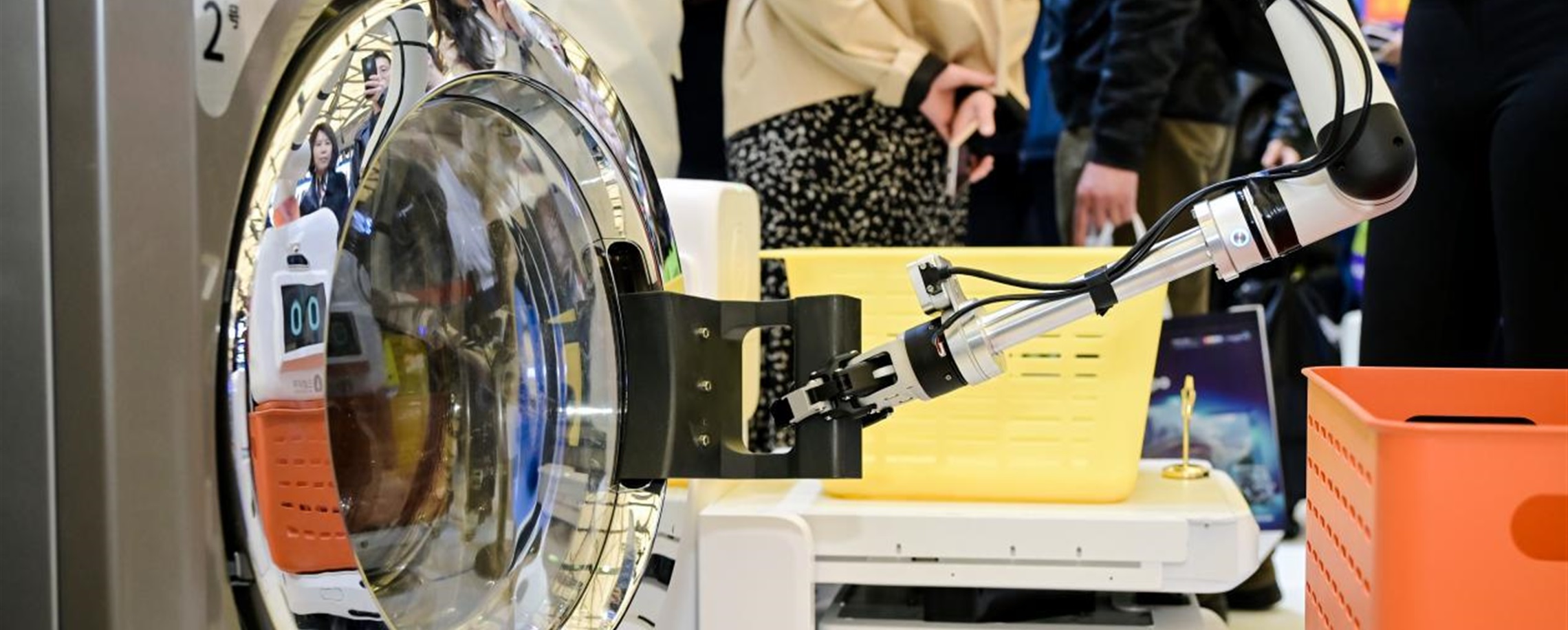
Midea, a leading Chinese electrical appliance manufacturer that is turning its focus to embodied robots, posted 2025 profit of 43.95 billion yuan (US$6.36 billion), up 14 percent from a year earlier. Revenue rose 12 percent to a record 456.45 billion yuan. Midea produces lighting, kitchen and laundry appliances, microwave ovens, and heating, ventilation and conditioning units. It also is an equipment maker for major international brands. It expanded its scope in 2016-18 with the acquisitions of Toshiba's home appliance unit, German robotics company Kuka and the Eureka floor care brand. Midea is moving quickly into new technologies, pledging investment in AI and robotics of 60 billion yuan over the next three years. In December, it debuted the "ultra" humanoid robot Miro U, which has six arms and runs on wheels.
Sany Heavy Profit Jumps on Overseas Growth
China's Sany Heavy Industry reported a 41.2 percent rise in net profit for 2025 to 8.41 billion yuan (US$1.22 billion), as revenue climbed 14.7 percent from a year earlier to 89.2 billion yuan. The company said growth was driven by a recovery in China's construction machinery sector and continued expansion overseas, supported by the launch of around 80 new products during the year. International operations remained a key pillar, with revenue from overseas markets rising 15.1 percent to 55.9 billion yuan, accounting for 64 percent of total core business revenue. Sany has prioritized globalization as its top strategy, accelerating its transition from a traditional export model to a more localized global operations approach, including manufacturing and service networks abroad. By segment, excavators, cranes and concrete machinery were the main contributors to revenue growth, reflecting improving demand both domestically and in international markets.
Hans's CNC Posts Strong Profit, Revenue Gains
Han's CNC Technology, a maker of printed circuit boards, reported 2025 profit surged 1.7 times to 824 million yuan (US$119 million) as revenue surged 73 percent to 5.78 billion yuan. Founded in 2002, the Shenzhen-based company designs, produces and sells specialized computer-controlled equipment used to make the boards that wire components to one another in an electric circuit, boards used in nearly all electronics products. The company raised HK$4.8 billion (US$618 million) in an initial public offering in Hong Kong in February, becoming the first in the printed circuit board equipment sector to achieve a dual listing in both the Chinese mainland and Hong Kong. According to its prospectus, it was China's largest specialized board PCB equipment manufacturer by revenue in 2024, with a market share of 10 percent.
Lianhua Narrows Losses
Lianhua Supermarket Co, the Hong Kong-listed subsidiary of Chinese retail giant Bailian Group, reported a 2025 revenue of 17.75 billion yuan (US$2.57 billion), down 9.9 percent from a year earlier. It narrowed its operating loss by 76 million yuan to 181 million yuan, narrowed by 76 million yuan. In revenue from its major segments, hypermarkets fell 14.7 percent, supermarkets lost 5.9 percent and convenience stores were down 11.2 percent. The company was operating in a market of weaker consumer spending and fierce competition from e-commerce.
Shenhua Energy Profit Declines on Lower Coal Prices
Shenhua Energy, China's largest coal producer, reported 2025 profit fell 5.3 percent to 52.85 billion yuan (US$7.65 billion), slightly better than forecast. Revenue decreased 13.21 percent to 294.91 billion yuan. The company said it sold 430 million tons of coal in 2025, down 6.4 percent, and cited supply and changes in the industry and lower prices. The company is operating amid a national goal of reducing use of fossil fuels and going green. The company last year completed the 853-billion-yuan takeover of coal miner Hangjin Energy.
Editor: Yao Minji
In Case You Missed It...
 Apr 1, 2026