For EU Companies, the Bets on China Haven't Changed, the Odds Have
For decades, the logic for foreign companies was simple: Produce in China with cheap labor, stay to tap the world's biggest consumer market, and navigate the rules amid hopes they will swing more in your favor.
That strategy has been somewhat upended by rising geopolitical and trade tensions, a slowing economy and a new China reality.
The country has quietly become something it was never expected to be for many foreign companies – a serious technological competitor.
The 2026 Business Confidence Survey by the EU Chamber of Commerce in China, released earlier this year, offers a barometer of this shifting reality.
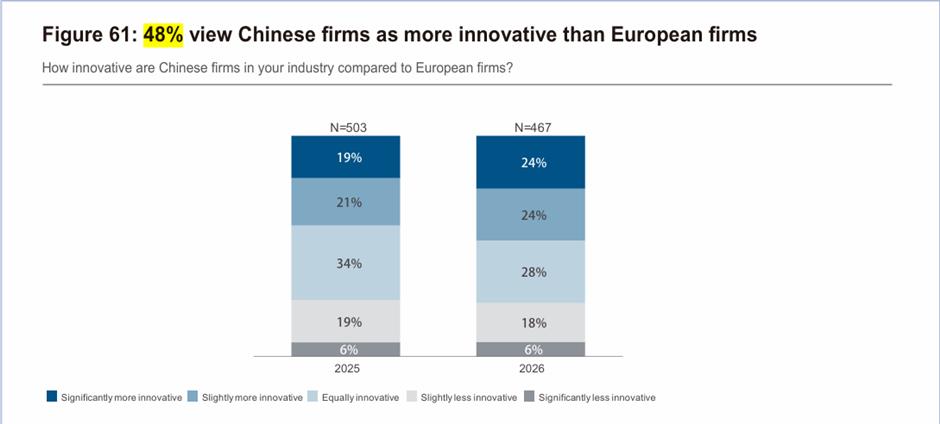
Nearly half (48 percent) of European members surveyed reported that Chinese firms are now more innovative than their European counterparts – a figure that would have been unthinkable only a decade ago. Those who hold the opposite view only account for 24 percent.
The number of respondents saying doing business in China has become more difficult did drop to 68 percent from 73 percent, but rising competition from domestic rivals remained a worry. That was the second-most cited challenge to operating in China, flagged by 47 percent of respondents and rising to 76 percent in the machinery and medical device sectors.
However, the number of companies describing the Chinese environment as politicized dropped below half for the first time since the COVID pandemic. A small but noticeable movement.
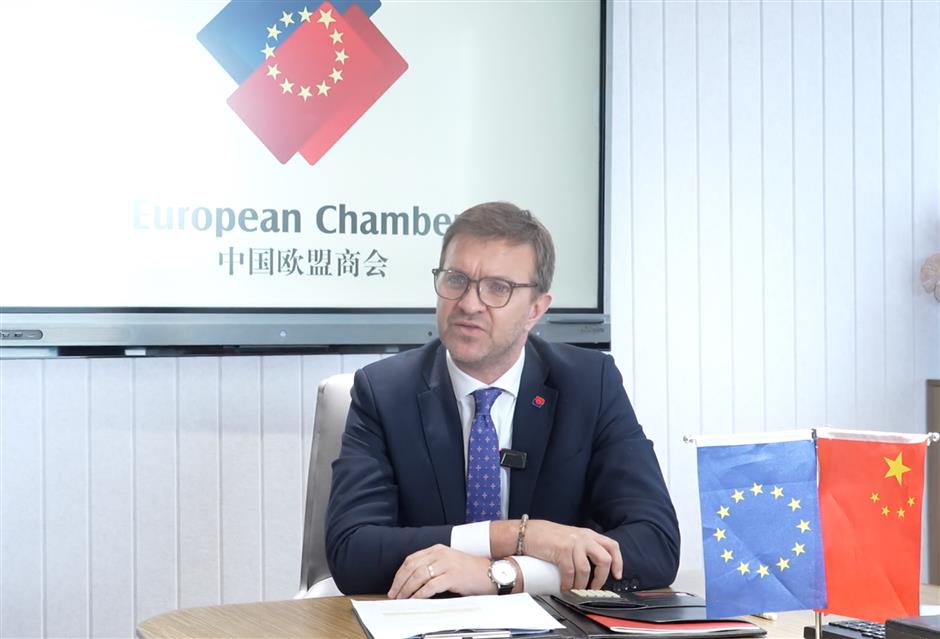
Carlo D'Andrea, chairman of the Shanghai branch of the chamber, told China Biz Buzz in an exclusive interview that many European companies still rank China among their top-three destinations for new investment, although that share is trending down.
"You have competition from privately owned Chinese companies," he said. "And then you have the geopolitical crises we see globally. And we want a level playing field."
The competitive pressure from domestic Chinese firms is no longer background noise. It's become the story of investment in China.
Chinese companies have become globally competitive in electric vehicles, industrial automation and AI applications, while rapidly narrowing the technological gap in semiconductor manufacturing.
DeepSeek's open source AI model, released in early 2025, outperformed benchmarks from Western giants at a fraction of the cost. Ford's chief executive, after visiting China in mid-2025, described the technological advances in Chinese electric cars as "the most humbling thing" he had ever seen.
D'Andrea acknowledged this shift in dynamics but declined to outright label it as bad news.
"The fact that even more innovative Chinese companies in some sectors are competing with us is positive," he said, "because it raises the bar – including the level of intellectual property protection for the entire ecosystem."
He added, "Some of our members said they are more innovative here than elsewhere in the world. In some sectors, what's learned from China goes back to headquarters."
The data and headlines back this up.
German engineering giant Bosch has committed about 10 billion yuan (US$1.38 billion) to an intelligent driving research and development hub in Suzhou, one of China's leading advanced manufacturing hubs. It is focused on full-stack assisted driving solutions, an area China is deploying fast and at scale.
Danish industrial giant Danfoss announced a further 2.7 billion yuan investment to build its second Chinese base – the 10th capital increase in China over two decades.
By 2023, China accounted for 15 percent of Bayer Consumer Health's global innovation portfolio, the highest share of any single market.
The positive message is that competition makes you sharper. The skeptical version: You're describing the conditions of your own displacement.
The chamber's survey also found that 75 percent of respondents said their China operations are more efficient than elsewhere, and 94 percent described China as important for sourcing. Yet total commitments of fresh investment continue to drop.
There is a widening gap between European boardrooms and operational reality on the ground. Headquarters increasingly ask, "Are we doing too much in China?" Local management teams often answer that business has rarely been more competitive yet also rarely more innovative.
"Companies need to find the right level of exposure to China, balancing flexibility and efficiency, while accounting for the broader geopolitical implications," D'Andrea noted. "It depends a lot on the sector you're operating in. There are some sectors where you are extremely welcome in China, and some sectors where the interest is more limited."
What European companies object to is not competition per se, he added, but competition on unequal terms.
"We want equal treatment. A level playing field," he stressed. "And then let the consumer decide which is the best product."
He cited cross-border payments, export controls, public procurement and the exclusion of foreign companies from Chinese mainland stock listing as key areas needing improvement.
Shortly after the interview, on June 22, Beijing announced 15 new measures on foreign investment, including a plan to support qualified foreign-funded companies seeking to list on Chinese mainland stock exchanges. A signal, at least, that the concerns are being heard.
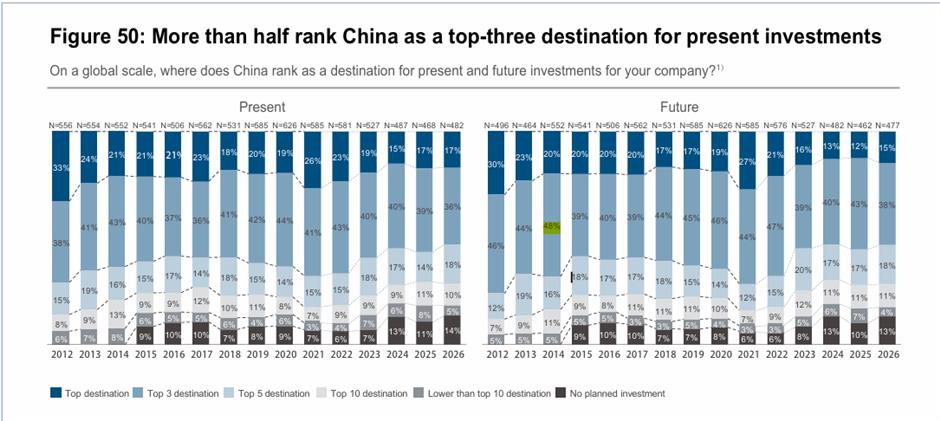
In another chamber survey conducted at the end of April and early May, 79 percent of respondents said this year's Middle East conflict has had a negative effect on their operations, with supply chains, logistics and shipping all disrupted by a crisis far from China. And yet, there has been no noticeable exodus of European companies.
"We do business in China for China, and sometimes in China for the world," D'Andrea said.
That distinction matters. China's status as the world's second-largest economy, its innovation infrastructure and its consumer base are not abstractions; they are operational realities that keep boardrooms committed.
What is changing is the posture. The era of unconditional engagement is over. What's replacing it – managed interdependency, selective cooperation, calibrated exposure – is harder to execute and often difficult to explain to shareholders.
European companies are still betting on China. They are simply placing that bet with a far clearer understanding of both the opportunities and the risks. The China bet hasn't changed. The odds have.
Editor: Liu Qi