The 'Hydration Break' Isn't a New Word; It's a New Warning
My father-in-law has recently become obsessed with the FIFA World Cup 2026. He doesn't merely watch; he studies, taking meticulous notes during live broadcasts and replays of matches he missed.
During the recent Dragon Boat Festival, he suddenly asked me, "What is a hydration break?" Hearing a Chinese nonagenarian flawlessly pronounce this sports jargon in English momentarily stunned me.
He had seen the graphic on screen and, after consulting his English-Chinese dictionary, found "hydration" translated as "水合" (chemical bonding with water), which made little sense in context. As an English professor, I explained it simply: a mandated pause for players to drink water. He nodded, seemingly satisfied with my explanation.
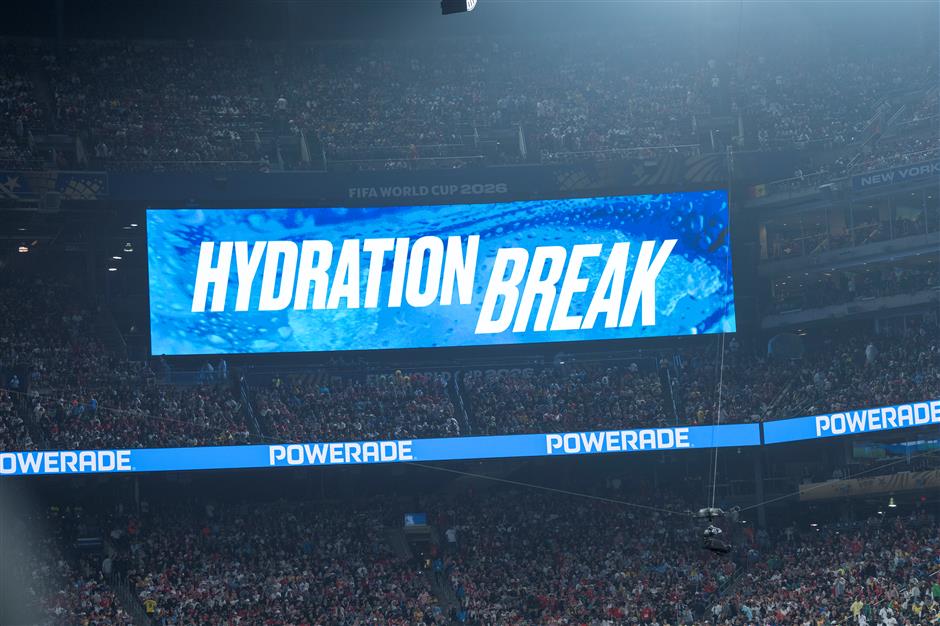
As a lexicographer, I was initially convinced "hydration break" was a neologism born of this tournament. I was wrong. The term is a mature, established phrase in sports medicine, rooted in the Greek element "hydro" for water. Yet, its sudden ubiquity highlights a fascinating intersection of linguistics, sports policy and commerce.
Dictionaries are supposed to reflect how language is used, but in this case, the rulebook dictated the vocabulary before the public even knew the expression. The phrase hasn't evolved; rather, the rules of the beautiful game have been rewritten around this very term, thrusting this niche jargon into the global spotlight.
As of now, no dictionary has officially enshrined "hydration break." But given the sheer volume of discourse surrounding this tournament, it is highly likely that the Oxford English Dictionary will eventually add it to its hallowed pages, formally cementing this phrase into the English lexicon.
Historically, hydration breaks were rare, triggered only by extreme heat. During the 2014 World Cup in Brazil, referees were permitted to halt play if temperatures exceeded 32 degrees Celsius. However, for the 2026 tournament spanning the United States, Canada and Mexico, FIFA instituted a rigid mandate for a three-minute break around the 22nd minute of each half, regardless of venue, weather, or roof coverage.
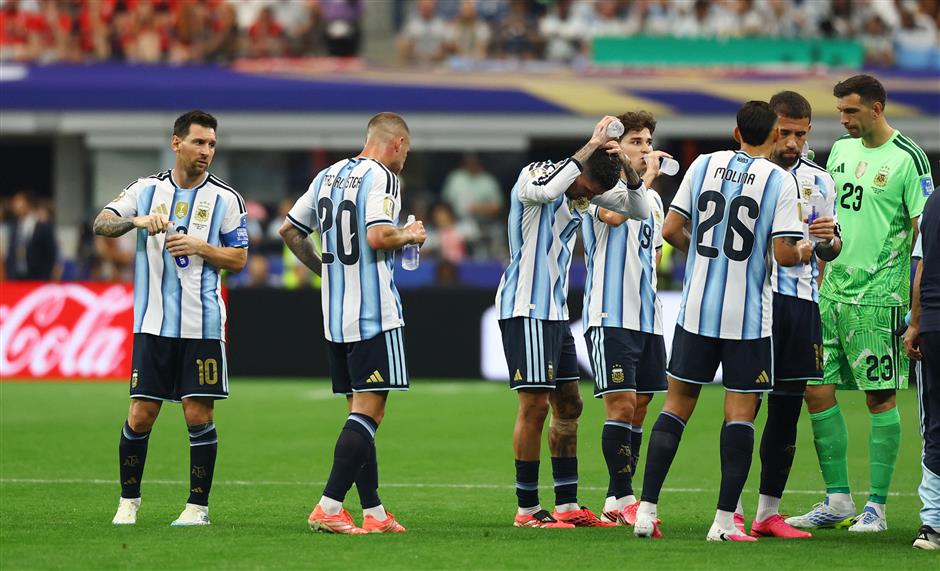
While framed as a vital player-welfare initiative against heat stress, this blanket policy has sparked fierce debate. Critics argue it artificially segments football's fluid 90 minutes into four quarters, à la popular American sports like American football, basketball and ice hockey.
This skepticism is well-founded: Fans in Vancouver have booed mandatory breaks during heavy rainfall, and matches in air-conditioned stadiums are still halted. The discontent has become so vocal that stadium DJs are now forced to deploy a tactical countermeasure: karaoke. From John Denver's "Take Me Home, Country Roads" to The Killers' "Mr Brightside," blasting universal singalongs has become the only way to drown out the jeers and mask the awkward transition to commercial breaks.
More cynically, many view the mandate as a Trojan horse for commercialization. Broadcasters are permitted to air commercials during these three minutes, effectively creating lucrative broadcast pauses. When Fox Sports' ad break in the opening match ran long, forcing players to stand idle on the pitch, the phrase "hydration break" took on a pejorative tone online: "named for water, driven by money."
Yet, beyond the lexicon and the ledger, the break has fundamentally altered the sport's tactical rhythm. Coaches now treat it as a mid-half timeout to reorganize, frantically adjusting tactics and substituting players to exploit fatigue, turning a physiological necessity into a strategic weapon. Statistics from the first matchday bear this out: shots before the first break totaled 115, compared to 170 in the period immediately following. Momentum is no longer organic; it is manufactured in three-minute increments.
Ultimately, "hydration break" is not a new word, but it has become a new cultural flashpoint. It forces us to ask whether modern football is still a continuous, flowing contest, or merely an increasingly commercialized, segmented product.
As my father-in-law continues to take notes, perhaps the most important lesson of this World Cup isn't found in the dictionary, but in recognizing when the language of player safety is being used to write a different story entirely.
(The author is a professor of English and college dean at Sanda University, Shanghai.)
Editor: Liu Qi
Popular Reads
The 'Hydration Break' Isn't a New Word; It's a New Warning
'The Magic of Tomorrowland' Returns to Shanghai in October
![[Expats & Ailments] Shanghai Surgeons Use Innovative Technique to Restore Mobility in 24 Hours](https://obj.shine.cn/files/2026/06/25/1cb4c9ad-ee39-4edf-8193-a2564e7b60c9_0.jpg)
[Expats & Ailments] Shanghai Surgeons Use Innovative Technique to Restore Mobility in 24 Hours