Ease the 'Electronic Whip' on Couriers: Shanghai Pushes Algorithm Reforms
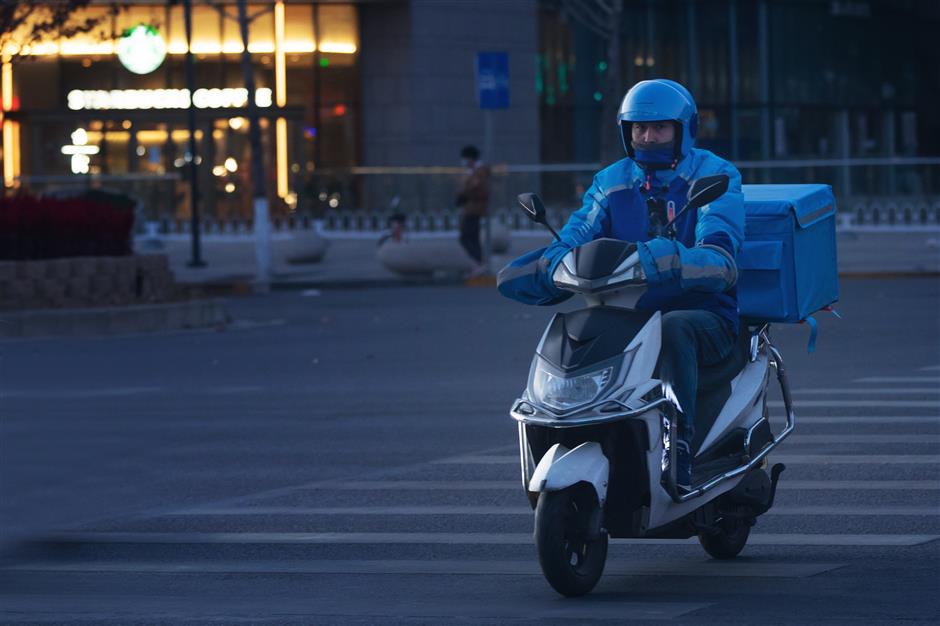
The government of Shanghai has been urging food delivery platforms to refine algorithms and alleviate pressure on couriers – a targeted effort that has yielded noticeable progress this year.
While the courier industry has made daily life far more convenient for people, it also faces criticism for placing immense pressure on couriers. In some cases, this pressure has led to traffic risks: Couriers ride mopeds recklessly to meet tight delivery deadlines, ignoring traffic safety in the process.
Against this backdrop, Shanghai brokered China's first-ever agreement governing platform algorithms and labor rules this April. The deal, signed by the major food delivery platform Ele.me (now rebranded as Taobao Instant Commerce) and representatives of Shanghai couriers, centers on boosting fairness and transparency across key algorithmic systems – including pricing, order dispatching, delivery time estimates and route planning.
Then in September, a nationwide agreement followed, focusing on addressing couriers' top daily concerns: wage security, labor protections and welfare benefits.
According to Taobao Instant Commerce, its revamped algorithm now boasts a 90 percent combined-order rate. It means long-haul deliveries are paired with nearby short-distance orders and assigned to a single courier; delivery time windows for longer routes are also adjusted dynamically to avoid piling on unnecessary stress. Orders involving heavy, bulky items or requiring stair climbing now carry more weight in the platform's pricing algorithm – putting the "more effort, more reward" principle into practice.
"After the algorithm was optimized, I personally feel it's more human-centered," said Che Zhenyu, a Taobao Instant Commerce courier serving in Putuo District.
Che moved to Shanghai from his hometown in north China's Shanxi Province in 2018 and has been delivering food for seven years. "Especially for newcomers unfamiliar with the routes, their earnings are up, and they're getting fewer fines," he added.
Che told Shanghai Daily that before the update, the platform's route suggestions would sometimes direct couriers to ride against traffic. Since the algorithm was revamped, he hasn't encountered a single case like that.
The platform's smart helmet, equipped with an artificial intelligence assistant, also helps. It offers voice interaction for tasks like order acceptance, restaurant arrival and delivery completion. This technology dramatically cuts down on traffic hazards caused by couriers using their phones while riding.
Couriers can buy this smart gear at discounts of up to 70 percent, or redeem them with points earned through deliveries. Che estimates it takes about two to three months of regular shifts to rack up enough points for a helmet.
He also noted that the system now recognizes factors like traffic jams or slow food preparation at restaurants, sparing couriers from unfair penalties. "The algorithm knows when you're stuck in traffic."
To go further, the platform has rolled out a "no penalty for overtime" policy. A "Service Score" system has been introduced this year. Instead of fining couriers for late deliveries, it awards points for on-time drops and deducts points for delays. This way, couriers can earn more based on how hard they work and the quality of their service.
This pilot program has already been implemented in dozens of cities, including Shanghai, receiving positive feedback from both couriers and customers, and is expected to expanded nationwide soon, according to the Taobao platform.
High-risk, high-intensity job
According to Xinhua news agency, China is the world's largest food delivery market, with 545 million online food delivery service users and a workforce of over 10 million couriers.
A report by iiMedia Research states that China's online catering and food delivery market scale reached 1.6357 trillion yuan (US$231.4 billion) last year, a year-on-year increase of 7.2 percent. The market size is expected to hit 1.9567 trillion yuan by 2027.
However, the working conditions of food delivery riders have long drawn public concern.
In 2020, an investigative report titled "Food Delivery Riders, Trapped in the System" sparked widespread debate in China. It revealed how efficiency-driven algorithms kept shortening delivery time, putting riders under extreme pressure. One rider described his work as "racing against death, competing with traffic police, and befriending red lights."
Last month, another major on-demand food delivery service platform, Meituan, aired a controversial commercial on China Central Television. It featured a female designer who switched to food delivery, claiming she could buy an over 10,000-yuan camera after three months of deliveries and was "enjoying the scenery." The ad triggered backlash for glamorizing a high-risk, high-intensity job and ignoring riders' real challenges.

This issue is hardly unique to China. In his 2020 book "Worked Over: How Round-the-Clock Work Is Killing the American Dream," American sociologist Jamie K. McCallum introduces the concept of the "electronic whip." He explains how technology, much like the overseer's whip of the past, drives low-income workers such as delivery riders, Amazon warehouse employees, and laundry staff at Disneyland to race against time, pushing them to the point of overwork – and in one case, even death.
Rider representatives, together with local authorities such as Shanghai's social work department, public security bureau, and Internet information office, are involved in Taobao Instant Commerce's 2025 algorithm reform.
Wang Haisu, a member of Shanghai's traffic police, explained that while handling traffic violations, police found the algorithm directly impacted riders' delivery times and salary assessments, which in turn led to illegal actions such as running red lights and riding against traffic.
Traffic violations and accidents involving riders have declined since the new algorithm's rollout.
"It's simply unfair to keep cutting delivery time just to boost efficiency or improve customer experience," Wang said.
Other major platforms are rolling out similar policies nationwide. According to China National Radio, Meituan has piloted a no-penalty policy for late deliveries in over 70 cities, replacing fines with a points-based evaluation system. JD.com recently announced a similar pilot program across 25 cities.
Riders' social security is gaining attention, too. JD.com announced it will provide full social insurance coverage for full-time delivery riders starting in March. Meituan announced in October that its pension subsidy program will expand nationwide to cover all riders.
Taobao Instant Commerce is rolling out a social insurance subsidy program for couriers too. It will subsidize at least 50 percent of pension and medical-insurance costs for riders who consistently complete orders and choose to enroll, while team leaders and "honor riders" will receive a full subsidy.
The program already covers 10 cities and will expand to all its directly operated cities by year's end, said the company.
Rider Che, a team leader who had never enrolled in pension or medical insurance before, only started doing so this May, thanks to the subsidy.
"It's a big help," he said. "People get sick sometimes. Now if I catch a cold, I won't have to pay out of (my) pocket. I can use insurance."
Editor: Liu Qi
In Case You Missed It...
 Sep 12, 2026
![[Weekend Escape] Yellow Mountain & Its Surrounding Villages](https://obj.shine.cn/files/2026/09/10/adb6c380-f548-43cd-a387-f3e924afc345_0.png)
![[Movers & Shakers] Nick Brown of FlowCycle Is Creating Bali in SH](https://obj.shine.cn/files/2026/09/11/34d53c76-ca94-417b-8777-83f87610b85d_0.jpg)