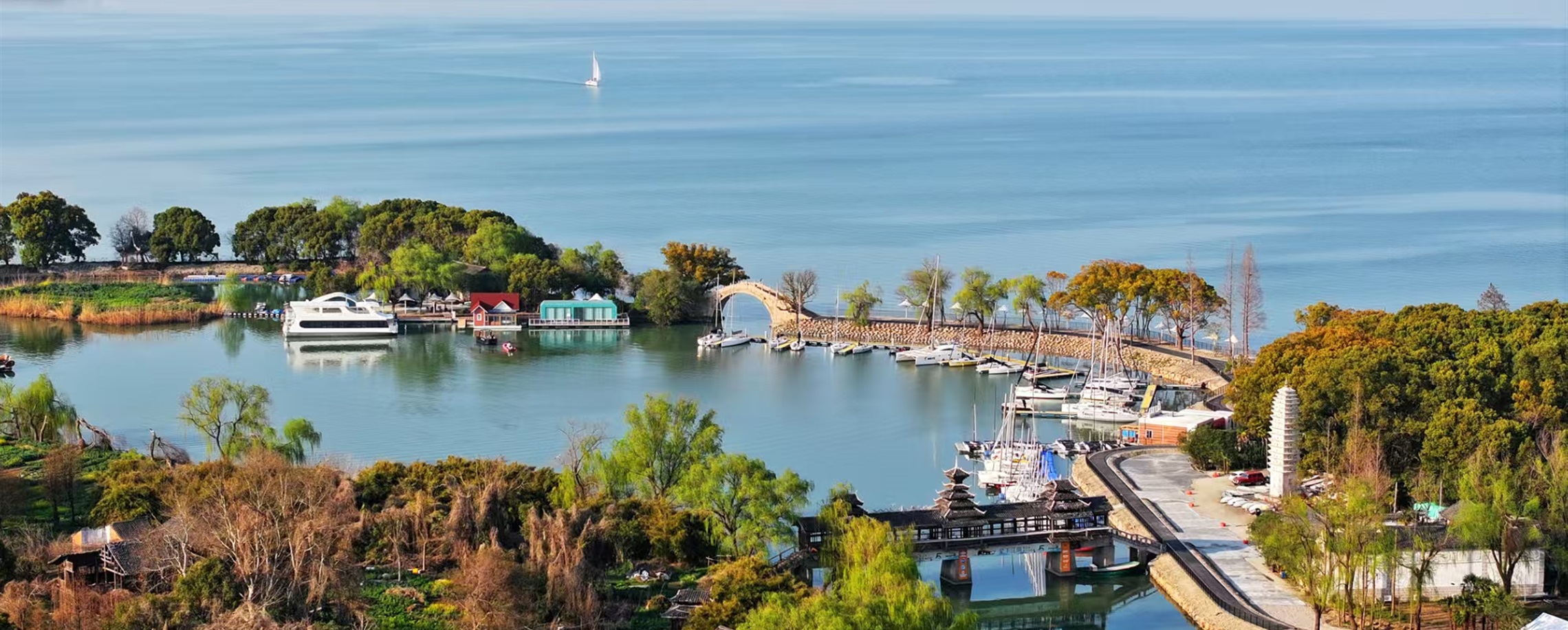
With Shanghai's Ever-Expanding Green Space, a City in Nature Takes Shape
As I rambled through a newly opened park in Shanghai, featuring dense forests and winding waterways, on a chilly afternoon earlier this week, a lightly dressed old man caught my attention as he ran in small but steady steps, sweat streaming down his cheeks.
I struck up a conversation with him as we both stopped on a bridge in the 33-hectare Xinyang Park in Putuo District, which first opened to public on February 2. There's an iron gate on the bridge that symbolically separates Xinyang Park from an adjacent park in Baoshan District. When I visited the park in Baoshan at the end of last year, I found the gate was closed, as Xinyang Park was still under construction back then. Now a small part of the gate is open, allowing pedestrians, including walkers and joggers, to enjoy the scenery of both parks. (Motors or bikes are too big to pass through the partially opened gate.)
"You look great for your age. Are you around 65?" I asked, trying to have an honest guess. With a radiant face and inconspicuous wrinkles, he looked very fit.
"I'm 75," he replied with a smile, as he edged his way through the narrow open gate into Fengxiangzhixiu Park in Baoshan.
"Wow, you really don't look that old," I exclaimed. "By the way, how far have you run today?"
"About 6 kilometers round trip – half in Putuo, half in Baoshan," he replied.
He said he lives in Baoshan, and before Xinyang Park opened, he could only run about 3 kilometers in Fengxiangzhixiu Park. Now he could double his workouts by running across the two districts.
"It's impressive for a 75-year-old man to run like that," another old man who stood by us said to me, as the elderly runner went on his way back home.
This second old man I encountered at the "border" between the two parks looked in trim, except he was bespectacled, and the lenses were thick with circular ridges, resembling the base of a bottle.
It turned out that he was also a septuagenarian – he was born in 1953. He had just locked his bike on the bridge and was ready to walk into the park in Baoshan when he overheard our conversation and chipped in.
Seeing that I was a fellow wanderer in nature, he seemed to have felt an instant connection – a joy indeed of having discovered a kindred soul. He then enthusiastically elaborated on how to explore the ever-expanding green landscapes in the vicinity.
"I live in Jiading District, and Xinyang Park is only about a 4.5-kilometer ride from my home," he told me. "Xinyang is in Putuo District but is very close to both Baoshan and Jiading."
What he likes most about Xinyang Park, he said, is that part of the 2,136-kilometer-long Shanghai Greenway passes through it, so people can bike here. Some other parks, including the adjacent one in Baoshan, ban bicycles.
Kids play in the newly opened Xinyang Park in Putuo District.
Running as therapy
He said he began to run regularly near his home in 2017, when a 4-kilometer round-trip pedestrian path along a river in Jiading was completed. That river is 1 kilometer from his home, so he would run 6 kilometers every day, unless it's raining.
With a steady increase of parks and trails around his home over the past few years, he now covers at least 15 kilometers every day through a combination of running and cycling, except on rainy days.
"My father had diabetes, and my younger brother, who is 71 years old, was diagnosed with diabetes when he was in his 40s," he told me. "My fasting blood glucose level used to increase slowly from around 5.1 mmol/L to 5.9 mmol/L, but my doctor said the condition could be reversed if I kept up with outdoor exercises like running, brisk walking or biking."
He took his doctor's advice. Thanks to regular exercises in the bosom of nature, his fasting blood glucose level has remained below the critical 6.1 mmol/L threshold, preventing an onset of diabetes.
"A regular physical check last year found that my prostate test results were slightly abnormal, but my doctor said that was nothing to worry about," I told him. "And his only advice for me was to keep exercising and avoid prolonged sitting."
"That's right," he assured me. "Don't worry. Keep exercising and you will be fine."
As we chatted away, I suddenly remembered a park to the south of Xinyang, called Qidonglin Park. The two are separated by a highway. When I explored Qidonglin last year, I failed to find any convenient way leading to the construction site of Xinyang.
"Is there a pedestrian path linking the two parks?" I asked the 73-year-old man.
"Well, you've come to the right person," he said. "That's up my alley. Follow me, and I'll show you the way."
He then unlocked his bike to walk it as we headed south to Qidonglin Park, also in Putuo. To show me the way to Qidonglin, he abandoned his previous plan to stroll in Fengxiangzhixiu Park in the north.
For about half an hour, he guided me through a "secret path" – a well-forested riverfront trail that passes under the aforementioned highway – which eventually led to Qidonglin Park. In Chinese, Qidonglin means the area where Shanghai's nearly 100-kilometer-long Outer Ring forest belt was first built in the 1990s. (Qidong means to start, while lin means a forest.)
Soon it was getting dark and he said he had to go home to take care of his wife. A few years ago, his wife had back surgery for a herniated disc. Since then, he has kept up with outdoor exercises alone in neighborhood parks.
"We used to travel far and wide together, but now I exercise by myself – for about an hour and a half every day around our home. That's why parks and greenways at our doorstep matter," he explained.
Waving goodbye, he said: "Till we meet again."
I returned with a smile of gratitude.
A life we dream of
His story reminded me of a 68-year-old man I happened to meet in a mini park by the Huangpu River last week. I was strolling along the riverside path in Huangpu District when I saw an old man from a distance who was doing shadowboxing and arm swings in a quiet corner near Nanpu Bridge, which featured various trees and shrubs.
An old man exercises in a mini park by the Huangpu River.
I said hi to him as I drew nearer, and his face lit up in a warm response. I learned in our casual conversation that he was 68 and had retired more than 10 years ago, because he used to engage in front-line factory work involving exposure to hazardous substances.
Moving closer, I took a good look at him. He had a face with a ruddy complexion and a healthy glow, with hardly a wrinkle in sight. I took off my hat and mask to show him my gray hair and wrinkles. I told him I would turn 60 this May.
With an understanding smile, he said that over a decade of simple but regular exercises by the river did help him stay in good health.
"It takes me only five minutes to come here from home on a bike," he told me. "This area used to be dominated by docklands, but it has since transformed into a riverside greenbelt."
He was referring to a 3.3-kilometer-long area in Huangpu District that was upgraded into an esplanade in 2017. This place used to be a shipyard, which was adapted into a World Expo site in 2010 and then remained largely closed.
In 2017, the 45-kilometer-long waterfront space along both banks of the Huangpu River was fully connected, including the 3.3-kilometer-long stretch in Huangpu District that transformed into an open green space with a connected footpath and many characteristic gardens, including those featuring herbal plants and rocks.
This year, Shanghai is ready to further spruce up its waterfront space, including that in Huangpu District, while building 100 more parks across the city.
People run along the riverside space in Huangpu District.
Not far from the 68-year-old man's exercising ground, a rock garden was being renovated into a multi-level riverside plaza with tiered platforms, featuring more plants and benches. It was closed for reconstruction at the end of last year and is scheduled to reopen in April.
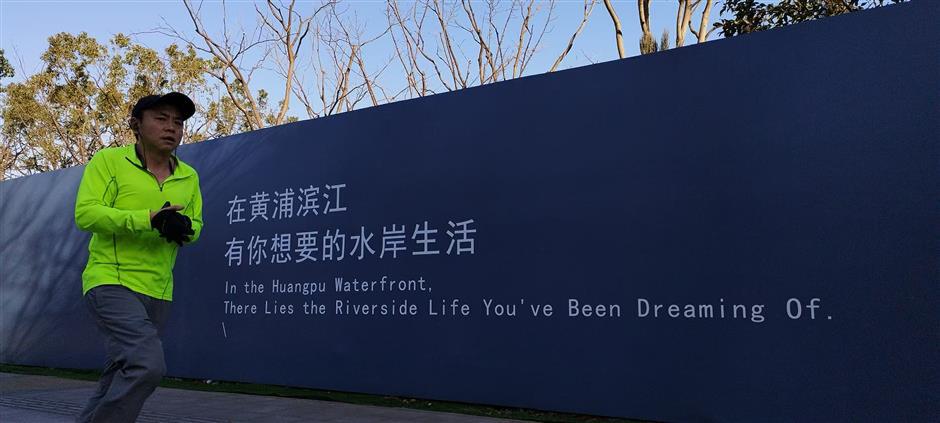
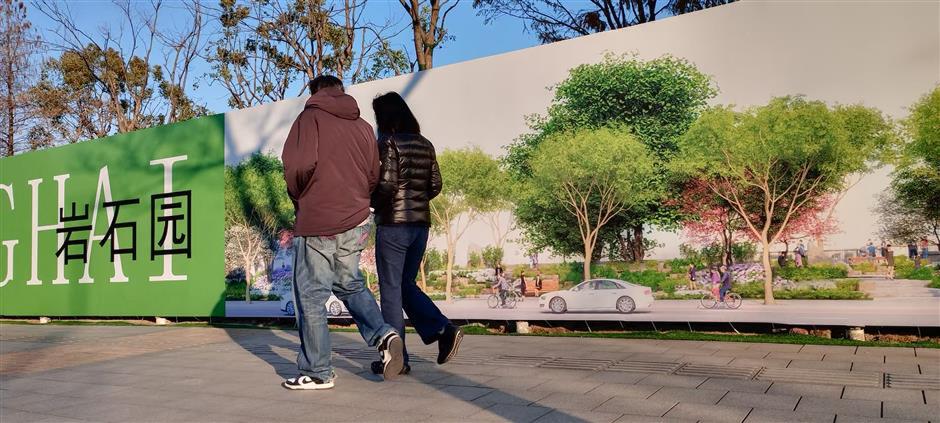
Near Lupu Bridge, which is about 3 kilometers from Nanpu Bridge, the walls of a big courtyard have been removed so that previously walled-in green space, which is now being further spruced up, will soon be accessible to the public.
As I walked along Huangpu District's waterfront between the Nanpu and Lupu bridges, I came across another man in his 60s, who was playing the French horn. I stood by the river and listened to him playing the instrument, while watching ships and boats come and go in the distance. When he paused for a break, I went up to say hello, and we struck up a conversation.
He said he came from Wuhan City in central China's Hubei Province to reunite with his daughter's family for the upcoming Spring Festival.
"I practice the French horn twice a day and run 10 kilometers every day along the river," he revealed. "I used to run half marathons when I was younger, and I've traveled the world. But as age catches up with me, I have settled for a daily 10-kilometer run along the waterfront, whose scenery I have grown to love."
"Still, I like the riverside landscape in the Pudong New Area better," he said with a smile. "My daughter's family used to live in a riverside area in Pudong, where I would run each time I came."
A day later, I visited Pudong's waterfront between Nanpu and Lupu bridges for the first time, and found it to be more spacious indeed, and in some sections one could even feel a greater sense of wilderness.
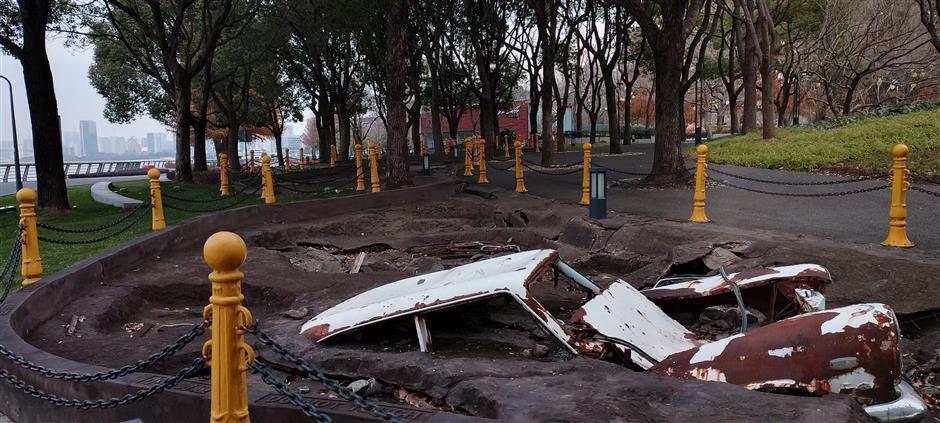
A piece of installation artwork caught my eye as I sauntered along Pudong's waterfront near Lupu Bridge.
A discarded car was half buried in the soil, its rusted shell jutting out in stark contrast to the lush trees surround it. It made me wonder at nature's hidden dynamics.
I went further south along Pudong's riverside path and soon found myself in Houtan, a wetland park built in 2010 on a former industrial site. Creeks, lakes, reeds and terraces inspired by traditional Chinese agricultural landscape have made the park a habitat for wildlife as well as a haven for pedestrians.
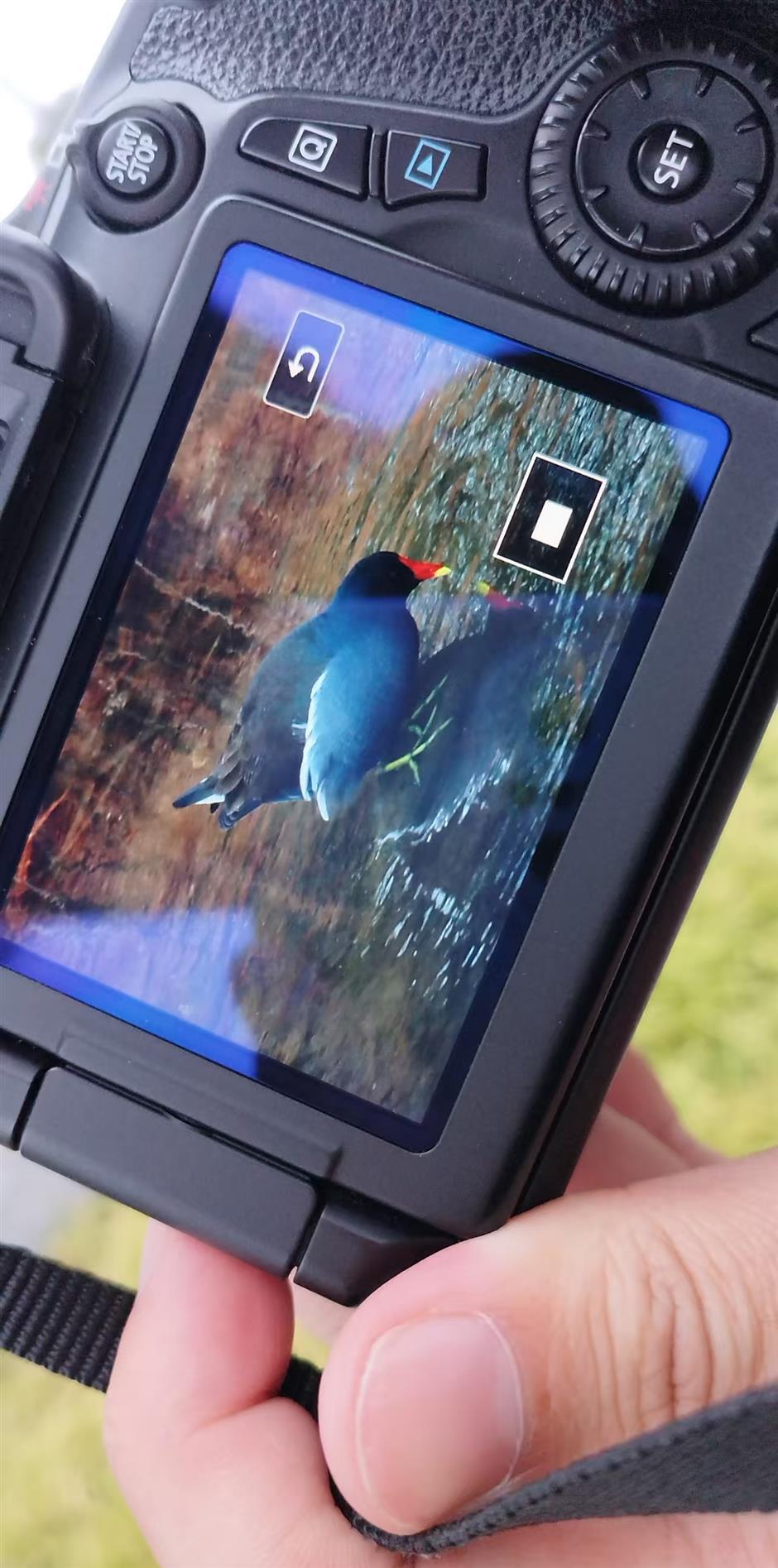
I ran into a young man who was taking photos of wild birds. He showed me the pictures of a moorhen and a grosbeak he had taken. He said he came all the way from suburban Songjiang District simply because he had heard from other bird watchers that Houtan harbors a rich diversity of wildlife.
A city in nature
As a nature nerd, I was once reluctant to visit Shanghai's downtown and Outer Ring highway areas, as my limited experience prevented me from seeing a bigger picture, in which public green space there has actually been expanding year by year in the form of more parks, especially those with remarkable wetlands.
I realized how "biased" I had been only after I began to travel slowly and intensely along the Huangpu River and through the city's Outer Ring forest parks a couple of years ago.
Now I've covered all the seven districts – Putuo, Pudong, Baoshan, Jiading, Changning, Xuhui and Minhang – where the city's nearly 100-kilometer-long Outer Ring forest belt has gradually transformed into parks, mostly with improved wetland ecosystems.
In those parks, I've seen elderly people rambling for fresh air or poetic inspiration under trees and around marshes. I've seen young adults jogging or cycling after work and watching birds at weekends. I've seen children drawing pictures with fallen leaves or fruits as their models.
I've also covered many parts of the public green space along the Huangpu River, including riverside parks and pedestrian paths, in an effort to understand the city better through intense travel on foot.
I've seen previous monoculture turfs transforming into habitats with diversified plants that attract beneficial insects. I've seen people playing basketball, football or musical instruments by the river. In particular, last year I saw myriad visitors from across the country coming to the 2025 Shanghai International Flower Show.
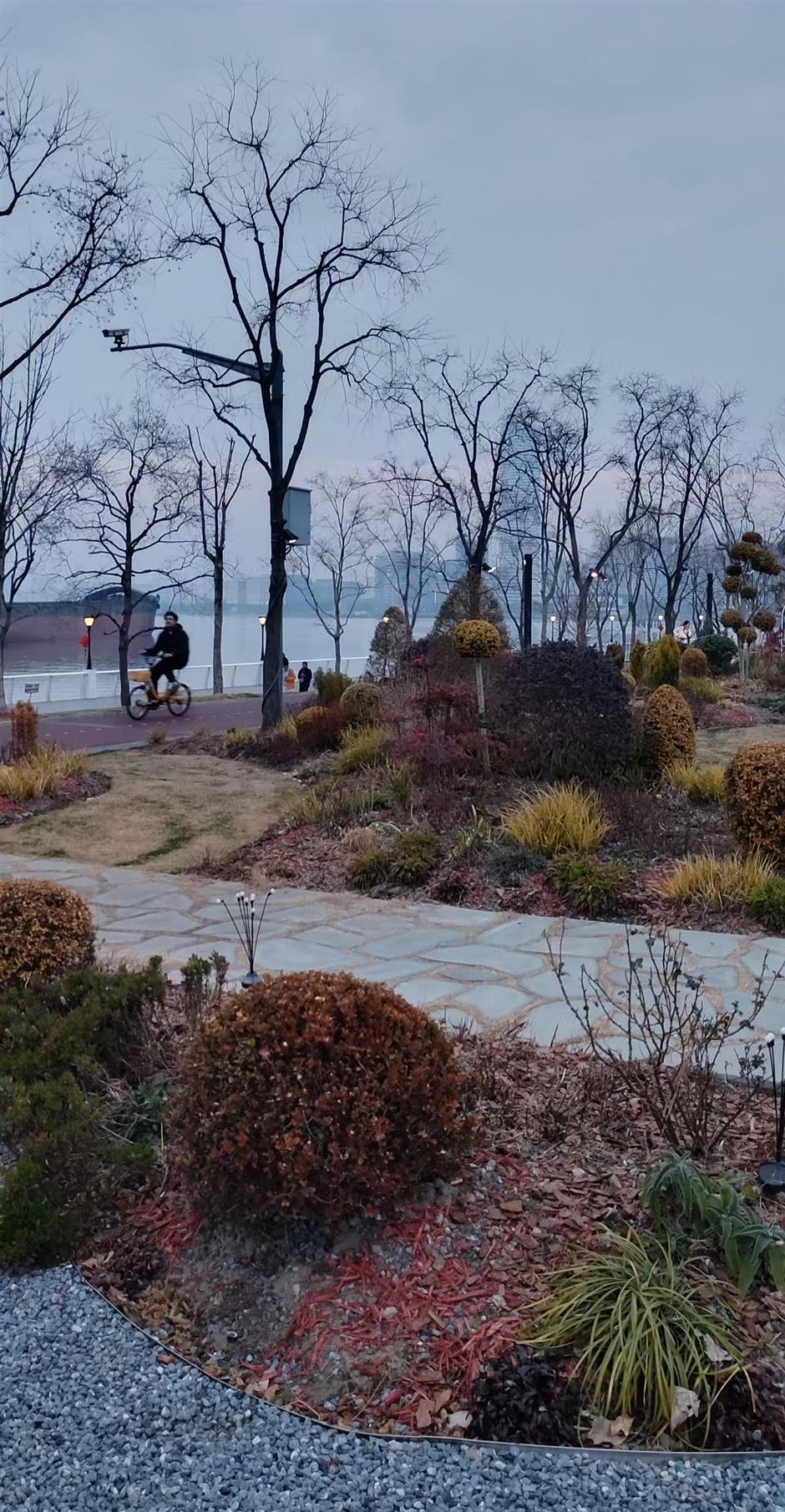
When I revisited the site of the flower show in the New Bund area in Pudong on Friday, I found most mini gardens and habitats created last year for the international event remained in good shape, giving color to Pudong's riverside landscape.
From the flower show venue, I walked all the way south for about an hour and a half to Sanlin Town, where the largest cypress wetland in Shanghai's central urban area was taking shape. Although it's not formally open yet, it has gone viral on social media as netizens come to take pictures and compare it to Altay in northwest China's Xinjiang Uygur Autonomous Region,which is known for the untouched beauty of forests, including deciduous cypress.
When I first visited the 10.7-hectare cypress wetland in Sanlin on Thursday, I found it was temporarily open. A few tourists sauntered in this wetland park with about 3,500 fir trees, while water birds skimmed swiftly over the surface of a swamp or flew low over a river.
To help birds, insects and plants grow in an environment with minimal human intervention, designers have created a cedar forest island inaccessible to people.
"I've seen quite a few art teachers coming to draw from life," a security guard in his 50s told me. "Their plein-air oil paintings capture the real scene perfectly."
And it's not just about beauty. The overall carbon storage capacity of the Aquatic Forest Park, where the cypress wetland is located, amounts to 1,000 tons. Carbon storage means holding carbon dioxide where it cannot warm the planet. Forests, soils and wetlands all help to absorb carbon dioxide. In the 14-hectare Qidonglin Park in Putuo, the total carbon storage capacity stands at 2,000 tons.
So far, Shanghai has built 1,100 parks with extensive green space, and will have built 2,000 parks by 2035.
Last year, the average per capita green space in Shanghai reached 9.5 square meters, up from 8.5 square meters in 2020. Don't underestimate this increase by only one percentage point. It means an increase of 25 million square meters of green space.
Certainly there is always room for improvement, but Shanghai is well on its way to becoming a city in nature.
In Case You Missed It...
 Apr 2, 2026
![[SH Buzz] BIG Changes. 13 New Openings + 6 Closures (Goodman!)](https://obj.shine.cn/files/2026/04/01/17a2d715-df2a-4452-be5c-7e713296594e_0.jpg)
![[Current Trends] What the New York Times Sees in Shanghai – and What It Doesn't](https://obj.shine.cn/files/2026/03/31/6807579f-920e-4cb5-a720-f4490463e7a0_0.png)
![[Current Trends] What the New York Times Sees in Shanghai – and What It Doesn't](https://obj.shine.cn/files/2026/04/01/a96bd403-c80c-481b-9a39-d9a049b45404_0.jpg)