With Shanghai's Outer Ring Forest Belt, A Garden City Takes Shape
"Look, they peck at food like chicken but they can swim!" a young woman exclaimed with wonder, pointing at a group of black birds foraging in a swamp.
"Are they chicken or not?" she asked me and another man. The three of us happened to be on the same boardwalk, observing wildlife at a wetland park in the Pudong New Area on the afternoon of December 3.
"They are definitely not ducks!" I assured her. They don't have webbed feet and their red bills with yellow tips are a far cry from ducks' beaks. However, that was all I could say. I wasn't sure whether they were a special kind of chicken capable of swimming.
"They are called hei shui ji (黑水鸡 black water chicken)," the man beside me added, but he wasn't sure whether they were chicken, either.
The failure to define the versatile black birds that could walk, swim and even fly didn't bother us, though, as we lost ourselves in the serene beauty of the swamp shining under the slanting sun.
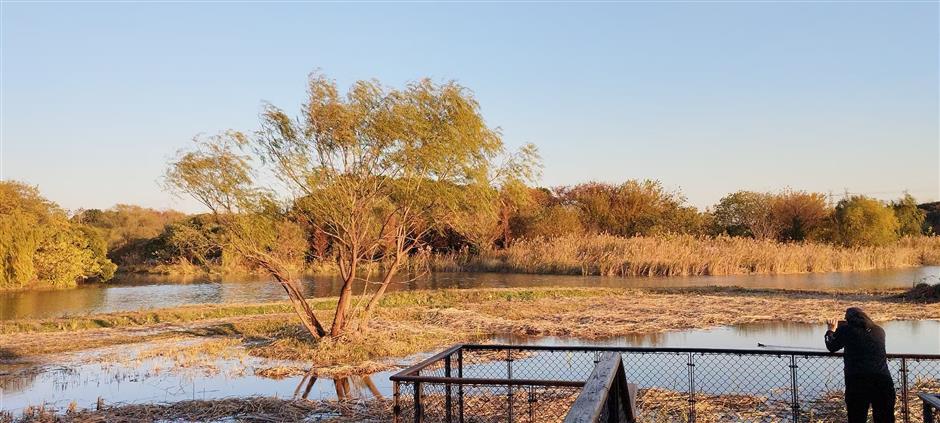
As the man and I walked further around the swamp, he said to me: "I've been here many times. I like this pristine place with plenty of reeds, especially when they reflect the rays of sunset."
The man, surnamed Xiao, is a retired teacher of Chinese literature well versed in "The Book of Songs," China's earliest collection of poetry consisting of more than 300 poems dating from the 11th century BC to the 6th century BC. He had taught the masterpiece at a college before retiring several years ago.
A poetic landscape
"Reeds are a romantic image in 'The Book of Songs'," said Mr Xiao, now 68 years old. "The rustic scene here chimes in perfectly with those ancient poems."
As we sauntered around the swamp rich in reeds and certain other emergent aquatic plants, Mr Xiao began to recite a passage from "The Book of Songs:"
"蒹葭苍苍,白露为霜.
所谓伊人,在水一方.
溯洄从之,道阻且长.
溯游从之,宛在水中央."
"The reeds and rushes are deeply green,
And the white dew is turned into hoarfrost.
The man of whom I think,
Is somewhere about the water.
I go up the stream in quest of him,
But the way is difficult and long.
I go down the stream in quest of him,
And lo! he is right in the midst of the water."
(Translated by James Legge, 1815-1897)
The reed marsh in the 41.8-hectare Jinhai Wetland Park in Pudong had inspired the poet in the retired teacher. And it was not just "The Book of Songs" that came to his mind. He took a picture of an empty boat lying quietly in another corner of the reed marsh and complemented it with a line from a Tang Dynasty (AD 618-907) poem, which can be translated as follows:
"At the wild ferry, no one is there, and the boat drifts sideways on its own."
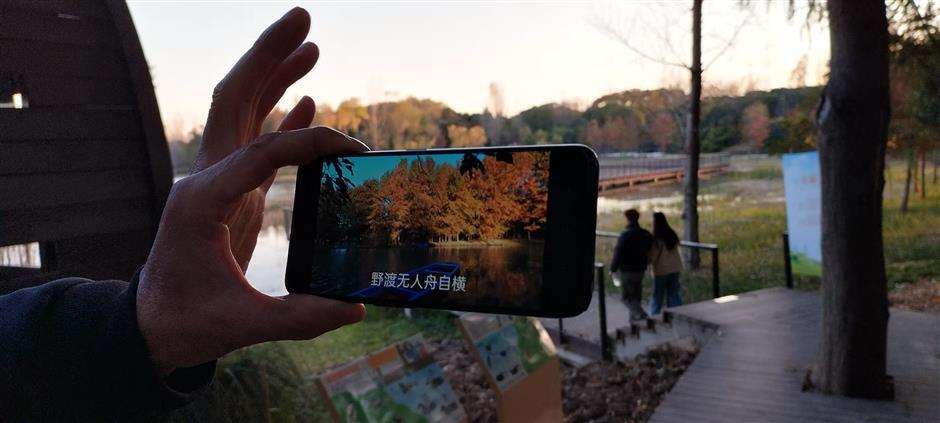
"No one is there" indeed, because the marsh featuring many reed islands is accessible only to water birds.
As I discovered later through online research, the "strange" creatures that pecked like chicken but could swim were not chicken at all, but rather a kind of water birds called common moorhens (Gallinula chloropus). In Chinese they're conveniently called hei shui ji. The retired teacher at least got their Chinese name right.
The appearance of common moorhens and certain other water birds attests to the attractiveness of well-vegetated marshes largely inaccessible to people. Last Wednesday we also spotted little grebes (Tachybaptus ruficollis) darting across or diving in the marsh.
A romantic moment at Jinhai Wetland Park in Pudong
Jinhai Wetland Park was not always a poetic place for people like Mr Xiao, nor a practical refuge for water birds, though. At first it was part of a 98-kilometer forest belt around Shanghai's Outer Ring Road that started to be built in 1995. It became a park only in 2016 after years of reconstruction that began in 2007, but for a long time before 2022 it was not an ideal habitat for water birds.
In July 2022, the park began to be further upgraded. By the time it opened at the end of the same year, the park had added more emergent aquatic plants and created a number of shallow stone beaches to woo water birds. The reed islands we watched from a distance last Wednesday were also part of the story of the wetland park's terrain reconstruction.
If the first phase of renovation, starting from 2007, transformed once inaccessible forests into a park mainly for people to visit, the second phase, starting from the summer in 2022, created an environment where all creatures could live in harmony.
The Shanghai way
The evolution of Jinhai Wetland Park is a telling example of how Shanghai has turned its single-function forest belt around its Outer Ring Road into a multi-functional series of ecological parks for both people and wildlife over the past 30 years.
In October, the round-city ecological parks were selected as one of this year's best cases under the Global Sustainable Development Lighthouse Initiative Knowledge Sharing Programme, which was jointly launched by experts from such organizations as United Nations Habitat, UNESCO, UNEP and International Geographical Union, as well as a number of universities, including those from China, the United States, Germany, South Korea and Singapore.
Zhu Dajian, a well-known expert on urban development, said in an article published in his WeChat public account in October that London was the first city (in modern history) to have created a green belt to prevent urban sprawl while preserving more green space.
He explained that London had relatively sufficient space at its disposal when the green belt began to be constructed in the early 20th century – the early stage of urbanization. Shanghai, on the other hand, has set an example of how a metropolitan city can continually expand its green space for both people and wildlife despite relatively limited space amid continuing urbanization.
Zhu also compared Shanghai's green belt development with that of Tokyo. He noted that the Japanese capital's round-city green belt eventually yielded to expanding construction sites while Shanghai's green belt has expanded into ecological parks that serve to link people from both sides of the Outer Ring Road while providing an ideal habitat for wildlife.
The pleasure of birding
A barrel-shaped wood cabin sits on the edge of the reed marsh at Jinhai Wetland Park, where people can observe birds from a distance. As Mr Xiao, the retired teacher, fine-tuned his camera positions to take photos of the birds and reeds, I looked around the interior walls of the one-of-a-kind wood cabin and saw a picture of a beihongweiqu (Daurian Redstart, or Phoenicurus auroreus) taken by a bird watcher.
"I know this bird," I said to Mr Xiao, calling his attention to what I had found. "It's a small passerine known for its vibrant plumage and melodious song, which generally breeds in temperate regions in the north but often migrates southward to warmer climates in winter."
"How did you know?" Mr Xiao asked curiously.
"I learned about beihongweiqu from a young bird watcher in Suide Park, Jiading District, on November 29," I replied. "She told me that bei in the name of the bird means 'north' in Chinese, while hongweiqu means 'redstart'."
"Where is Suide Park, exactly?" he asked. "I would like to go there, too." I told him he could take Metro Line 11. As I discovered through field research over the past couple of weeks, most ecological parks around the city's Outer Ring Road are at most a 3km walk from nearest Metro stations.
The young woman I met in Suide Park on November 29 said she had been a dedicated bird watcher for many years. She opened her camera to show me the pictures she had taken of a beihongweiqu and a silver-throated bushtit (Aegithalos glaucogularis) in the park that day, and briefed me about their habitats.
She was one of the 28 "citizen scientists" – dedicated bird watchers – who visited Suide Park and adjacent Butterfly Language Garden on November 29 to watch birds under the auspices of the city's center for the development of public green space, including those round-city ecological parks.
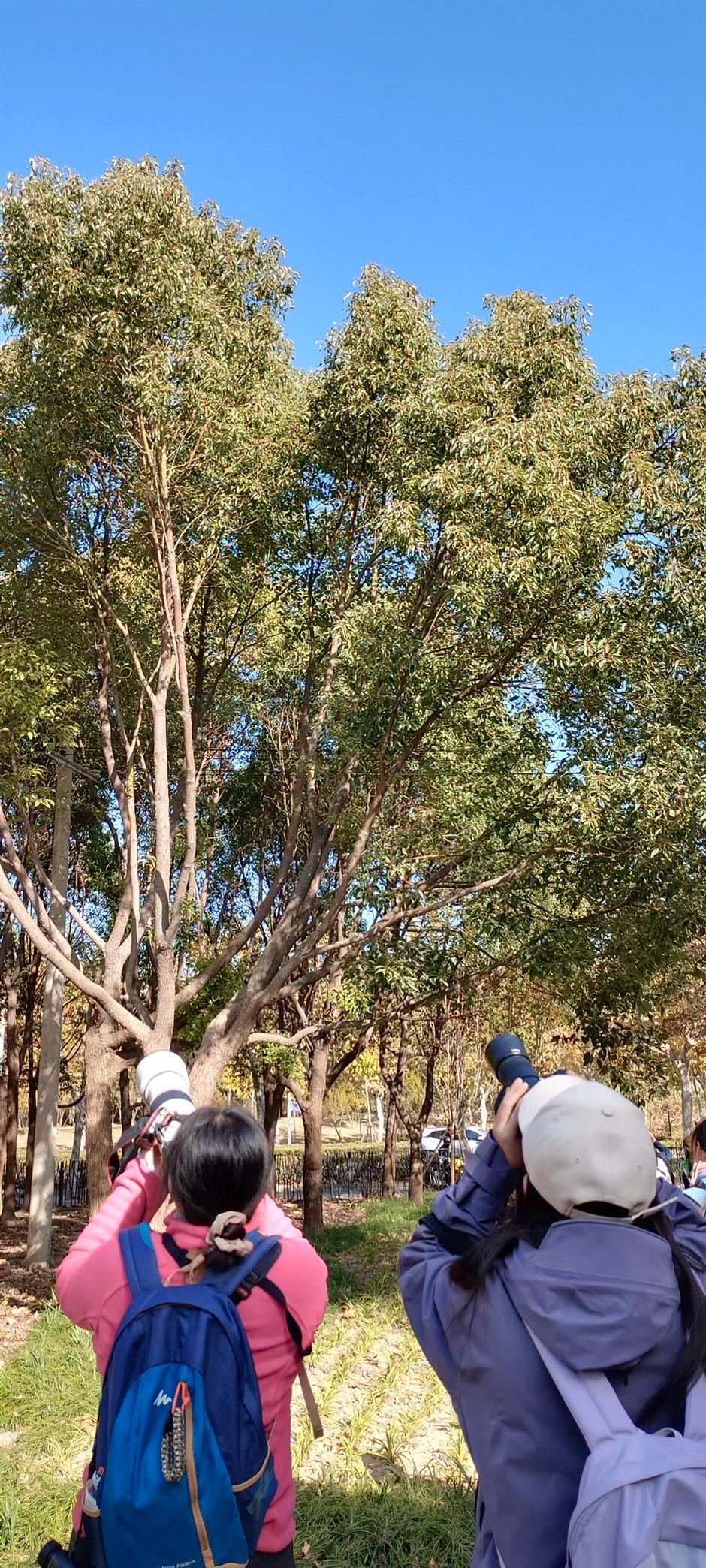
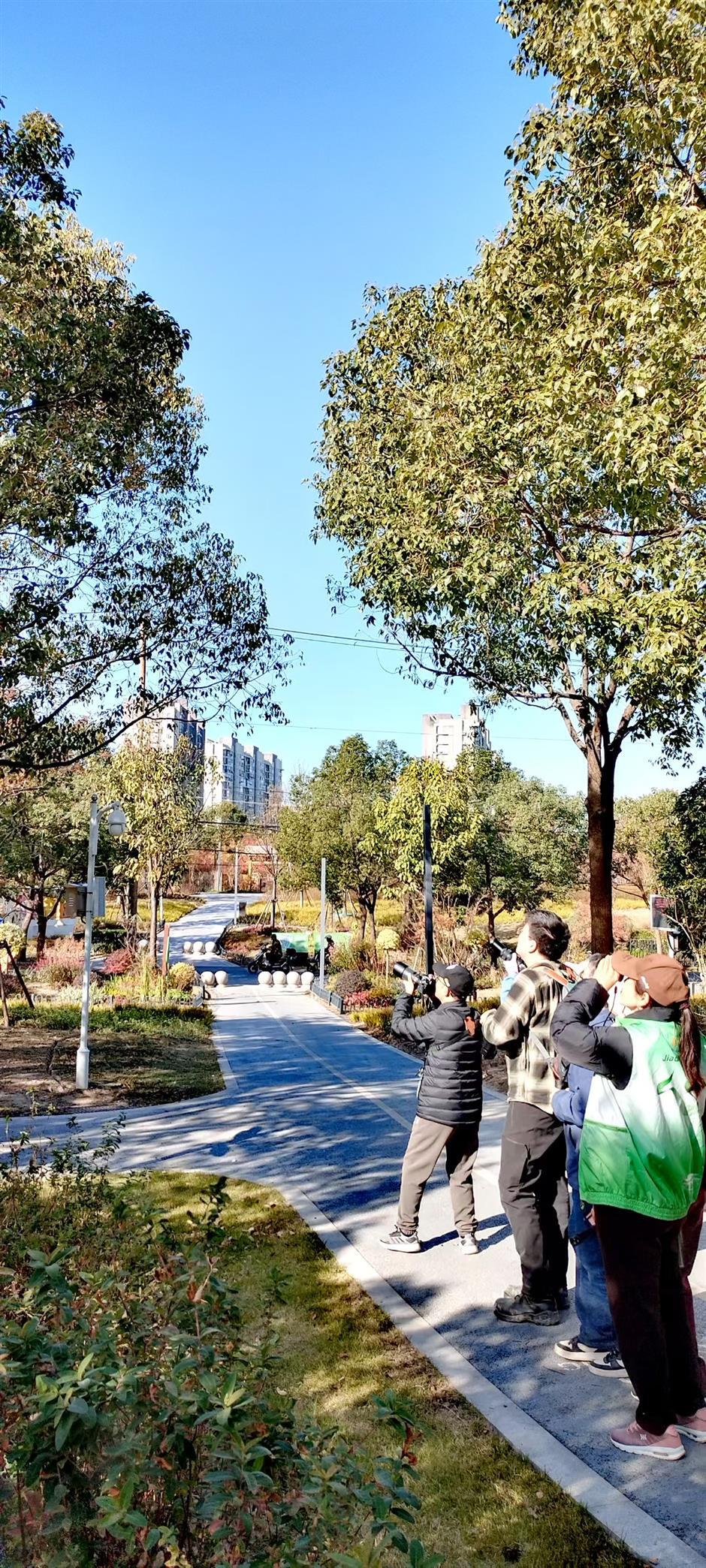
At Butterfly Language Garden, another young bird watcher told me she had spotted quite a few gray-backed thrushes (Turdus hortulorum), also a migratory bird.
I couldn't identify many birds, but on November 29 I enjoyed listening to a chorus of birds in both Suide Park and Butterfly Language Garden as I followed the bird watchers through colorful forests featuring Chinese tallow trees (Triadica sebifera), ginkgo trees (Ginkgo biloba) and ahuehuete trees (Taxodium mucronatum), among others.
On December 4, the center for the city's public green space development published a namelist of birds discovered by "citizen scientists" in the two parks on November 29. They found 26 kinds of birds in Suide Park and 21 kinds in Butterfly Language Garden. Most of those birds appeared in both places, such as Daurian redstarts, silver-throated bushtits, gray-backed thrushes and Chinese grosbeaks.
Like Jinhai Wetland Park, both Suide Park and Butterfly Language Garden were renovated on the basis of former outer-ring forest belts.
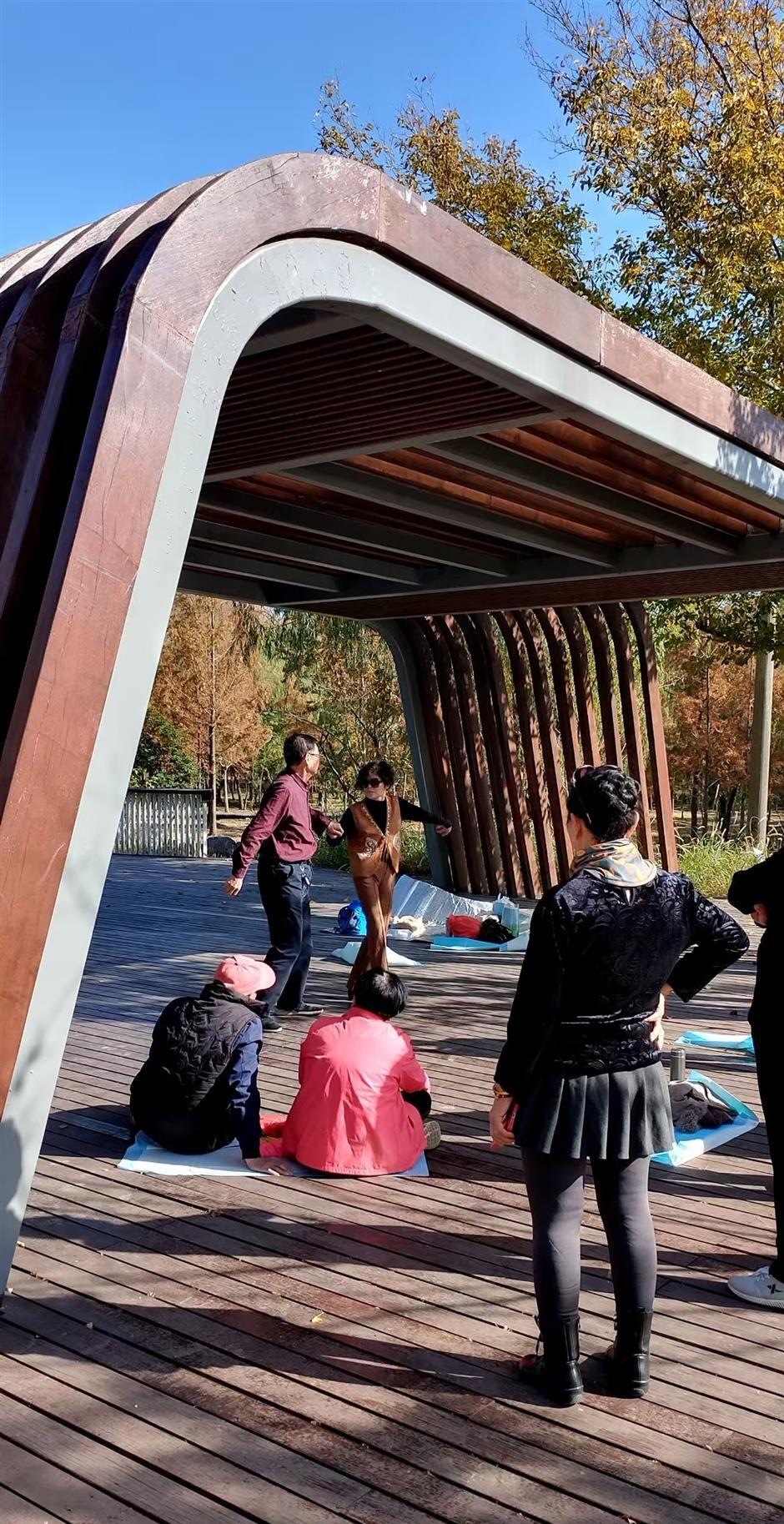
"I come here every day for exercise," a middle-aged man told me as we met in Suide Park on November 29. He was teaching another middle-aged man how to practice tai chi.
"It takes me only 15 minutes to drive on a moped from my home to the park," he said.
Then, as I looked around, I could also see old people dancing in a riverside plaza and young families dining out in tent areas of the well-forested park.
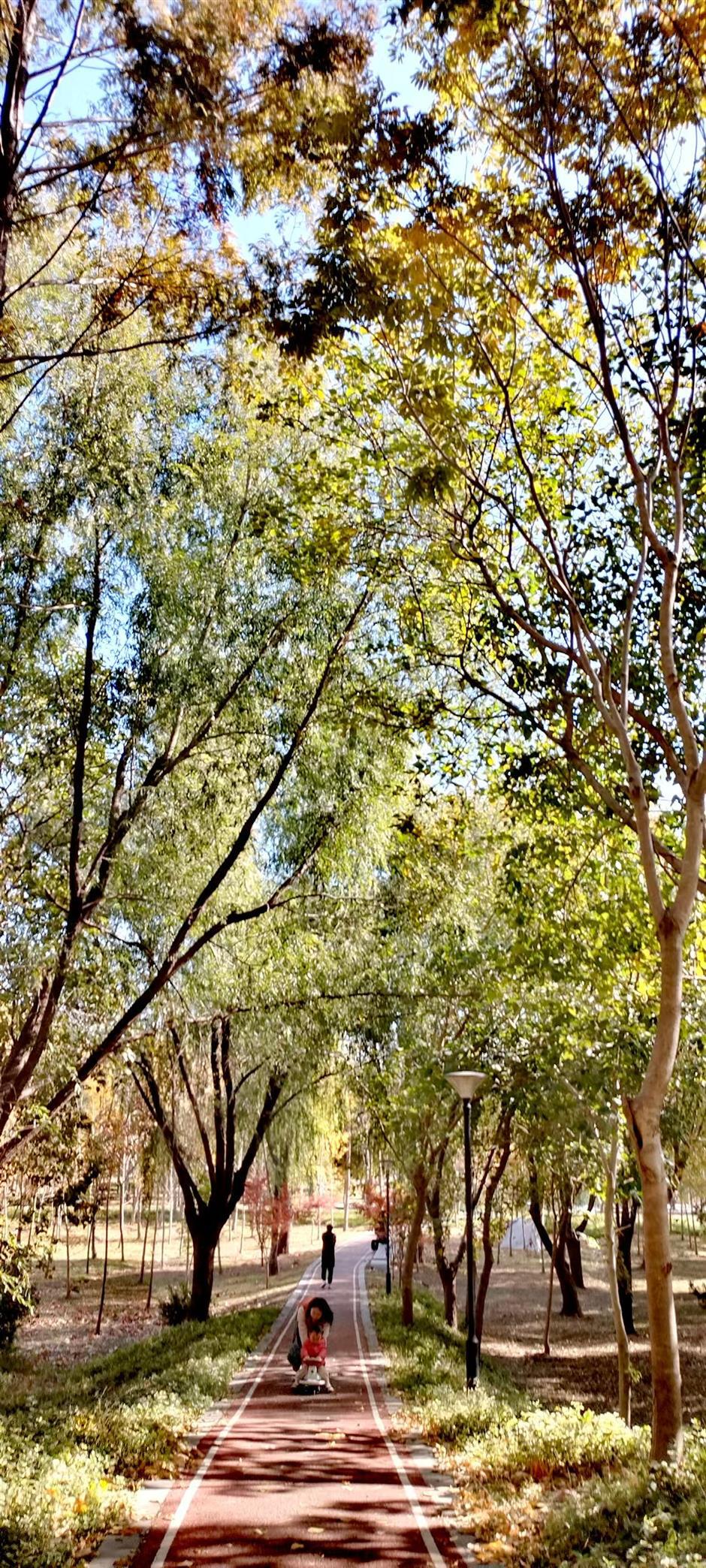
A boy sat in a ride-on toy car while his mother pushed the car uphill until they both reached the top of the curved pathway flanked by tall trees where I stood.
The mother held the toy car still for a moment, then turned it around, and suddenly let go of it: The kid was left alone in handling the toy car as he headed downward at great speed like a free falling object.
"Aren't you afraid that your son's toy car may roll over on the curved pathway?" I asked the mother in a surprised tone.
"Not at all," she assured me with a smile. "He's familiar with this place. We come and play here quite often. The park is almost at our doorstep."
My favorite park
An 83-year-old man surnamed Chen who lives in Putuo District also frequents an ecological park near his home. He has made it a habit to walk every day in Fengxiang Zhixiu Eco Park in adjacent Baoshan District, except when it rains.
I ran into him on December 1 as I was at a loss as to how I could walk from this eco park to nearby Putuo District, where another park is being renovated and expanded.
"I'll show you the way," he said with a broad smile. "But the gate between the two parks is closed now, because the park in Putuo is still under construction."
I followed his pointing finger and made my way to the gate separating the existing park in Baoshan District from the park under construction in Putuo.
"The park in Putuo will soon be completed," the old man assured me.
He was right.
Xinyang Park under construction in Putuo is one of the 10 new ecological parks to be completed this year, adding the city's number of outer-ring ecological parks to 50, with a total area of 1,738 hectares. Eventually, Shanghai's round-city ecological parks will extend both ways along the Outer Ring Road to cover a total area of 287 square kilometers.
"What do you like most about this park in Baoshan?" I asked the 83-year-old man as we both walked slowly along dimly lit zigzag paths surrounded by Chinese wingnuts and camphor trees, most of which were at least 30 meters high after decades of growth.
He replied in two simple Chinese words: shu duo (many trees).
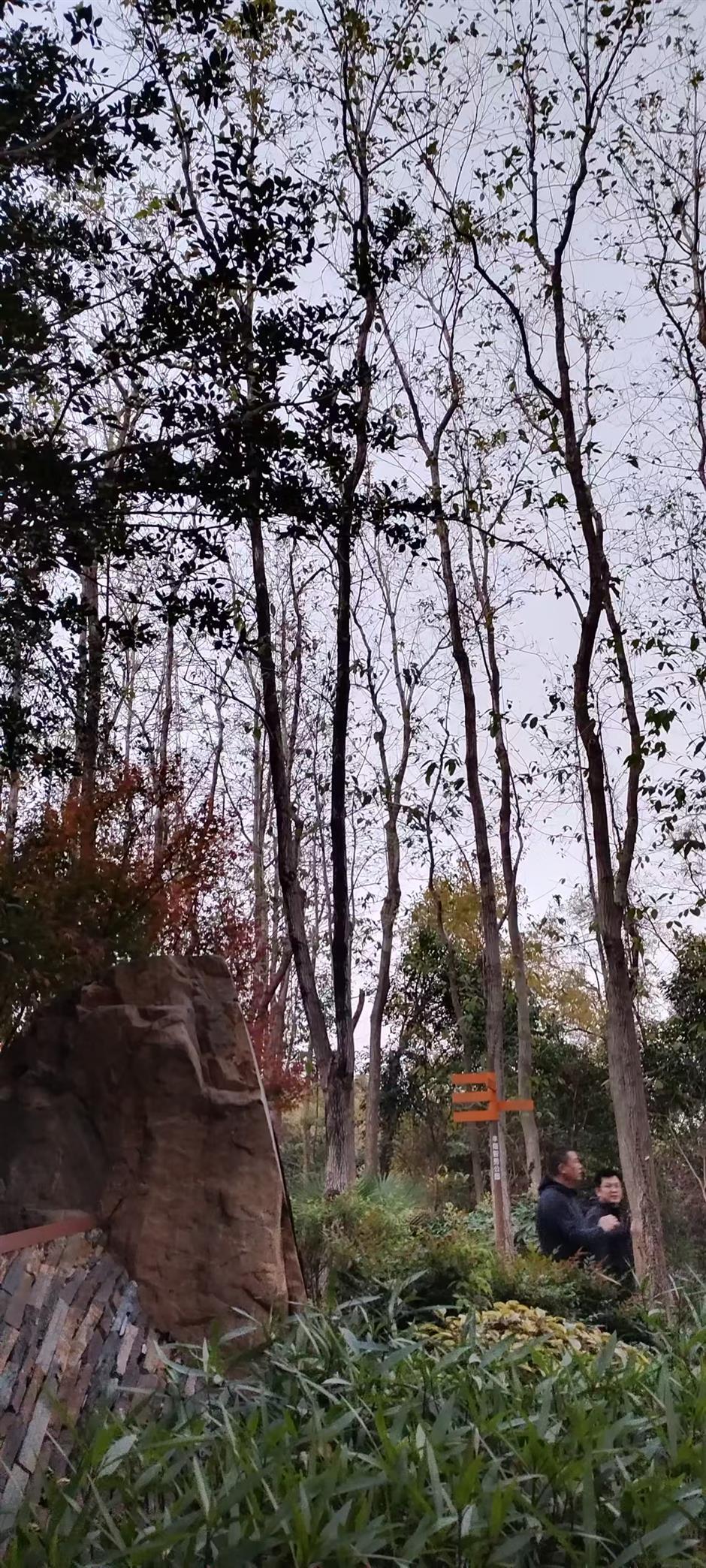
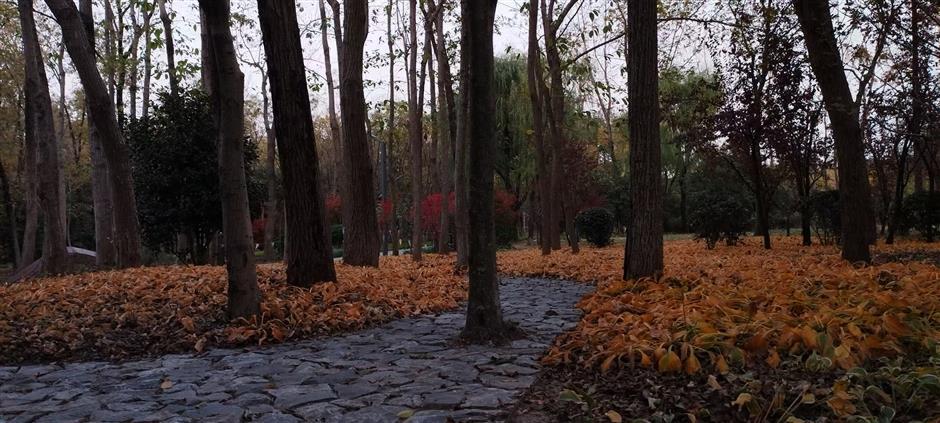
The old man hails from rural Anhui Province and had tilled rice fields until he was over 70 years old. His wife died three years ago and then he moved to Shanghai to live with his two sons, who run an eatery together. He has been a regular visitor to the eco park in Baoshan since it reopened in 2023 after renovation on the basis of a former outer-ring forest belt.
"There should be many trees in your hometown," I said.
"We mainly had rice fields. Here you see tall trees everywhere," he explained.
Indeed, official figures show trees cover 83 percent of the eco park. And when renovation started in July 2022, workers kept most trees intact by building zigzag paths around them. In some cases, workers recycled the removed, stunted or withered trees and used them to create winding timber paths.
The old man walked so slowly that we covered half of the 32-hectare park in more than one hour. If I were walking by myself, I would have covered the whole park in a much shorter time.
But, as I had to walk as slowly as the old man so that we could have a meaningful dialogue, I was able to stop now and then to appreciate as many plants as possible. I saw such submergent aquatic plants as Vallisneria natans, Potamogeton wrightii morong and Iris pseudacorus, which were added during the park's renovation to help clear its body of water, which was once blanketed with duckweed as it suffered from eutrophication.
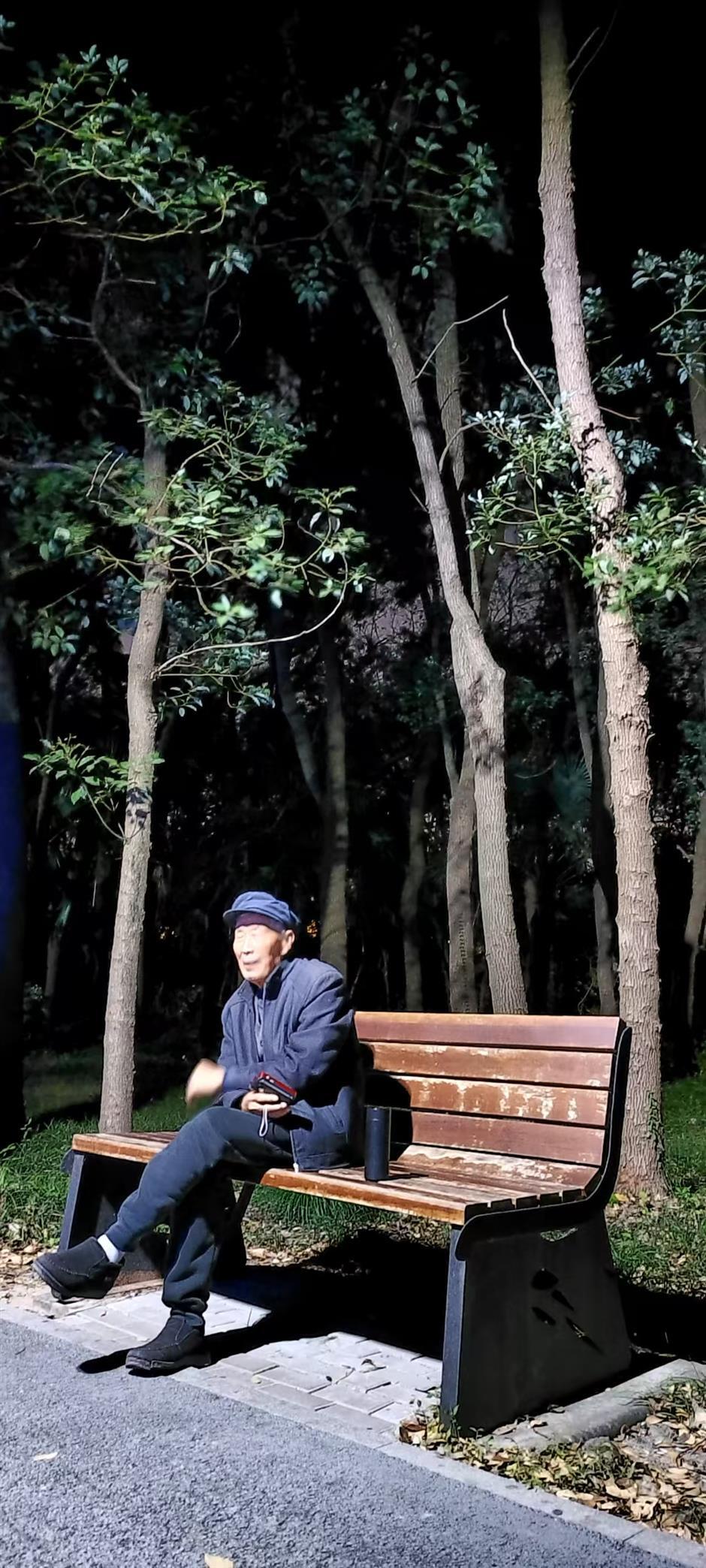
The old man's habit of walking in a forest reminds me of an article published in the Harvard Medicine Magazine a couple of years ago, especially its headline: "A walk in the woods may boost mental health: Many physicians are prescribing time in nature as balm for the brain."
It also reminds me of an article published in Guangming Daily, a Beijing-based media outlet, earlier this year, which cited scientific studies to show that walking in a forest could help bring down the heartbeat rate and the blood pressure for someone aged between 45 and 86. The article was an abstract from a Chinese edition of the book written by French neuroscientist Michel Le Van Quyen, titled Cerveau et nature: Pourquoi nous avons besoin de la beauté du monde.
Drawing a leaf
A forest walk benefits not just elderly people, but children as well.
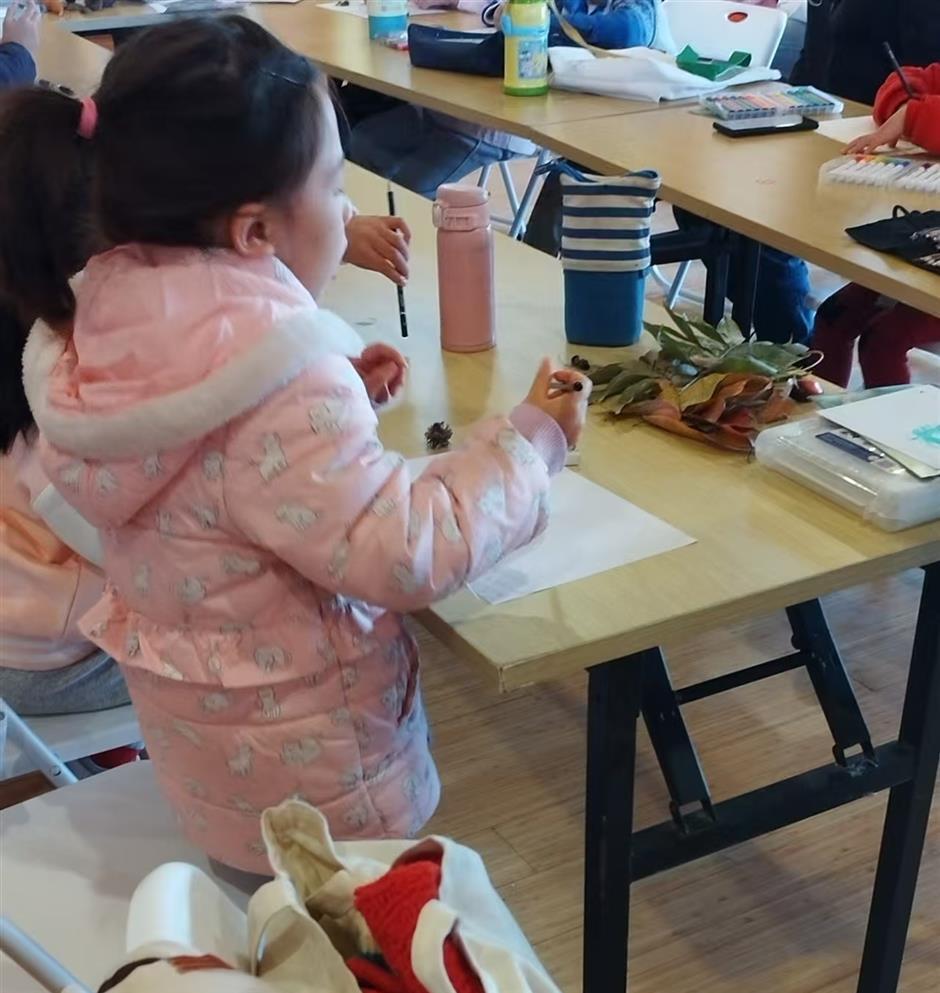
"Every one of you is a talented painter!" a teacher told a group of children ready to draw pictures.
It was on November 22 when I chanced upon this group of pupils in a 6.25km-long greenway in Changning District, who had just learned to watch birds and identify plants with the help of a teacher specializing in integrating nature into education.
The Changning outer-ring greenway has become a favorite path for cyclists and runners alike since it opened in 2020 after a few years of renovation, starting from 2017. The region was once "invaded" by goldenrod – an invasive species – and suffered from eutrophication. Now the 65-hectare greenway has added many new trees and plants, including American crabapple (Malus coronaria), Golden bells (Forsythia intermedia Zabel), and Tall verbena (Verbena bonariensis).
As I drew nearer to see what the pupils were drawing, I was surprised to find everyone using a pile of fallen leaves or fruits they had just collected as still-life subjects.
What a creative art class!
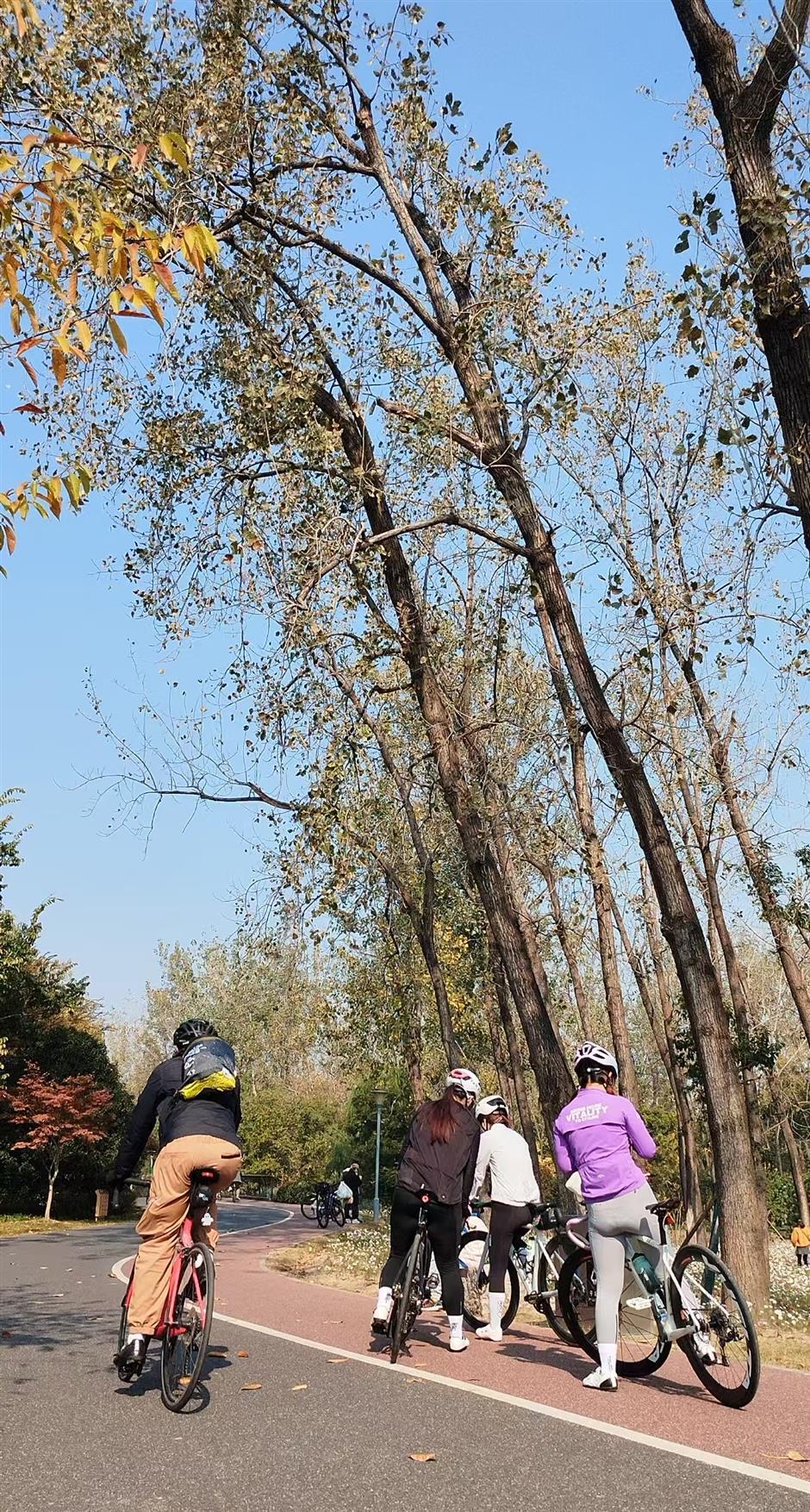
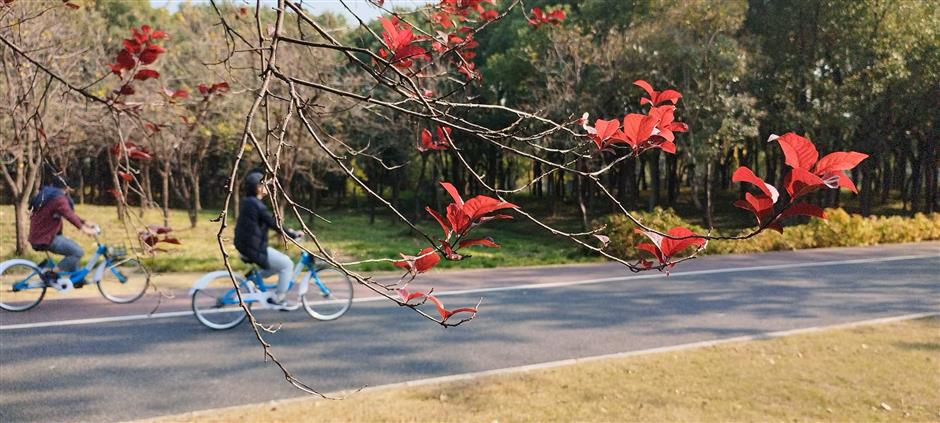
This year marks the 30th anniversary of the city's outer-ring forest belt. The city's center for public green space development has organized nature education activities involving children aged 6 to 12 as part of the commemorative events. The creative art class I observed in Changning's outer-ring greenway is a case in point.
An afterthought
Over the past couple of weeks, I've explored at least one eco park in each of the seven districts – Putuo, Jiading, Baoshan, Pudong, Changning, Xuhui and Minhang – around which Shanghai's round-city eco park belt is taking shape. I may not be able to describe every park I visited in detail, but collectively they impress me as a growing urban oasis where people learn to grow with nature that heals.
Shanghai is a densely populated city, but that doesn't mean it has to be crowded with concrete forests. The more you stroll in an outer-ring eco park, the more you feel that Shanghai is becoming a city in gardens.
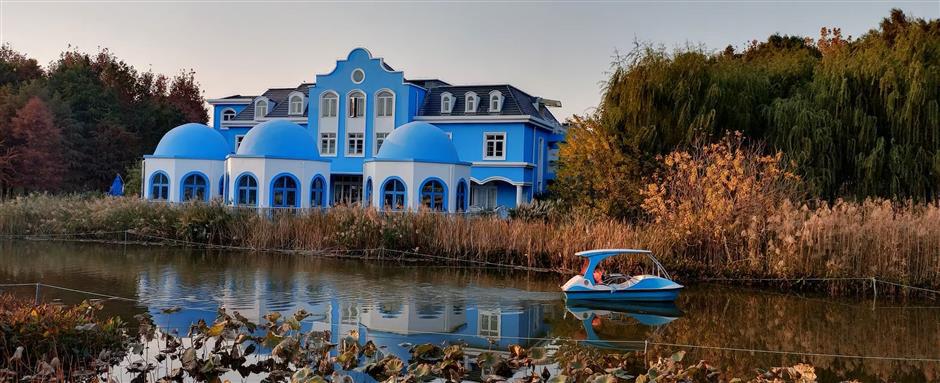
This video shows how eco parks provide people with an "urban oasis" around the Outer Ring Road in Minhang District.
Editor: Shi Jingyun
In Case You Missed It...
 Sep 20, 2026

![[Decades Club] Rob Jameson: 20 Years Inside Shanghai F&B](https://obj.shine.cn/files/2026/09/15/8869ded2-b793-498a-8cbd-d195ec720715_0.jpg)