'You're On Your Way:' The American Professor Guiding Arrivals at Shanghai's Gates
At the Pudong International Airport station on Shanghai Metro Line 2, American volunteer Ray J. Rivera stands by the gates.
He doesn't rush to give directions, and he rarely speaks first. Most of the time, he watches who keeps switching screens at the ticket machines, who lingers over maps, and who hesitates at the barrier.
Then he walks over.
"Need help?" he asks.
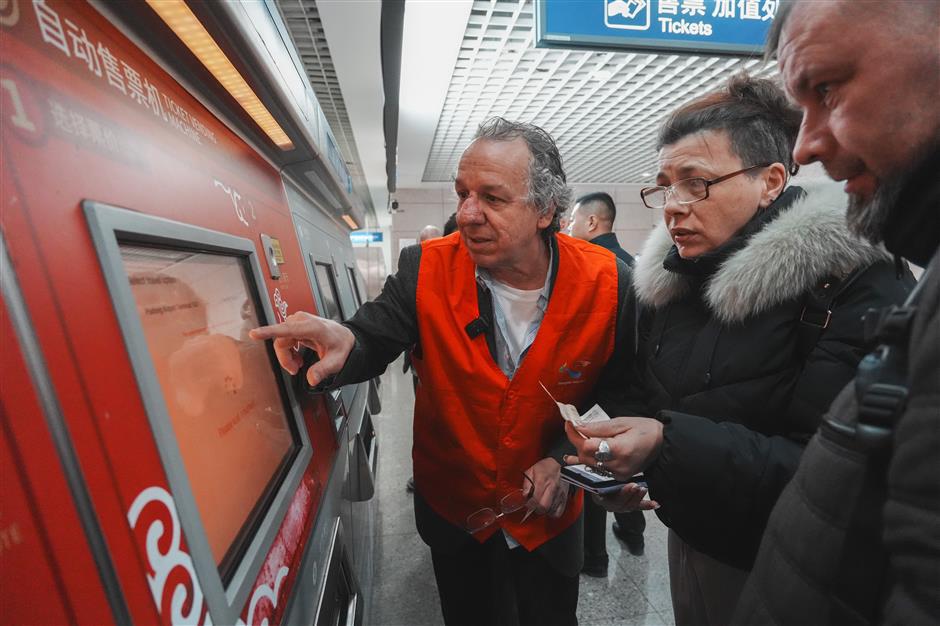
When maps fall short
Ray is a ShanghaiTech University assistant professor of technical English and intercultural communication and volunteers with the Zhangjiang Volunteer Association and Shanghai Metro Second Operation Company.
Over the past six months, he has been a regular presence along Metro Line 2, the east-west line linking Pudong International Airport and the Hongqiao Transportation Hub, often the first step into the city for international visitors.
Many arrive well prepared with maps, travel guides, and have watched tutorial videos. But once inside Shanghai's vast metro network, reality often proves more complicated than expected.
"There's plenty of advice online, but much of the influencer content is outdated," Ray said.
In many Western cities, subway systems are far less complex. When navigation apps instruct passengers to "take Exit 17," some ask in disbelief: "Do you really have 17 exits?" The answer is yes.
Language can be another barrier. Many travelers rely on pinyin but struggle to distinguish similar sounds. "Guo" and "Gou," or "Zhuo" and "Zhou," can be easily confused, sometimes sending them in the wrong direction.
At that point, Ray steps in.
He pulls out a sticky note and writes down key steps – "Transfer at Longyang Road," for example – before placing it on the back of a passenger's phone. He then gestures with all five fingers together, as required in volunteer training.
"Even when people have maps, they still like having that note," he said. "It's just extra reassurance."
At major transit hubs, that reassurance often begins with a sense of familiarity.
According to Zhang Jie, secretary-general of the Zhangjiang Volunteer Association, local volunteers approaching confused foreign travelers are sometimes met with polite but defensive waves.
But when a fellow foreign face steps in, the hesitation often disappears.
"They open up right away," she said.
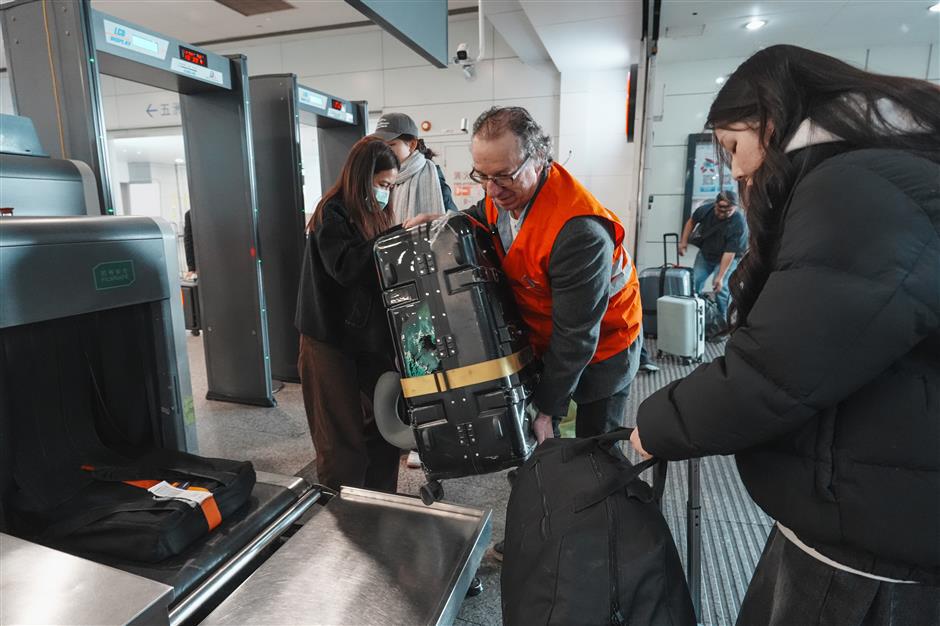
The 'magic moment' at the gate
For Ray, what people need most is not a perfect answer, but the sense that they can keep going.
"We're not here to solve every problem," he said. "We're here to help people feel confident and welcome."
He walks them to the ticket machine.
"How are you paying?" he asks.
The answer determines the next step. For short-term visitors, setting up mobile payment often requires identity verification and a local phone number, which can be difficult. Many still rely on cash.
Others try Alipay, sometimes with partial setups. Ray said this is common among Russian travelers, who often have accounts but struggle with configuration. Volunteers step in to help adjust settings.
Even with the right payment method, ticket machines can be confusing.
"A lot of it is just knowing what to click next," Ray said. "If something goes wrong, they're not sure how to reset or get back."
Others, particularly visitors from Europe, hold up bank cards.
Last year, Shanghai Metro introduced a "tap-to-ride" system, allowing entry with a contactless international card. In its first six months, the system recorded more than 1.21 million rides, with overseas cards accounting for over 60 percent.
"That's chenggong (成功)," Ray said. "Success."
But it's still new, and not everyone realizes they can use it yet.
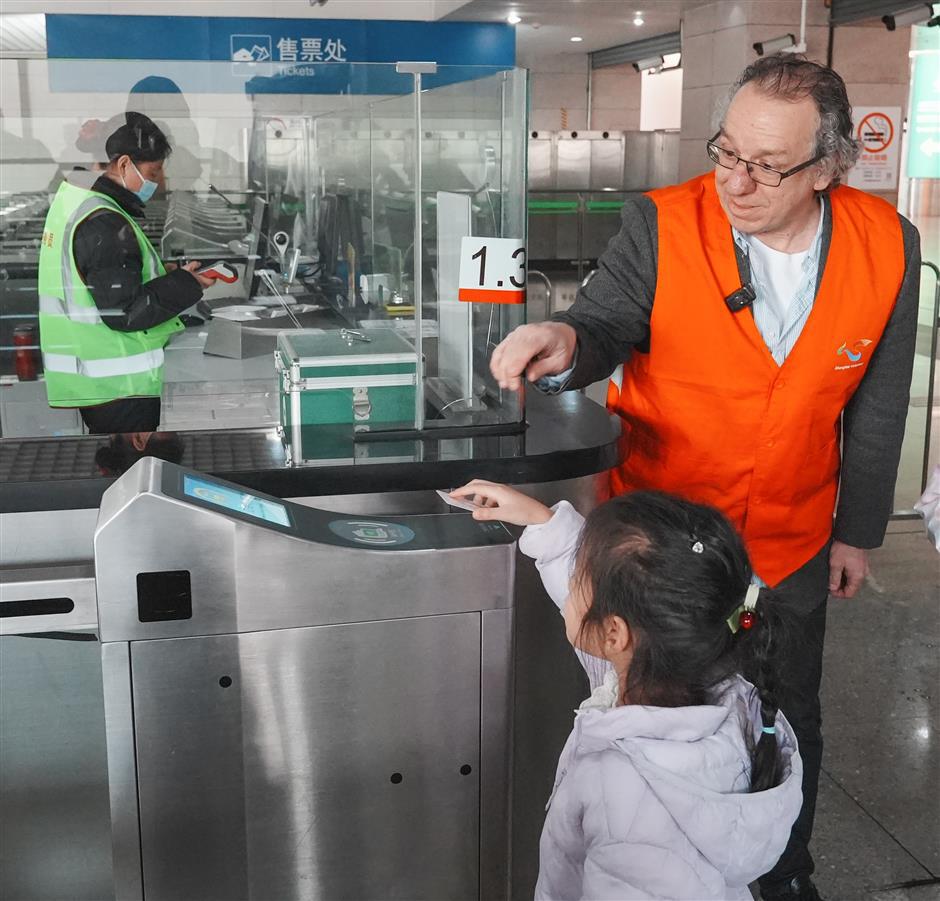
When someone hesitates with a bank card, Ray walks them to the gate, guiding them to a wider, accessible lane.
"Just tap," he says. "If it works, you're on your way. If not, we'll figure it out."
They tap their card. The gate opens.
"For them, it's like magic," Ray said, smiling.
"You're on your way."
Crossing over
Through his volunteer work, Ray has seen many kinds of transitions.
One evening last year at the Pudong International Airport station, Ray noticed a well-dressed African businessman standing near the gates, visibly struggling.
He was trying to get to Yiwu. He had last been to China in 2018, when buses were still his way of getting there.
This time, nothing seemed to match what he remembered.
Some people told him to go to Hongqiao and take a high-speed train. He shook his head. "I need to take a bus," he insisted.
"He was facing a China completely different from the one he remembered," Ray said.
Ray and other volunteers worked out the route and guided him through the station – down corridors, through security, and to the correct terminal.
Because he had no mobile payment set up, he could not complete the purchase. Ray stepped in to cover the remaining fare. The man eventually made his way to Yiwu.
Most of the time, though, these transitions are far more ordinary.
Someone asks where to find a good beer, or whether the Costco in Kangqiao really sells US$1.50 hot dogs.
Others have simpler questions: Are these the right directions? Do I really transfer at Longyang Road? What should I do first when I get to Nanjing Road?
He recognizes that kind of transition because he has lived through one himself.
In 2004, when he first came to China, he was at a low point in life. Everything felt unfamiliar. He could not read the signs or decide what to do next.
"It was a tough time in my life, but it was also the right time," he recalled.
He spent that summer studying Chinese at Peking University, an experience that opened what he later described as a new dimension in his life. He kept coming back, and eventually built a life here.
"Everyone should experience what it feels like to arrive in China and have someone there to welcome you," he said. "People helped me. So I want to do the same."
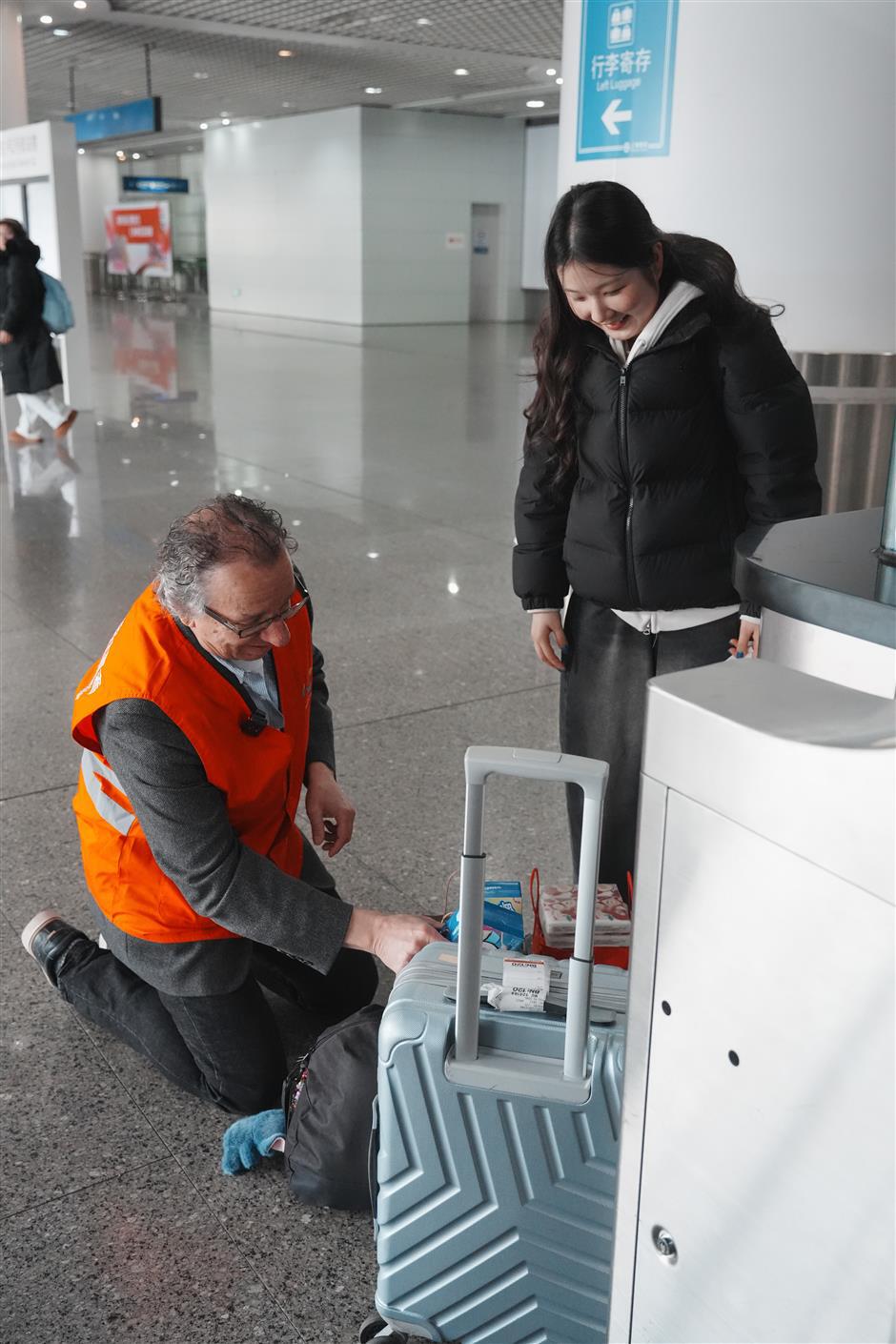
After helping a traveler through the gate, he sometimes offers one piece of advice: "When you get to Nanjing Road, don't just look at your phone. Look up."
Once again, the gate opens. Someone turns back to say thank you, then disappears into the crowd.
Ray does not follow. His work ends there.
The city begins after that.
Editor: Yang Meiping
In Case You Missed It...

 Sep 16, 2026

Popular Reads

HYROX Winner Apologizes, Saying She Should Have Stopped After Soiling Herself in Beijing

AI Couture, 500 Brands, Free Entry: World Design Cities Conference Returns To Shanghai This Month

Shanghai Trade Rises 13.1% in August as Exports, Imports Post Double-Digit Gains
![[Community] Say Bye, Say Hi: An Evening of Swapping, Sharing and Connecting](https://obj.shine.cn/files/2026/09/16/699fe833-2ba8-4118-b51a-6cee96e14a30_0.jpg)
