Chinese E-Commerce Platforms Remove Chemical After Public Outcry Over Its Link to Date-Rape Drug
A chemical that could be made into a widely feared date-rape drug once ingested has been quietly available for purchase on major Chinese e-commerce platforms, sparking widespread attention and discussion.
On April 27, Luo Miao, a former contestant on the popular online debate show U Can U Bib, posted on China's social media platform Weibo that 1,4-butanediol — a direct precursor to the date-rape drug GHB — was readily available for purchase on e-commerce sites. The post quickly went viral.
The following morning, Red Star News reported that numerous online shops were selling 1,4-butanediol, with prices ranging from just over 10 yuan (US$1.46) to several dozen yuan. One popular listing offered "analytical grade" and "chemical grade" purity, with product descriptions explicitly stating the chemical was "for research and laboratory use only" and "not for pharmaceutical or food use."
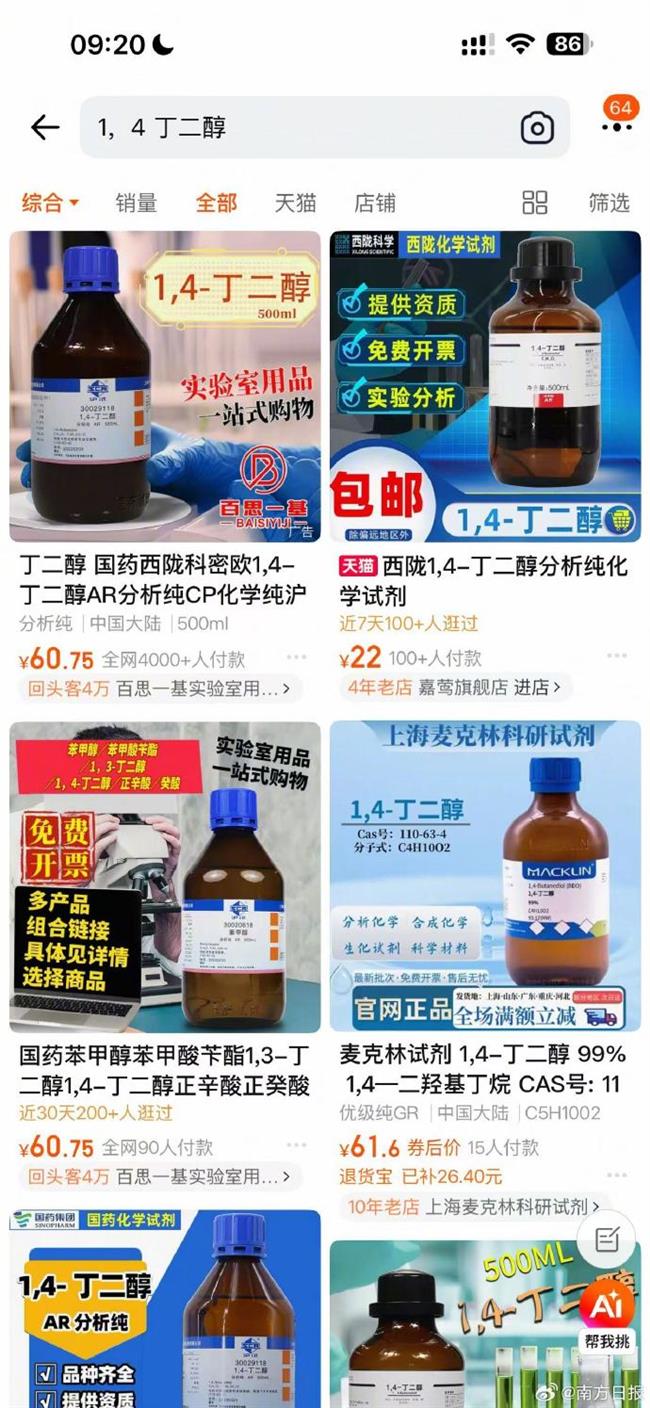
However, in the user comment section, some buyers asked questions such as "Can you eat it?", "How do you quit it?", and "What effect does it have on fish?" — suggesting potential misuse of the product. Around noon yesterday, major e-commerce platforms had removed all listings of 1,4-butanediol, according to the report.
Once ingested, 1,4-butanediol is rapidly converted in the body into gamma-hydroxybutyric acid (GHB), commonly known as the "date-rape drug." GHB is classified as a Schedule I psychotropic substance under Chinese law. At low doses, it can cause hallucinations and memory loss; at high doses, it can lead to coma, respiratory depression, and death. GHB, MDMA, and ketamine are known as the three major date-rape drugs, and have been linked to numerous drug-facilitated sexual assaults.
Despite the risks, 1,4-butanediol currently occupies a legal gray area. Wang Hongbing, a lawyer with Beijing Yingke Law Firm, told Red Star News that under current regulations, the chemical is neither classified as a hazardous chemical, a precursor chemical, nor a psychotropic substance, but rather as an ordinary chemical.
"Even if merchants sell directly to individuals, existing laws cannot penalize such sales based on drug, precursor, or hazardous chemical regulations," Wang said.
Tan Mintao, a lawyer with Beijing Zhongwen Law Firm, noted that while China's National Narcotics Control Commission has repeatedly warned that 1,4-butanediol is a high-risk drug precursor often used to manufacture GHB, the substance remains only on a risk alert list, not formally regulated.
"If 1,4-butanediol is added to food or drinks and sold, it could be prosecuted as selling toxic or harmful food," Tan added.
The dangers of 1,4-butanediol abuse have been substantiated by real cases. In October 2023, a man in Shenzhen's Longgang District added "didi" stock solution (containing 1,4-butanediol) to green tea, creating a mixture nicknamed "didi water." A 15-year-old girl who consumed it died after succumbing to gamma-hydroxybutyric acid poisoning.
"From a moral standpoint, it is inappropriate for e-commerce platforms to openly sell 1,4-butanediol. However, legally, it is difficult to say they violated any laws," said lawyer Wang Hongbing.
He called for regulatory reform, recommending that substances prone to addiction and abuse, even if not yet formally controlled, be placed on a temporary restricted list, with tighter oversight on their sourcing, distribution, and purchasing channels.
Editor: Wang Qingchu
In Case You Missed It...
 Sep 28, 2026
Popular Reads
Momenta and Shenlong Tech Partner to Develop Smart Driving Systems
Shanghai Scallion-Pancake Seller Leaves French Note for Actor Friend Before Trip Home

Giant Pandas Ping Ping and Fu Shuang Arrive at Zoo Atlanta for 10-Year Stay