'Echoes of the Silk Road' Displays Xinjiang Cultural Relics
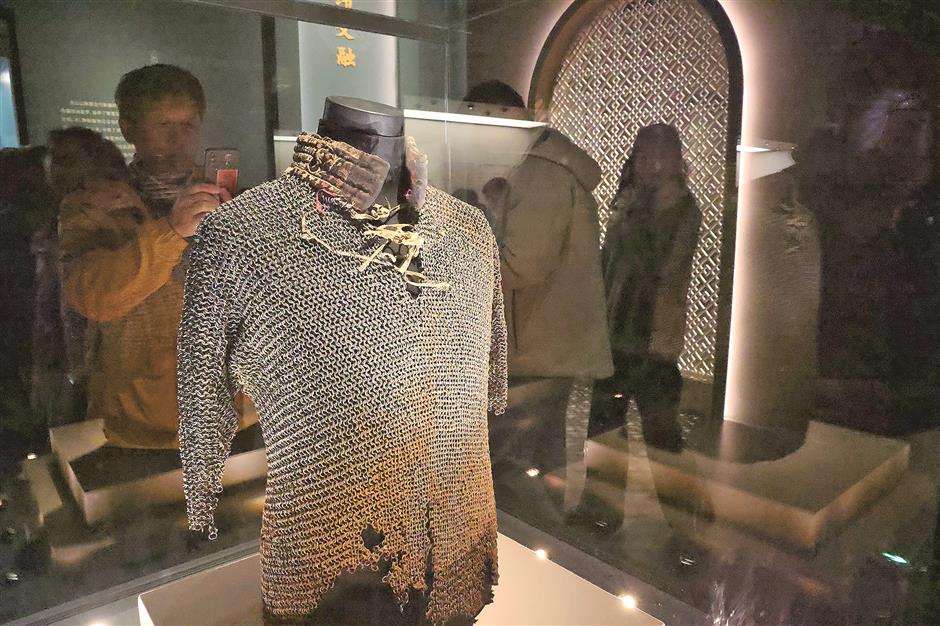
"Echoes of the Silk Road", the latest flagship exhibition at Minhang Museum, is a curated selection of cultural relics from museums across Xinjiang to Shanghai.
Opened on January 21 and running through May 19, the exhibition is jointly organized by the Minhang Museum of Shanghai, the China Cultural Relics Exchange Centre, and the Xinjiang Uygur Autonomous Region Museum as well as six prefecture or county-level museums in the region.
Featuring 110 precious artifacts, the exhibition presents a multidimensional view of ancient Xinjiang's unique position and splendid civilization along the Silk Road, spanning military administration, economic exchanges, social life and cultural beliefs.
The show systematically traces the historical development and cultural achievements of the Xinjiang section of the Silk Road, guiding visitors to revisit its glorious past.
One of the highlights is an original first-class cultural relic: a painted silk depiction of Fuxi and Nuwa, a pair of important deities in Chinese mythology credited with creating humanity, surviving a great flood, and establishing civilization.
The artwork was unearthed from a joint burial tomb in Xinjiang and was originally fixed to the ceiling of the tomb chamber.
Measuring nearly two meters in length, the artwork delivers a powerful visual and emotional impact when viewed up close.
Historically, Xinjiang has served as a crucial window and crossroads for exchanges between Eastern and Western civilizations. Through the integration of exhibitions and market activities, the museum aims to present the spirit of cultural exchange embodied in "Echoes of the Silk Road" in a more engaging and accessible way.
The show has also been turned into a festive occasion for enthusiasts of museums and cultural relics, and relevant activities, such as a specialty bazaar, brought agricultural products of Zepu to Shanghai residents.
Zepu County of Kashgar Prefecture sits in the southwest of Xinjiang.
The exhibition's opening week coincided with the "Minhang-Zepu Cultural Exchange Week." In addition to the exhibition, visitors can explore a themed market that brings ancient scenes of East-West cultural exchanges to life.
The bazaar features more than 300 items of intangible cultural heritage and specialty products from Xinjiang, including traditional garments, silk products and local agricultural goods, alongside cultural elements from Shanghai.
Through February 23, the museum will distribute a limited number of free handbooks on a first-come, first-served basis, which is available from 9:30am daily.
It provides a daily limit of 100 copies on weekdays, and 300 copies during weekends and public holidays.
Minhang Museum also plans to host pop-up events in the coming months, aimed at attracting audiences through audio and visual presentations to raise awareness of the museum and encourage a deep engagement between visitors and curators.
If you go:
Opening Hours: 9:30am-4:30pm, Tuesday to Sunday (last admission 4pm)
Address: No. 1538 Xinzhen Road, Minhang District
Contact Number: 021-6488 0567
If you go:
Opening Hours: 9:30am-4:30pm, Tuesday to Sunday (last admission 4pm)
Address: No. 1538 Xinzhen Road, Minhang District
Contact Number: 021-6488 0567
Editor: Shi Jingyun
In Case You Missed It...
![[ChinaMaxxing] 24 Excuses to Eat According to the Chinese Solar Calendar](https://obj.shine.cn/files/2026/04/03/309b403b-fba3-4c41-93e6-89008e3b13e0_0.jpg)
 Apr 3, 2026
![[Hai Guide] Explore the Flowers and Exhibitions This Spring](https://obj.shine.cn/files/2026/04/03/6ead35ae-ea88-4c70-b14b-47ab01a9655f_0.jpg)