Actors Body Hits Out At Rampant AI Cloning of Voice, Image
The Actors Committee of the China Federation of Radio and Television Associations, in a statement, has expressed outrage over flagrant AI cloning of actors' voiceprints and images.
It condemned unauthorized, distorted editing of existing film and TV products by using actors' images and voiceprints for AI model training.
The statement emphasized that such practices seriously infringe upon the legitimate rights and interests of performing artists and disrupt the order of the audio-visual industry.
It restated that performers have the rightful control over their images, voices, and artistic identities, and that collecting, using, or sharing these without permission is not allowed, even if labeled as "For non-commercial use," "For public interest use," or "Personal secondary creation."
It also required online platforms for short videos and related products to come up with a long-term mechanism for verification of AI content and immediate removal of illicit works.
It also demanded that platforms keep AI-synthesized content data and cooperate with infringement investigations.
This announcement follows a shocking revelation that some studios are testing AI for all but the leading actors, sparking speculation that some supporting roles may soon be AI stunts.
Riding the wave of this trend, a domestic company recently announced the "signing" of two AI actors, Qin Lingyue and Lin Xiyan, who will soon star in AIGC TV dramas.
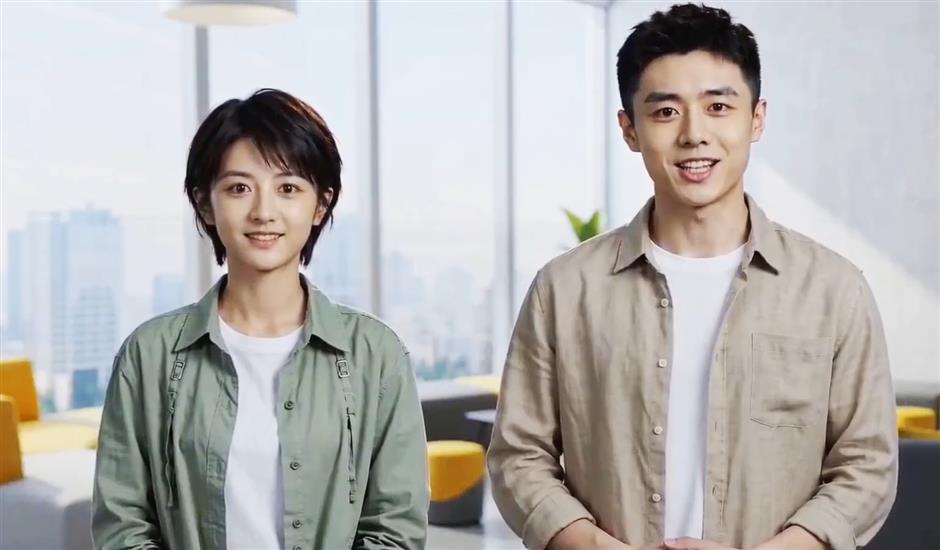
Many netizens oppose it, pointing out that the two AI actors resemble several celebrities.
Lin looks like a collage of three actresses: Zhao Jinmai, Zhang Zifeng and Liang Jie.
In fact, "Face fusion," a technique that combines features from multiple faces to create a new one, is widely known in the industry. Some actors said 500 yuan could buy their portraits.
This practice raises ethical issues about the future of struggling performing artists, many of whom aspire to be stars.
With one-click AI generation, except for those A-list actors, it seems their only option is to feed their images for AI training.
The short drama sector is the first to feel the impact.
As AI-short dramas go mainstream, their fallout is being widely felt.
According to DataEye statistics, among the top 100 comic dramas in January, the proportion of AI-realistic short dramas soared to 38 percent, from 7 percent last year, with the market expected to hit 24 billion yuan (US$3.4 billion).
In the past, a short drama took weeks for casting, shooting, and editing at a high cost.
With one click AI generation, the cost has dropped to 1,000 yuan per minute.
A smaller team or even individuals can toss up something that once required a big team.
Editor: Yang Meiping
In Case You Missed It...
 Aug 4, 2025
![[Weather] Typhoon Champi Closes Shanghai Attractions, Disrupts Weekend Events](https://obj.shine.cn/files/2026/10/23/f76ff132-9477-4587-8eed-3b9812ed7f4f_0.jpg)