Mudslide Kills At Least 16, Leaves 546 Missing in Xizang After Glacier Collapse
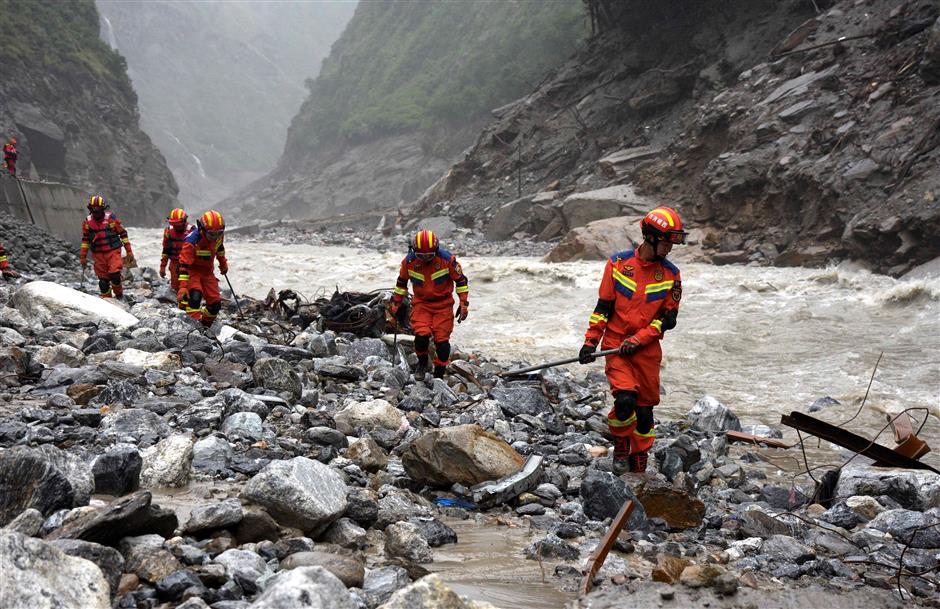
A sudden glacier collapse triggered the massive mudslide that struck Gyirong Port on the China-Nepal border, killing at least 16 people and leaving 546 others missing, authorities in southwest China’s Xizang Autonomous Region said today.
At a press conference in Shigatse, regional officials said no additional survivors had been found in the search and rescue operation. The disaster hit Gyirong Port on August 26, flattening buildings and facilities in one of the region’s key border areas.
According to the regional government, 261 foreign nationals from 23 countries have been identified among those unaccounted for. They include 104 people from Nepal, 49 from India, 33 from Latvia, 18 from the United States, 15 from Britain, six each from Canada and Australia, four from South Africa, three from Malaysia, three from Germany, three from Russia, two from Ireland, two from Estonia, two from France, two from the Netherlands, two from New Zealand, and one each from Kazakhstan, Finland, Lithuania, Portugal, Ukraine, Spain and Hungary.
Chinese authorities said they had notified the relevant embassies and consulates in China. They also said that after multiple rounds of searches, site inspections and checks of people at the port, no foreign tourists were currently stranded in Gyirong County.
The regional government said two 24-hour English-language hotlines had been opened for families of missing foreign nationals: 0086-891-6817165 and 0086-18308026705.
Officials said the cause of the disaster had been determined after analysis by a cryosphere emergency disaster-reduction team from the Chengdu Institute of Mountain Hazards and Environment under the Chinese Academy of Sciences. The team reviewed remote-sensing monitoring data, on-site information and field investigations.
According to the assessment, at 10am Beijing time on August 26, a glacier on the southern slope of Langtang Lirung in Nepal fractured at an altitude of about 5,200 meters, triggering an ice-rock collapse. The debris then plunged rapidly to around 4,000 meters, scoured the mountainside and formed a giant mudslide.
The mudslide traveled about 22 kilometers at high speed before reaching Gyirong Port, which sits at an altitude of about 1,800 meters on the Chinese side of the border. Officials said the disaster destroyed about 0.7 square kilometers of the area, leveling 27 buildings and related facilities.
Monitoring showed that only about 6 to 7 minutes passed between the initial ice-rock collapse and the impact at Gyirong Port, underscoring the suddenness and destructive force of the event.
Experts at the briefing said the disaster was caused by glacier instability linked to the long-term effects of climate warming. They said the event reflected a new and significant pattern of cryosphere hazards on and around the Qinghai-Xizang Plateau: sudden outbreaks, huge flood peaks, fast movement, severe destruction and wide impact.
Editor: Wang Qingchu
In Case You Missed It...

 Sep 4, 2026