On a Train, Your Speakerphone Call Is Everyone's Business
"It's none of your business if I'm on the phone."
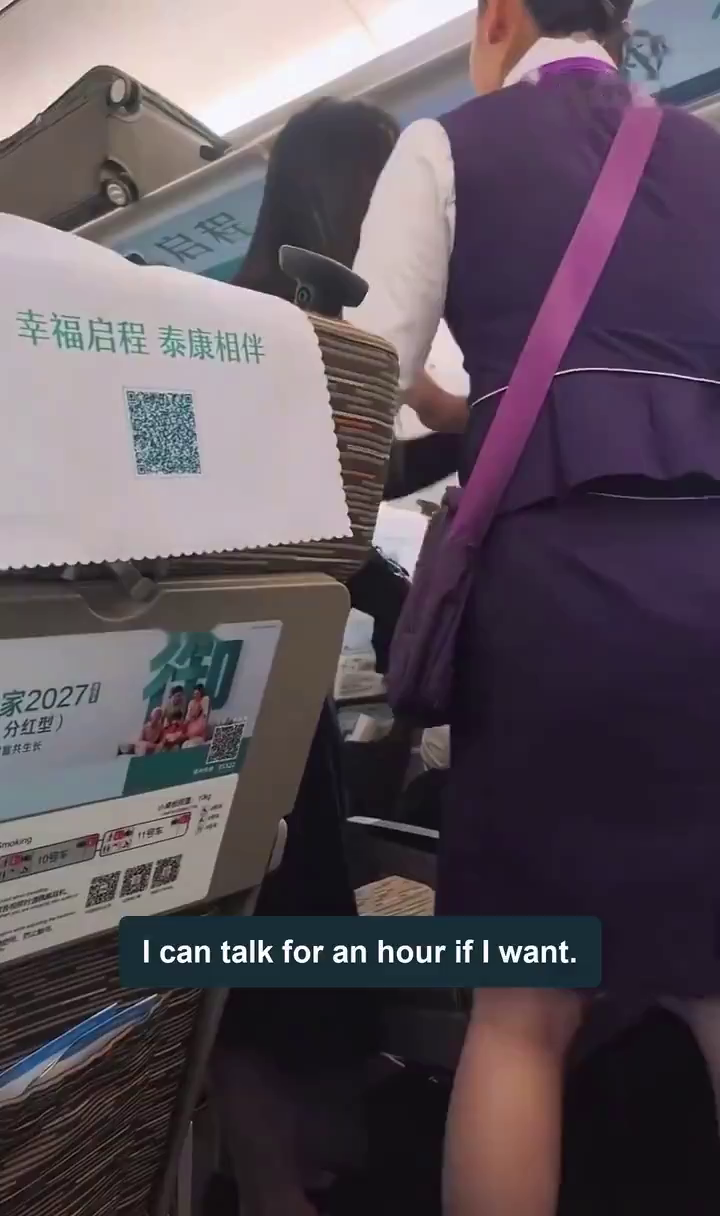
A woman said that on a high-speed train from Beijing South to Shanghai Hongqiao on October 12, after the passenger in the row in front turned around and asked her to stop. According to a video that circulated online two days later, she had been talking to her boyfriend on speakerphone for about an hour. The other passenger told her the carriage was a public space and not her living room, and the two started arguing.
A passenger confronts a woman over her speakerphone call on train G735 from Beijing to Shanghai on October 12, 2026.
Anyone who takes high-speed trains in China regularly has probably sat near someone like her, or near the passenger who talks at full volume for half the trip, or the one watching short videos with the sound on.
Crew on patrol found the two women in Car 10 shortly after the train left Jinan West. In a statement on October 14, the Nanjing passenger section of China Railway Shanghai Group said staff calmed both of them down, the caller hung up after being reminded, and there was no further disturbance. Media reports added that staff arranged another seat for the woman who had complained.
As far as the railway is concerned, that was a dispute handled well, and in a narrow sense it was. The call ended and the carriage went quiet. But it took a stranger risking a public row to get there, and the person who wanted quiet ended up being the one who moved.
Staff may not have been able to do much more. An operator at the 12306 hotline told China Blue News that crew can remind passengers but have no power to make them end a call or switch off a speaker, even in quiet carriages. Other reports quoted the hotline as saying there is no hard rule against calls or speakerphone use in ordinary carriages, and that passengers who want a quiet trip can book a seat in a quiet carriage.
That advice puts the burden in the wrong place. Quiet carriages, where audio goes through headphones and calls are taken outside, suit people who want to sleep or work. An ordinary carriage doesn't need to be that strict. People chat, phones ring and children cry. But a passenger in an ordinary seat can reasonably expect not to spend an hour listening to a stranger's private call, and shouldn't have to book a special carriage to avoid it.
There is already a model for this. Since 2020, national rules for urban rail have barred subway riders from playing audio through their phone speakers, and Shanghai's metro passenger code specifically rules out speakerphone calls. So a commuter is covered by a written rule on a 20-minute ride on Line 2, but not on a high-speed train journey that lasts several hours. Metro riders can at least get off at the next stop. A passenger on a railway train had a seat number and nowhere else to go.
Leaving it to passengers rarely works. When Britain's Liberal Democrats proposed banning phone audio without headphones on trains and buses in April 2025, polling commissioned by the party found that 54 percent of people would not feel comfortable asking a stranger to turn their music down. Most people put up with it. The ones who speak up risk a row.
The railway should start with the clearest case. Its own statement after the incident asked passengers not to disturb others when using electronic devices. That should become a rule in every carriage: calls, videos and music go through headphones. Whether sound is coming from a phone speaker is easy to see, so crew would have nothing to argue about.
Speakers aren't the whole problem, though. A loud, hourlong call is just as hard to sit through without one. For that, the railway needs a clear order of steps. Passengers should be able to report a problem to staff without having to confront anyone themselves. Crew should then ask the person to keep it down. If the noise carries on and it's something the person could stop, such as a call or a video, that person should be the one asked to finish it in the vestibule. A crying baby is a different matter, and families in that situation need help from staff more than anything.
What happens when someone refuses? That is for the railway to decide and publish, instead of leaving each crew member to negotiate on the spot. Shanghai's metro code says riders who keep refusing to stop can be handed over to the police. High-speed trains don't have to copy that, but passengers and staff should know where the line is.
The woman on the G735 said her call was none of anyone else's business. On a train, it was everyone's. The passenger in front of her just shouldn't have had to be the one to say so.
Editor: Wang Xiang
In Case You Missed It...
 Oct 14, 2026