'Five Centers' Are Not Just For Shanghai But For The Nation
Editor's Note:
Amid changes unseen in a century, Shanghai is now focusing on a key question – how to further broaden the development space for "Five Centers" by leveraging the centers' pioneering role, leading with science and technology innovation, advancing coordinated efforts, and serving national strategies.
This is the second part of a series of articles recently published by Jiefang Daily and Shanghai Observer to explore the direction and opportunities for the next phase of the "Five Centers" construction in line with the proposals for the 15th Five-Year Plan. For Shanghai, technological innovation is not merely one of the "Five Centers" tracks; rather, it is the "new core" that provides powerful momentum for the city's development.
Shanghai Daily translated and edited these articles.
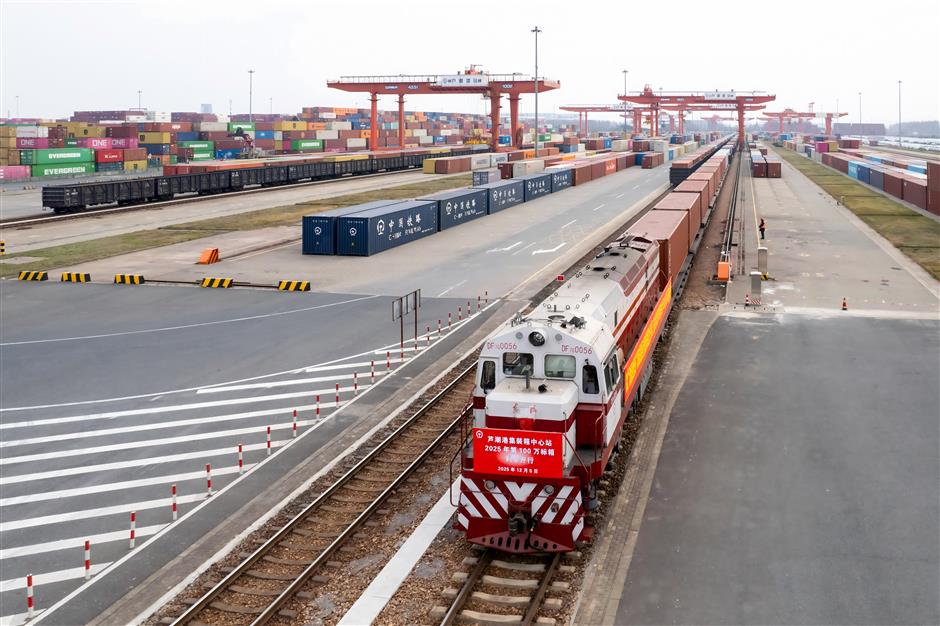
A sea-rail intermodal train loaded with solar panels, auto parts and other goods departed from the Luchao Port container terminal in Shanghai on December 5.
Loaded on the train was the 1 millionth TEU (20-foot equivalent unit) in the city's rail-sea transport this year. While the number is a trifle in view of the freight handled annually by the top harbor in the world, it is a telltale number in the context of China's geo-economic map. To say the least, this railway is part of a vast transportation network covering more than 40 cities in 10 provinces and municipalities, including Jiangsu, Zhejiang, Anhui and Sichuan provinces.
Shanghai acts as a pivotal gateway in this network, as freight hailing from the hinterland is transferred to ships via Shanghai Port, and then heads to global destinations.
In recent years, the city has made strides in building its "Five Centers," namely the International Economic Center, International Financial Center, International Trade Center, International Shipping Center, and International Center for Sci-Tech Innovation. The aspiration begs the question: Are the centers solely for the city of Shanghai?
The answer can be found in the grand strategies of the nation: Shanghai belongs to the whole of China, in light of its stated mission to serve national development strategies.
First-Mover Advantage
Much could be made of the very conception of the "Five Centers." After the launch of reforms and opening-up, Shanghai quickly emerged as international centers for economy, finance, and trade, or the "Three Centers." Following China's World Trade Organization (WTO) accession at the turn of the century, leveraging the expansion of imports and exports, Shanghai was well poised to become the largest shipping center in the world.
The "Five Centers" concept became complete in 2014, as the central government designated the city as a center for sci-tech innovation with global influence.
A cursory look around would suggest that there are fewer international metropolises with such endowments as Shanghai. New York and London excel in finance, San Francisco leads in sci-tech innovation, and Paris is known for its culture, but Shanghai is more versatile, even without considering its solid industrial foundation, with its industrial GDP weight far above that of an average first-tier international city.
There are good reasons for this versatility: a city with a single function is vulnerable when confronting complex global competition. In the face of raging trade and tech wars, China needs to convert science and technology into industries, and then trade, which could be facilitated by shipping and finance. The country needs a fulcrum, which is Shanghai, to prop up this system.
As the city evolves from the "Three Centers" to the "Five Centers," each new role is conceived of abreast of the times, making the city a first mover that vigorously supports national development, as well as the city's own construction.
A case in point is the International Center for Sci-Tech Innovation. This was launched in 2014, when smartphones were gaining traction, and the Internet economy was booming. The surging demand for the digital economy laid the groundwork for artificial intelligence (AI) and chip upgrades.
Looking back, when ChatGPT-induced fervor over AI-made science and technology the focus of international rivalry eight years later, we realized that all this had been anticipated in the gist of the "Five Centers."
"China's huge population demands rapid development, while Shanghai is historically and realistically destined to participate in global competition and cooperation on behalf of the country, hence the city's inexorable role," Wang Sizheng, president of the Shanghai Society of Macroeconomics and an expert advisor to Shanghai's 15th Five-Year Plan (2026-30), points to the actual conditions of China and Shanghai.
Regional Synergy
As a center implies the agglomeration of resources, the abundance of resources might spill over into adjacent areas. That explains, globally, the large urban clusters formed around central cities, for example, the Boston-Washington Urban Corridor in the United States, the London Metropolitan Area in the United Kingdom, the Tokyo-Nagoya-Osaka Urban Corridor in Japan, and the Seoul Metropolitan Area in South Korea.
Urban clusters, as the highest form for spatial organizational in term of economic development, are therefore key indicators of a country's core competitiveness. Take the example of Shanghai, which leads the Yangtze River Delta region (including Shanghai and the nearby provinces of Jiangsu, Zhejiang and Anhui). Notwithstanding the region accounting for only 4 percent of China's land and 16.9 percent of its population, the delta contributes nearly a quarter of the country's total economic output.
This is confirmed in statistics for 2024, which reveal a number of well-off neighbors radiated by Shanghai's leading role in high-end innovation: Kunshan's GDP exceeded 500 billion yuan (US$71.4 billion), Zhangjiagang, upwards of 300 billion, and Taicang, just short of 200 billion.
As the delta engine, Shanghai has been fostering regional synergy all along.
Wang noted a peculiarity: Over the past 20 years, the city has been resiliently cooperating with its neighbors in developing high-end industries in new energy vehicles, integrated circuit, and biopharmaceuticals, in a well-choreographed inter-regional dance, in contrast to the isolated or insulated mode of growth often pursued by such urban clusters elsewhere.
A case in point is robotics. In July 2022, the Shanghai Municipal Commission of Economy and Informatization notified related departments of Jiangsu, Zhejiang and Anhui provinces, proposing to hammer out collaboration in building a full supply chain in robotics in the delta region, by uniting 12 upstream and downstream enterprises. Today, in Shanghai STEP Robotics, the bearings are sourced from Wenzhou, the servo motors from Quzhou, and the reducers from Suzhou. More than 5,000 such robots, with an entire supply chain scattered across the region, have rolled off the production line, to be used in NEV assembly lines and lithium battery manufacturing.
There are even more cases of high-end regional collaboration in large aircraft, large ships and IC. In developing COMAC C919 large jetliners, for instance, a third of the suppliers are from the delta region. For the big-time LNG carriers built by Hudong-Zhonghua Shipbuilding (Group) Co Ltd, the delta region accounts for more than 90 percent of domestic suppliers. Shanghai Huahong Grace Semiconductor Manufacturing Corp (HHGrace) started off by building the first 8-inch IC production line on the Chinese mainland in 1996, and is operating today three 8-inch wafer fabrication facilities in Jinqiao and Zhangjiang, and two 12-inch wafer fabrication facilities in Wuxi. The twin-city layout of these facilities sustains HHGrace as a global leader in pure-play wafer foundry solutions.
Numerous facts show that the higher the city is as a powerhouse, the stronger its spillover effects.
So much so that this symbiotic relationship could help remove barriers of administrative boundaries. Take the example of the adjacent Wujiang Fenhu High-Tech Zone which, to all appearances, prefers to be seen as part of the Hongqiao Sub-Center, rather than a Suzhou gateway. Early this century, the zone in Suzhou secured itself a rare privilege: It can use telephone numbers preceded either with the 0512 area code (for Suzhou), or 021 (for Shanghai).
This reflects tacit recognition of Shanghai's leading role in the delta.
Pooling Resources
As a matter of fact, the "Five Centers" strategy looks beyond the delta region, by pooling vital resources for the national market.
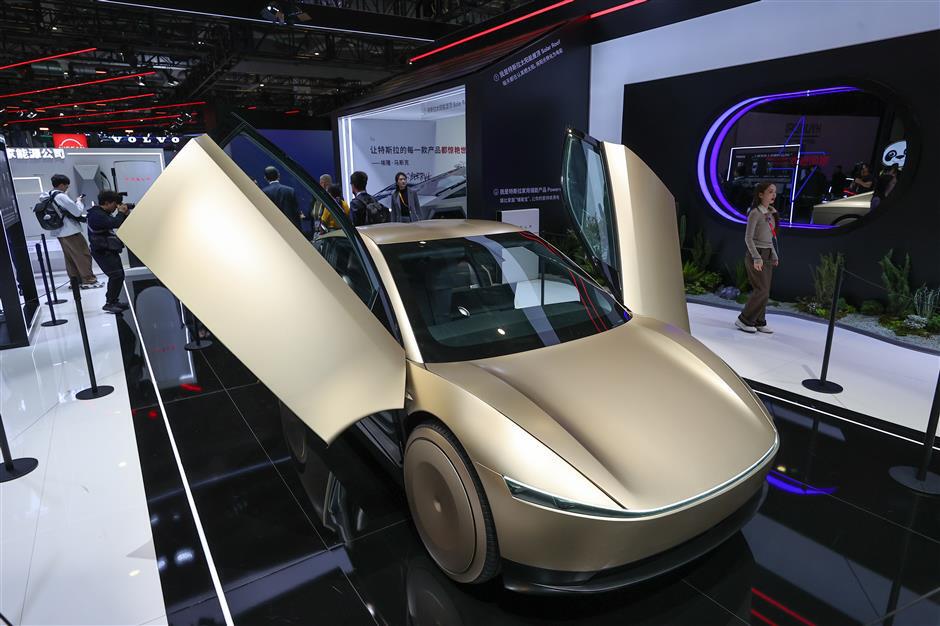
The Tesla Gigafactory serves as another example. Located in the southeast corner of Shanghai, the factory is served by highly localized chains of suppliers consisting of hundreds of domestic providers from across China. Thus it comes as no surprise that the components of a Model Y come from Beijing, Tianjin, Suzhou, Ningbo, Jiangmen, Huizhou and other cities. The efficient industrial chain enables the Gigafactory to roll out a finished unit every 30 seconds, crowning it a global leader in terms of efficiency.
Through the ebb and flow of the supply chain, foreign enterprises can source in Shanghai in the most efficient manner, while domestic enterprises, by involving themselves in the global chain, can also access the global market via Shanghai. Currently, more than 60 out of Tesla's over 400 tier-1 suppliers in China have been co-opted into global supply chains, seeing phenomenal growth amid international competition.
Such observations are much evidenced in corporate response. At this year's China International Import Expo, Grace Tao, vice president of Tesla, while recalling the launch of the Shanghai factory, said, "Overall, Tesla could have built a factory anywhere in China, but Shanghai was the most balanced choice."
Shanghai's integrated strengths in logistics, trade and high-end manufacturing have enabled Tesla, the "catfish" in the industry, to help more Chinese enterprises to go global.
This is precisely the underlying logic of building the "Five Centers:" to allocate resources on a global scale on behalf of China.
Challenges remain. Shanghai's per capita GDP is currently around US$30,000, lower than that of other first-tier international cities. The professionalism of its financial services and the diversity of its trading products cannot compare with well-developed international financial centers. The huge volume of goods trade in the city cannot offset its deficit in services trade. The city as an international shipping center needs to address the shortfall in high-end services. And there is much room for improvement in the commercial application of its scientific and technological achievements.
However, these gaps are precisely what make the "Five Centers" relevant: Shanghai, by participating in global competition on China's behalf, and drawing on the experience of global development, serves as the best test field for Chinese modernization.
In early December, at a seminar focusing on accelerating the construction of the "Five Centers," Zheng Yongnian, dean of the School of Public Policy at The Chinese University of Hong Kong (Shenzhen), pointed out that, given the city's strength in basic science and research, the delta region's adeptness at application and transformation, and the support the city enjoys as an international financial center, the synergy of these three factors can effectively drive industrial upgrading. However, he added that Shanghai still needs to give fuller play to the vitality of production factors through institutional and systemic reforms.
Nevertheless, the city's potential is enormous, considering its geography, its economic foundation, and policy support. Through continuous reform, opening-up and innovation, the future Shanghai will not only be a giant in terms of scale, but also a rule-maker, and this is where its versatility boils down to.
Editor: Su Yanxian
In Case You Missed It...
 Aug 25, 2026

![[Feel Shanghai] Your Ultimate FAQs and City Guide 2026](https://obj.shine.cn/files/2026/08/20/877c357c-8de1-4d00-aa64-2fa44b857386_0.jpg)


![[SH Transit] How Shanghai's 'Air Express Lines' Speed Up Domestic Connections](https://obj.shine.cn/files/2026/08/25/39f368b4-c3fe-4776-853e-4d14e19ca50a_0.jpg)