China to Codify Green Transition into a Single, Coherent Rulebook
For more than a decade, China's environmental credentials have been burnished in campaigns against pollution, and in its drive to adopt renewable energy sources. With good results now tangible, the country is entering a new phase to prioritize advanced manufacturing and clean technologies. Eco-friendly policies are moving from enforcement to institutional integration.
That's why the drafting of the Environmental Code of the People's Republic of China, which was adopted today by the National People's Congress, is attracting such attention. The legislation aims to consolidate dozens of environmental regulations into a unified legal framework covering pollution control, ecological protection and climate governance. In essence, China is attempting to turn years of environmental policy into a coherent rulebook for the green transition.
China's environmental governance has evolved in distinct phases over the past two decades. In the early 2000s, environmental regulation struggled to keep pace with rapid industrialization. As factories multiplied and cities expanded, pollution became one of the country's most visible development challenges.
The response in the 2010s was decisive. Authorities launched campaigns to clean up air, water and soil pollution, with regulation tightening from formerly loose oversight. Success has been documented. Average concentrations of PM2.5 particulates, the common primary air pollutant, fell at least 61 percent in the 13 years ending in 2025, according to the Ministry of Ecology and Environment. Water quality also improved markedly, with the share of surface water rated as "good" increasing to at least 90 percent.
Yet campaigns, by definition, are temporary. They can deliver more immediate results but don't necessarily help businesses looking at long-term investments. Companies planning multibillion-dollar battery plants or renewable-energy projects need regulatory predictability – a clear set of rules defining the playing field.
That is precisely what the new environmental code seeks to provide. It comes amid the national goal of hitting peak carbon emissions by 2030, then reducing them to net neutrality by 2060. And it also dovetails with a transformation in China's industrial structure.
Over the past decade, China has emerged as the world's largest manufacturer of clean-energy technologies. Electric vehicles, solar panels and lithium batteries have become central pillars of the country's green industrial policy.
According to the UK-based Benchmark Mineral Intelligence, which specializes in tracking the new-energy vehicle industry, global sales of electric cars last year rose 20 percent to 20.7 million, with sales in China accounting for about two-thirds of the total. China has become not only the world's largest maker of the cars but also dominates the industry that turns out batteries to power them.
The scale-up of China's green manufacturing annual added is also reflected in official industrial data, like the chart below from the Ministry of Industry and Information Technology.
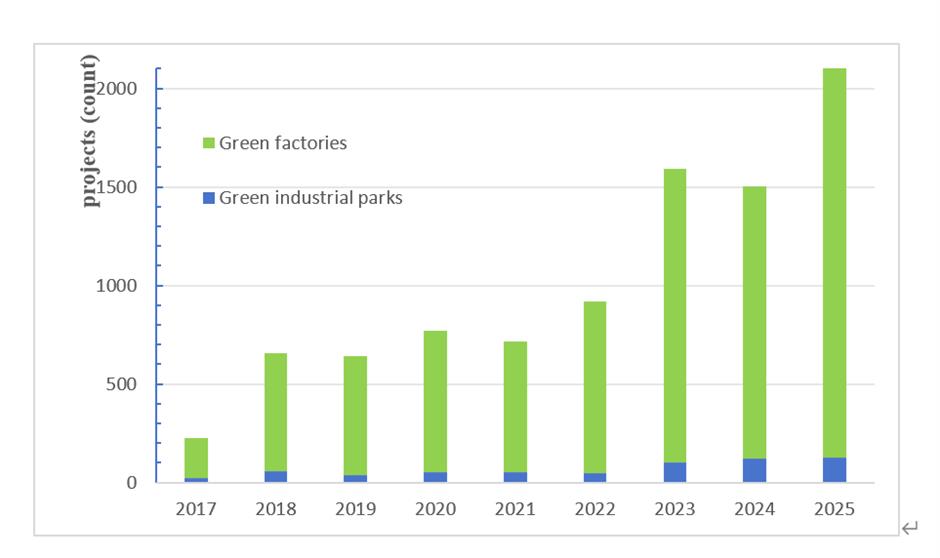
China's clean-energy industries drove more than 90 percent of the country's investment growth last year. By the end of the third quarter of 2025, the outstanding balance of yuan and foreign-currency green loans topped 43.51 trillion yuan (US$6.2 trillion), a 17.5 percent increase from the start of the year, according to the Green Finance Development Center. The money has flowed into green factories, green product development and the creation of industrial parks dedicated to green industries.
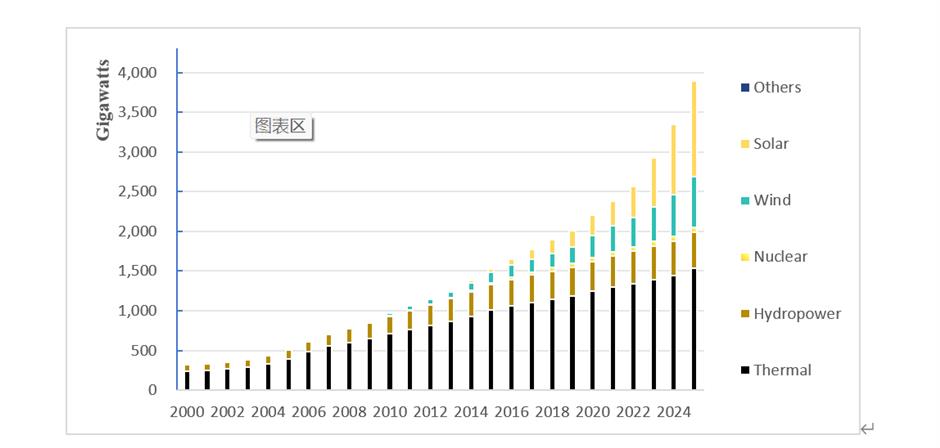
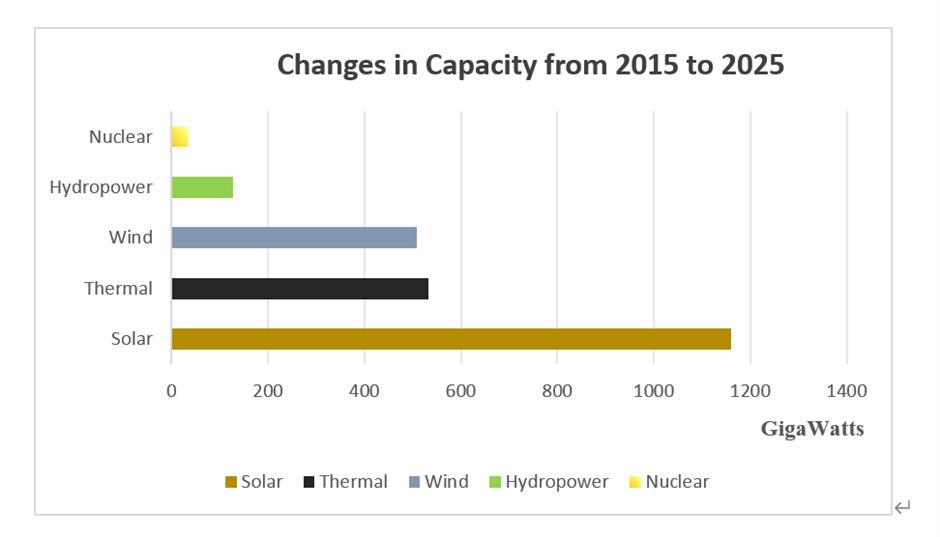
The renewable energy sector accounted for about 11.4 percent of China's gross domestic product in 2025, according to CREA analysis for Carbon Brief. For the first time, China last year deployed more clean power capacity than fossil fuel generation, drawing 51 percent of its power from renewable sources, according to Global Energy Monitor.
China had 1,494 gigawatts of clean power generation capacity in operation last year. Solar power capacity has surged 1,554 percent in the past decade, with solar farms accounting for 18 percent of operational capacity last year. By the end of 2025, China's installed wind power capacity reached about 520.6 gigawatts, accounting for nearly 46 percent of the world's total capacity. Gains have also been made in hydropower and clean biofuels.
China's clean-energy industries are also expanding rapidly in global trade. Exports of solar power panels and related product have helped other countries reduce carbon emissions by billions of tons, and the cost of that help gets cheaper the more China's industry expands.
Foreign companies operating in China are already seizing the opportunities of China's go-green policies. One prime example is Tesla's mega-factory in China, which manufactures electric vehicles for both the domestic and overseas markets.
For multinational firms seeking to build low-carbon supply chains, regulatory clarity matters. A transparent legal framework helps create an environment where both domestic and international companies can operate under consistent environmental standards.
China's approach contrasts with emerging climate policies elsewhere.
The EU's Carbon Border Adjustment Mechanism aims to impose carbon costs on certain imported goods, such as steel and cement. The goal is to prevent "carbon leakage" by ensuring that imports face environmental costs comparable to those imposed on European producers.
China's strategy has focused more on transforming domestic industrial systems through renewable energy expansion, manufacturing innovation and increasingly stringent environmental regulation.
(The author is an associate researcher at the Institute of Ecology and Sustainable Development, Shanghai Academy of Social Sciences.)
Editor: Liu Qi
In Case You Missed It...

 Mar 12, 2026
![[Hai Guide] 2026 F1 Chinese Grand Prix Spectator Guide](https://obj.shine.cn/files/2026/03/11/9d839dbb-4b36-4303-b8c7-5998e96b68d5_0.jpg)



![[Big News] SH Just Made Medical History w/Brain-Chip Interface](https://obj.shine.cn/files/2026/03/13/9df3ad1e-ab0c-42f3-9611-7db7cc2fd591_0.jpg)