What Are We Forfeiting As AI Accelerates Domination of Daily Life?
Systems & Signals
Business landscapes are shaped not just by headline disruptions, but by the structural shifts beneath them. This series decodes the forces transforming China and global markets, from AI adoption and innovation ecosystems to trade recalibration and institutional strategy. Drawing on on-the-ground reporting and strategic analysis, the column offers executives and policymakers timely insights into how technology, governance and human capability coevolve in an age of rapid change.
A friend of mine, Eric Huang, spends his evenings with Bach.
He writes about classical music for both Chinese and international publications, sings in an amateur choir and organizes concerts for a small circle of enthusiasts. His calendar is full, not with obligations, but with things he has chosen to care about.
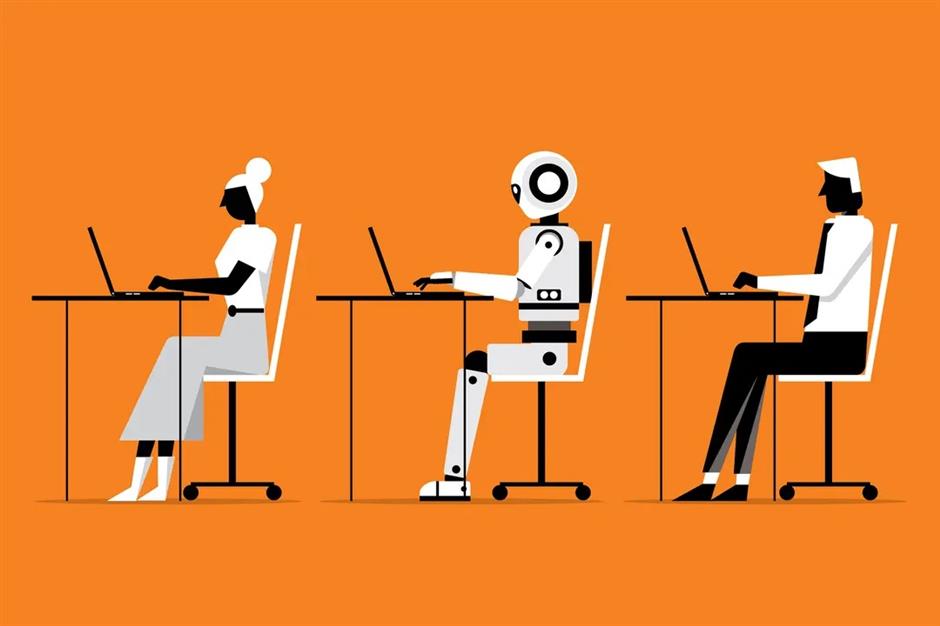
During the day, his company is cutting staff. As a senior design expert, he understands the direction. Tools that once assisted his work now replicate parts of it. Concepts appear in seconds. Iterations no longer require teams.
When we last spoke, I expected anxiety. What I heard instead was something closer to relief.
"Artificial intelligence pressed pause for me," he said. "It forced me to ask what actually matters."
Eric is not unusual. He belongs to a coterie now facing the same question – mostly people in their forties, based in large cities and with careers built on years of accumulated skill. They did what they were supposed to do. They specialized, improved, moved forward.
That logic no longer holds.
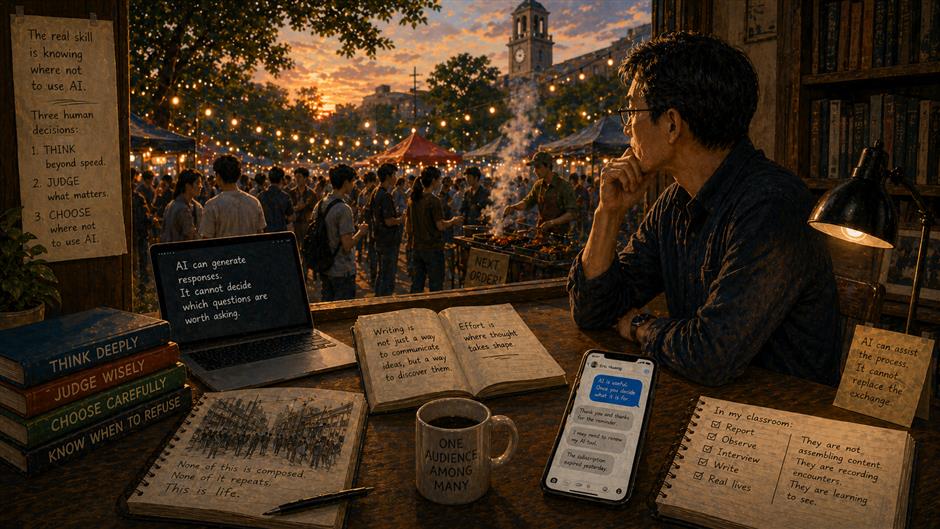
For a time, the instinct was to keep up. Learn the tools. Move faster. Stay relevant. But increasingly, I see a different response. Not acceleration, but refusal.
Not everyone wants to run in a race where the finish line keeps moving.
AI has made access cheap. Tools, knowledge and output now sit within reach of almost anyone. The distance between beginner and expert has narrowed, at least in appearance. What once required years of training can now be approximated in minutes.
We call this progress. In many ways, it is.
But it comes with a quiet trade-off.
We have not lost intelligence; we have lost the habit of using it.
The time once spent struggling with a problem has been compressed into a prompt. The effort required to form an idea has been replaced by selecting from generated options. We move quickly from question to answer, often without fully engaging either.
We are not just using AI. We are avoiding effort. That may be efficient, but it is not neutral.
That's because effort is not a cost to be eliminated. It is the process through which thought takes shape. Remove it, and you do not just save time. You lose something harder to measure.
If this continues, the next divide will not be between those who use AI and those who do not. It will be between those who still think and those who no longer need to.
Thinking, in its deeper form, resists speed. It requires time, doubt and a willingness to stay with uncertainty. AI can generate responses. It cannot decide which questions are worth asking. That remains ours.
Alongside thinking, judgment becomes decisive.
We need to know what is good, what is true, what deserves attention. AI can produce endless variations. It does not care which one matters. It reflects patterns. It does not hold standards.
The danger is not that AI produces bad work. It is that it produces acceptable work so easily that we stop demanding more.
And then there is a third decision, less obvious but more consequential.
We must decide where not to use AI.
The instinct today is total adoption. If something can be automated, it will be. If something can be accelerated, it should be.
But some processes lose their value when they are optimized.
Writing is one. It is not only a way to communicate ideas, but a way to discover them. Remove the effort, and you often remove the thought.
Conversation is another. Relationships do not emerge from efficiency. They take shape through pauses, interruptions and response.
Expression, in all its imperfect forms, belongs here as well.
The real skill is no longer mastery of tools. It is the ability to draw boundaries around them.
I see this most clearly in my classroom.
I teach journalism to second-year students. They understand what AI can do. They know it can fabricate interviews, construct narratives and produce articles that look convincing.
But in my class, they must report. They must speak to people, observe details and write stories grounded in real lives.
They could generate their assignments. Some may try. Most do not.
Part of the reason is technical. Fabricated stories lack texture. They miss the hesitation before an answer, the contradiction within a sentence, the detail that does not quite fit.
But the deeper reason is simpler.
They want the work to belong to them.
Their writing is uneven. Their structure sometimes fails. One student rewrote a paragraph three times because she could not capture the way her interviewee paused before mentioning his father. The sentence still did not fully work. She kept it anyway.
That decision matters more than polish.
They are not assembling content. They are recording encounters. They are not just learning to write. They are learning to see.
As I write this, I am waiting to begin a class. Outside, the campus is holding a food festival. The crowd presses in around small stalls. Smoke rises from grills. The smell of meat and spice drifts through the air.
A student at the front of a line checks her phone, steps aside, then returns when her friend arrives. Two strangers negotiate who was there first. Someone laughs too loudly at something that was not that funny. A vendor wipes his hands on his apron and calls out the next order.
None of this is composed. None of it repeats.
AI can generate an image of this scene. It can balance the light, sharpen the colors, arrange the composition.
But it cannot stand in line. It cannot hesitate. It cannot decide whether to stay or leave.
In one world, this is content. In another, it is life.
The distinction is not philosophical. It is practical.
For a time, I treated AI as a creator. I asked it to write poems, compose songs, generate images. The results were impressive. They were also interchangeable.
Now I use it differently.
I let it read what I write. I let it respond. It acts as a listener, not a substitute.
It is one audience among many.
The others are the people around me. Their reactions arrive without filtering. A pause, a shift in tone, a brief silence. These signals carry meaning. They shape what I think I have said.
AI can assist the process. It cannot replace the exchange.
When I finished writing this, I sent Eric a message. I had used an AI tool to help him secure a ticket to a concert he had been trying to attend.
"AI is useful," I wrote. "Once you decide what it is for."
He replied, "Thank you and thanks for the reminder. I may need to renew my AI tool. The subscription expired yesterday."
Which may be the only order of things that still belongs to us.
(The author is an adjunct research fellow at the Research Center for Global Public Opinion of China, Shanghai International Studies University, and founding partner of 3am Consulting, a consultancy that specializes in global communications.)
Editor: Liu Qi