Top News
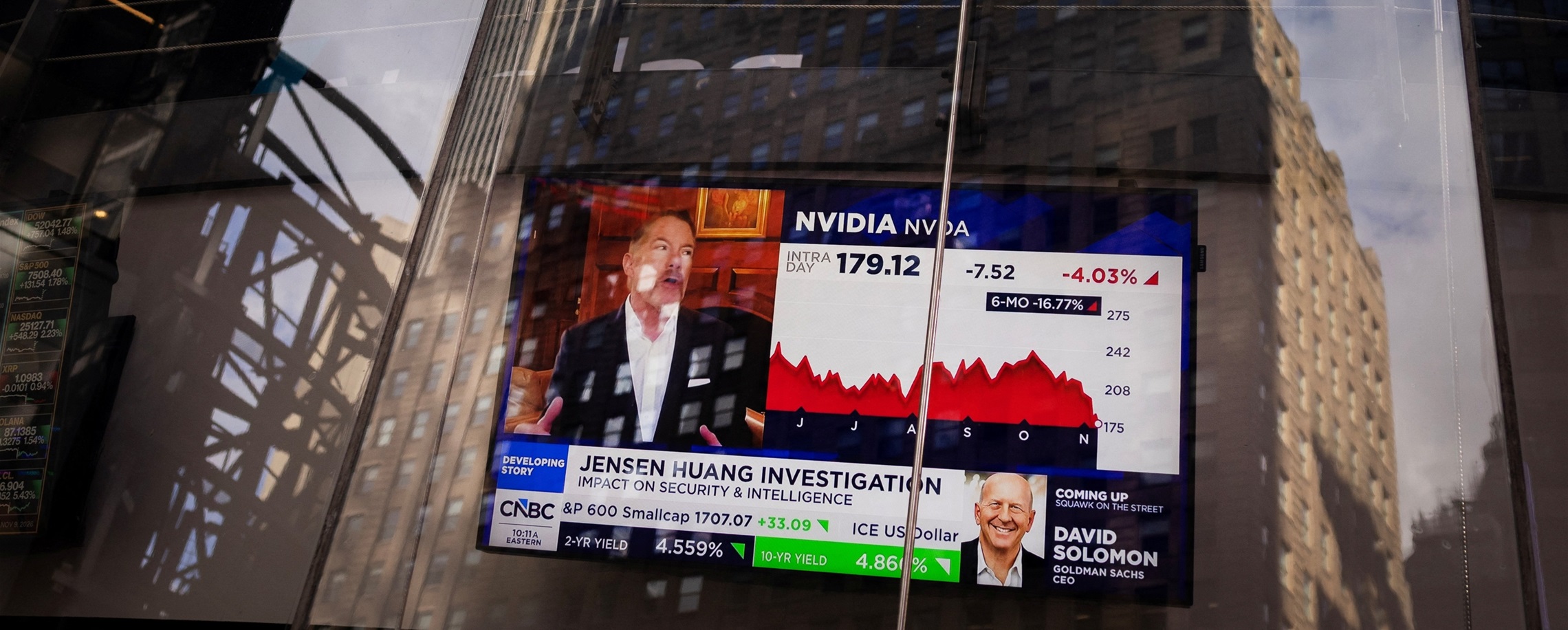
Nvidia Shares Slide as Board, FBI Investigate CEO's Affair
Nvidia shares fell 4.3 percent in New York on Monday despite a Wall Street rally in tech shares after the chipmaker's board opened an independent inquiry into whether Chief Executive Jensen Huang was targeted by a foreign intelligence operation. Huang, 63, admitted and apologized for an extramarital affair with a Singapore-based businesswoman now suspected of gathering intelligence for China. US President Donald Trump later told a press briefing that the FBI is investigating the affair but Huang has assured him he had had no idea she might be a spy. China's Foreign Ministry dismissed the espionage allegation as a baseless smear.
The fate of Taiwan-born Huang – co-founder of Nvidia 33 years ago, mastermind of its growth into the world's most valuable chip company and a sort of an AI rock star – isn't clear. If he were forced out, there's no clear successor. The company's directors said they have "confidence in Jensen" and "no reason to believe that either national security or Nvidia secrets were compromised." Elon Musk and other industry moguls have come out in support of Huang.
UN Climate Change Conference Begins. Is Consensus Possible?
The 31st UN Climate Change Conference has begun in Turkey following a year that has produced record high temperatures and increasing natural disasters blamed on a warming planet. Representatives from about 190 countries are debating how to address a climate crisis that shows little signs of slowing. The world's biggest emitter of greenhouse gases won't be attending. The US pulled out of global climate agreements after President Trump took office nearly two years ago and began dismantling pollution control policies. Past summits of the UN group have focused on setting limits on harmful emissions, though implementation has fallen short of goals. The climate debate is complicated by continuing friction between rich and poor countries over who pays for the impact of the climate crisis. Africa, in particular, which has faced prolonged droughts and destructive flooding, says it contributes little to greenhouse gas emissions and should receive funds to cope with the fallout. And low-lying island nations in the Pacific Ocean that are particularly susceptible to rising sea levels want aid.
Trump, in Election Autopsy, Says Immigration Crackdown 'Too Tough'
US President Donald Trump, in wide-ranging interview with US TV network CBS after the Republican rout in last week's midterm elections, acknowledged his immigration crackdown was probably "too tough," just days after he named the chief architect of that policy, Stephen Miller, as his new chief of staff. The sweeping deportations of immigrants – some of whom held down good jobs and lived in the US for 10 years or more – has been cited as a main reason Latino voters, who supported Trump two years ago, deserted Republicans in droves this time around. In the interview, Trump admitted no personal blame for the Democrats seizing control of both houses of Congress and said again that he has no regrets about starting the war in Iran, another factor in the Republican trouncing. The president also said the risks posed by artificial intelligence can be managed but signaled an openness to safeguards.
US Defense Secretary Faces Impeachment Vote
US Defense Secretary Pete Hegseth faces an impeachment vote in the lame-duck House of Representatives next week after Republican Thomas Massie introduced articles of impeachment alleging illegal prosecution of the Iran war without congressional approval and other abuses of power. Hegseth, a former commentator on the right-wing Fox News network, has remained defiant against critics of the unpopular war, with President Trump saying he has confidence in the Pentagon chief. Massie's campaign for re-election this year was derailed by a candidate supported by Trump. Republicans still hold a thin majority in the House. The newly elected Democratic Congress doesn't take office until early January.
Top Business
Huawei, JAC Eyed for Maserati Project, BYD Plays Down Takeover Talk
Stellantis, owner of Italian luxury carmaker Maserati, is exploring a partnership with Huawei and China's JAC Motors, Yicai reported on Monday. JAC will build a Maserati model in China using Huawei technology under a project called Maserati Design. JAC previously confirmed exploratory talks, but the companies have yet to announce a binding agreement. This comes days after BYD Executive Vice President Stella Li played down speculation that the Chinese automaker might buy Maserati, saying BYD might have been interested a few years ago but now sees more value in building its own premium brands.
EU Accuses TikTok of Sucking Young Users Into 'Rabbit Holes'
ByteDance's TikTok video platform has been accused by the EU of failing to protect young users' mental health by exposing them to a relentless stream of content that risks worsening eating disorders and reinforcing anxiety. In a preliminary ruling the EU regulator said TikTok's algorithms are leading young and vulnerable users "down rabbit holes they cannot easily escape from." TikTok rejected the accusations. The platform, which has 189 million users in the EU, faces a possible fine next year of up to 6 percent of annual global revenue unless it changes its business model in the 27-member bloc.
WuXi AppTec Removed From Pentagon Blacklist
Chinese biotech company WuXi AppTec was removed from the US Defense Department's list of Chinese companies with alleged ties to the military, according to a government posting on Monday. The decision came after a federal court issued an injunction barring the Pentagon from enforcing the designation after WuXi AppTech filed a lawsuit to get its name removed. The Shanghai-based company called the designation arbitrary, capricious and unsupported by facts. Earlier this year, the Pentagon expanded its blacklist of alleged "Chinese military companies" to 188.
China Expands Scrutiny of Micro Dramas
China's National Radio and Television Administration tightened scrutiny of micro dramas to include AI face and voice theft. Nearly 550,000 of the micro dramas went online in the first 10 months of this year– about 17 times the full-year 2025 total – with AI-generated productions accounting for 94 percent.
Tencent AI Scientist Warns of Higher risks of Bioweapons, Pandemics
Yao Shunyu, chief AI scientist at Tencent Holdings, warned at a science symposium that AI will soon reach a critical threshold in biology, potentially accelerating drug discovery while also creating risks of bioweapons and new pandemics from AI-designed pathogens. However, he noted, "I think every technological change is just a matter of time and will eventually be solved. The bigger challenge is the social and organizational dimension." His comments reflect a growing view among experts that biology will be AI's next major frontier, following coding, which sent shockwaves through global cybersecurity. When Tencent unveiled its flagship Hy4 model, the company said it stripped out cyber-hacking capabilities.
Economy & Markets
China Consumer Inflation Cools, Wholesale Prices Accelerate
China's consumer prices in October eased but wholesale prices grew at their fastest pace in more than four years, underscoring the effects of weak consumer spending and a sluggish property market. Consumer inflation slowed to 0.7 percent growth from a year earlier from 0.9 percent in September, the National Bureau of Statistics. The tame inflation is in stark contrast with other major economies grappling with prices surging above central bank targets. China's producer prices, the factory-gate gauge, accelerated to 5.7 percent from 5 percent a month earlier, as higher energy and commodity prices from the Iran war lifted manufacturing costs. Supply shortages of semiconductors have also boosted prices in some manufacturing sectors. Core inflation, which strips out food and energy prices, came in at 0.8 percent from 1 percent in September.
China to Continue Suspension of Some Import Tariffs on US
China said it will continue its suspension of additional 24 percent tariffs on US imports for two months, but a base tariff of 10 percent will remain. The suspension also covers special fees to be levied on US-linked vessels docking in Chinese ports and stricter export controls over certain rare-earth and battery-related goods. At the Washington summit in September between Chinese President Xi Jing and his American counterpart Donald Trump, both leaders agreed in principle to a US$60-billion package of reciprocal tariff cuts, though the plan has never been finalized. A statement from the State Council, China's cabinet, said the suspension is aimed at implementing the "outcomes and consensus reached at the Washington meeting." It added that Beijing will closely monitor tariff actions taken by the US and adjust policies accordingly.
Alibaba T-Head Unit Headed for Hong Kong IPO, Report Says
Alibaba's T-Head chip unit is planning a Hong Kong initial public offering next year, aiming to raise up to US$3 billion, International Financing Review reported. T-Head has built a comprehensive suite of AI data center chip solutions covering everything from parallel and general-purpose computing to high-speed interconnects and data storage, its website says. In September, the unit unveiled its next-generation AI chip, the Zhenwu V900, which Alibaba claimed was the most powerful AI chip in China in terms of computing performance.
Shanghai Companies Log US$2.9 Billion in Orders
Shanghai state-owned companies reported 137 preliminary overseas orders valued at US$2.9 billion during the current China International Import Expo in the city. Copper was a major item. Guomao Holding reached preliminary deals worth about US$1 billion to import copper cathodes from five suppliers, including BHP, Glencore and Trafigura. Shanghai Electric and Siemens Energy also agreed to deepen cooperation on manufacturing gas turbines in China.
Corporate
Sohu Swings to Third-Quarter Loss as Gaming Revenue Falls
US-listed Chinese online media and gaming company Sohu reported a third-quarter net loss of US$14.7 million, turning from profit of US$8.7 million a year earlier. Revenue fell 26 percent to US$133.2 million. Online gaming, which accounted for about 85 percent of sales, fell 30 percent to US$113.9 million. Sohu said the result reflected a strong year-earlier quarter, when a major game update and a new title lifted sales. Beijing-based Sohu said it expects a fourth-quarter net loss of between US$17 million and US$27 million. Its shares tumbled 8.5 percent.
China Mobile, Zhipu to Collaborate on Computing Power
China Mobile has teamed up with Z.ai, more commonly known as Zhipu, to collaborate on domestic computing power, large language model services and the commercialization of artificial intelligence. Zhipu's GLM series models will be integrated into China Mobile's model service system. The Chinese AI startup said allying with China Mobile will help connect the upstream and downstream segments of the industrial chain, improve model inference efficiency and expand the scale of GLM usage, driving large language models from independent technological innovation toward large-scale industrial application.
Nio's Chip Unit Sets Up Shenzhen Subsidiary for Chip Sales
Chinese electric carmaker Nio's chip unit has set up a wholly owned subsidiary in Shenzhen focusing on chip sales, software development and smart hardware sales. The unit, GeniTech, also known as Shenji, began operating last year after a restructuring of Nio's chip division. It said in July that it had shipped more than 300,000 of its self-developed NX9031X driver-assistance chips, which are used in Nio and Onvo vehicles.
RelyEZ Energy Storage Jumps 59 Percent in Hong Kong Debut
Shares of RelyEZ Energy Storage closed 59 percent above their offer price in their Hong Kong debut on Monday. The company raised HK$562.7 million (US$72 million) before expenses, after selling about 57.5 million shares. Founded in Shenzhen in 2019, RelyEZ makes containerized battery storage systems for large power projects and smaller units for factories and industrial parks. The company says it had delivered more than 13 gigawatt-hours of storage systems and products to over 100 customers worldwide as of October 9.
Dalian Wanda Founder Returns to Company
Founder of Chinese multinational conglomerate Wanda Group, Wang Jianlin, has returned as chairman of Dalian Wanda Commercial Management Group, 14 years after stepping down. Wang succeeds Chen Hongtao, who remains the company's legal representative, National Business Daily reported. The parent company has interests in property development, tourism, entertainment and media, and investment.
BioMap to Build Computing Platform in Hong Kong
BioMap, a biotech firm started by Baidu founder Robin Li Yanhong, plans to build a biocomputing platform in Hong Kong, targeting key development areas in the city by leveraging its Chinese mainland ties. China has become an important link in the global biotechnology chain with its progress in new drug discoveries and use of AI. Many of its major biotech companies are listed in Hong Kong.
Editor: Yao Minji
In Case You Missed It...
 Nov 9, 2026