Trump's new tariffs jolt Chinese markets, with pharma and furniture stocks plummeting. Other Asian markets also drop
Asian markets were caught off guard on Friday by US President Donald Trump's announcement of a new round of tariffs on imports of drugs, furniture and heavy truck imports.
"Barely anyone had anticipated such a move by the US, which instantly sent a chill through markets," said Sun Lijian, an economics professor at Fudan University. "This decision comes out of nowhere and again shows how unpredictable the US is now."
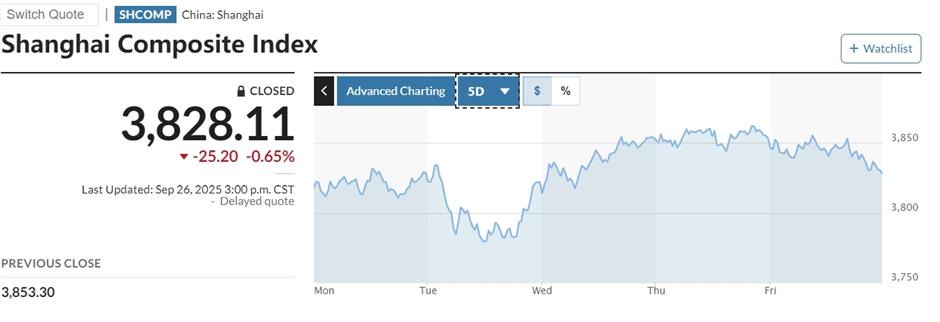
The benchmark Shanghai Composite Index declined 0.65 percent on Friday, while the smaller Shenzhen Component Index slumped 1.76 percent and ChiNext nosedived 2.6 percent. The declines eroded the rallies of previous days, but Shanghai's market ended the week with a 0.16 percent gain, Shenzhen was up 1.06 percent, and ChiNext added 1.86 percent.
Hong Kong's Hang Seng Index lost 1.35 percent on Friday, while Japan's Nikkei shed 0.87 percent and South Korea's Kospi tumbled 2.45 percent.
Trump announced a 100 percent tariff on branded drugs, a 25 percent duty on imported heavy-duty trucks, a 50 percent tariff on kitchen cabinets and bathroom vanities, and a 30 percent tariff on furniture. The new duties take effect on October 1.
Shares in affected sectors plummeted in Asia on Friday. In biotech, Japan's Sumitomo Pharma and South Korea's SK Biopharmaceuticals each fell 3.5 percent, and Australia's CSL dropped 1.7 percent.
Among Chinese stocks in the pharmaceutical sector, Fosun Pharma lost 3.43 percent, Akeso was down 1.25 percent and Innovent lost 3.89 percent. In China's home furnishings and fixtures sector, Ningbo Deye dropped 2.49 percent, and Entive Smart Kitchen Appliance declined 4.86 percent. An index on furniture shares, compiled by the Asset Management Association of China, fell 0.7 percent.
Chinese technology stocks earlier in the week were buoyed by new initiatives announced by Alibaba. The tech giant said it plans to scale up investment in artificial intelligence beyond the 380 billion yuan (US$53 billion) announced earlier this year, roll out its most powerful language model yet and collaborate with US chip giant Nvidia in a software deal related to tools used in training humanoid robots.
The company's shares in Hong Kong rose to a four-year high on the news, but fell 3.2 percent on Friday amid a general cooling of AI-related shares globally after US Fed Chairman Jerome Powell said in a speech that share valuations were looking a bit pricey. US hedge fund manager David Einhorn, founder of Greenlight Capital, told a panel at the New York Stock Exchange this week that the spending splurge on artificial intelligence has become so extreme that the returns may not be what companies and investors expect.
China is beefing up efforts to cope with rising global uncertainties. During a meeting of the central bank this week, officials recommended implementation of a "moderately accommodative monetary policy," a step up from a tone of "maintaining" policies set forth in previous meetings.
Investors in the US and Europe largely shrugged off Trump's new tariffs, with markets rising on Friday. But for the week, the Nasdaq lost 0.7 percent, the S&P 500 slid 0.3 percent and the Dow shed 0.2 percent. In Europe, the Stoxx600 rose 0.8 percent on Friday after a steep drop a day earlier.
Editor: Yao Minji
In Case You Missed It...
 Apr 1, 2026