Music Takes the Stage at the 41st Shanghai Spring International Music Festival
For one day, the Shanghai International Equestrian Center changed. The usual clatter of hooves and the tension of competition gave way to music.
The opening of the 41st Shanghai Spring International Music Festival felt less like an event and more like a shared experience. Diplomats, musicians, and audience members from around the world came together in one space to celebrate music.
Pianist Kong Xiangdong reflected on the city. “Shanghai has always been a place where different cultures come together. Everyone who lives here can be Shanghainese.”
Kong Xiangdong in the finale at event
With a history of more than 60 years, the festival asked a question central to international gatherings: is dialogue possible without translation? Here, the answer is yes, if the language is music.
The stage unfolded like a conversation. Chinese instruments spoke first, their lines shaped by tradition. Then a new voice entered. Brazilian pianist Christian Budu shifted the accent without changing the rhythm.
“I believe the arts are the best way to overcome misunderstandings between nations,” he said. “Art speaks both culturally and universally. Even without knowing a language, we can connect through music. Brazilian music blends influences from Europe, Africa, and native traditions to create something new. Music brings out our shared human sensitivity and helps us find common ground.”
Christian Budu performing at event
Vocalists merged Chinese and Western traditions, allowing contrasts to coexist. The accordion became a bridge across oceans, played by musicians from New Zealand and Russia in a way that feels familiar and new at the same time.
Alex Butler, General Manager of Shanghai Spotlight and co-organiser of the festival, said, “One of the most notable aspects of the festival is the opportunities it creates for both musicians and music lovers. From schoolchildren stepping onto the stage for the first time to world-renowned artists performing for large audiences, the festival shows Shanghai as a city that values music and provides a stage for artists at every stage of their careers.”
When Kong Xiangdong stepped on stage for the finale, it was no longer a solo performance. Every preceding voice and motif joined as a single whole.
Butler added, “It is one of many examples of the partnerships the festival has built with world-class institutions. The respect and admiration guest musicians express is striking and, to me, one of the festival’s greatest strengths.”
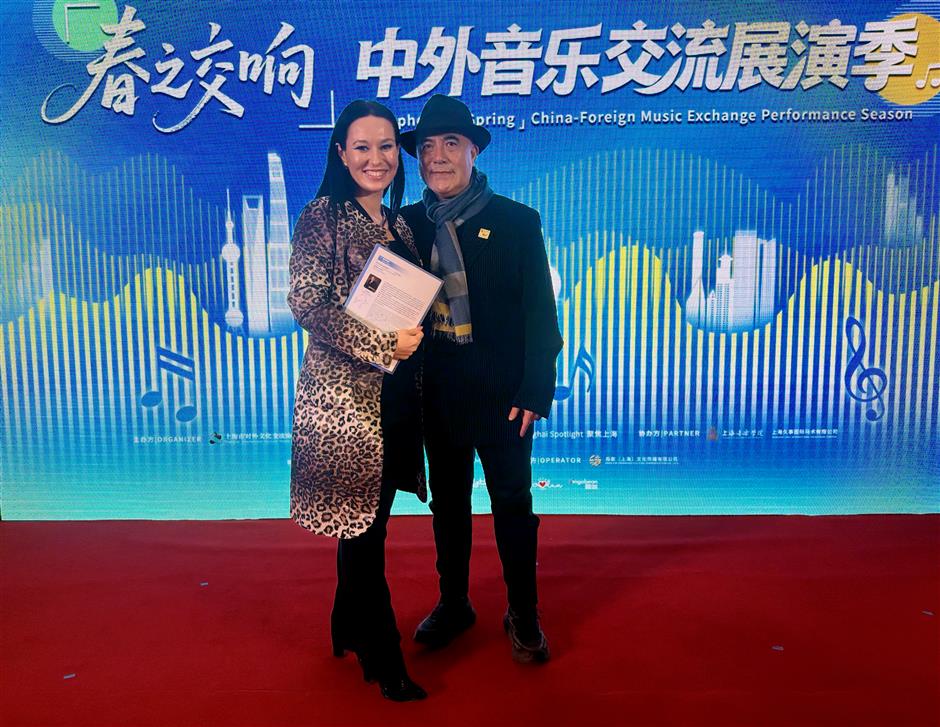
The most memorable moments happened off stage. In shared silences, fleeting glances, and the pause when the audience listened as one, boundaries of country, language, and context disappeared. Music does not unite. It simply shows that we have never been truly separate.
In recent years, the festival has welcomed more international artists, turning it into a platform for cultural exchange. It gives young musicians and first-time performers the same stage as experienced artists, showing that music is about community as much as performance. Perhaps that is the essence of festivals like this: not to build bridges, but to remind us that we have always been on the same side.
Editor: Chen Jie
In Case You Missed It...
 Apr 2, 2026
![[See & Be Seen] The Warrick University AI Leadership Conference](https://obj.shine.cn/files/2026/03/26/98afeb92-182c-4c02-b3b8-d306ecacf471_0.jpg)
![[Scaling China] Scotland's Oldest Tannery Just Met a Meditation Chair Startup. Shanghai Made the Introduction.](https://obj.shine.cn/files/2026/03/30/2093c8f2-2c66-4b06-b941-96e9aff0ff61_0.jpg)