Who Defines Reality: The Crux of the Debate in World Awash With Algorithms
Open three browser tabs. Ask the same chatbot the same morally charged question in English, Mandarin and Arabic. You may not receive three translations of one answer. Instead, you may encounter three moral weather systems.
The center of gravity can shift: individual freedom in one language, family obligation in another, social order in a third. Recent cross-cultural research has found that a model's moral and political orientation can vary with the language of the prompt, even as its tone remains serenely universal.
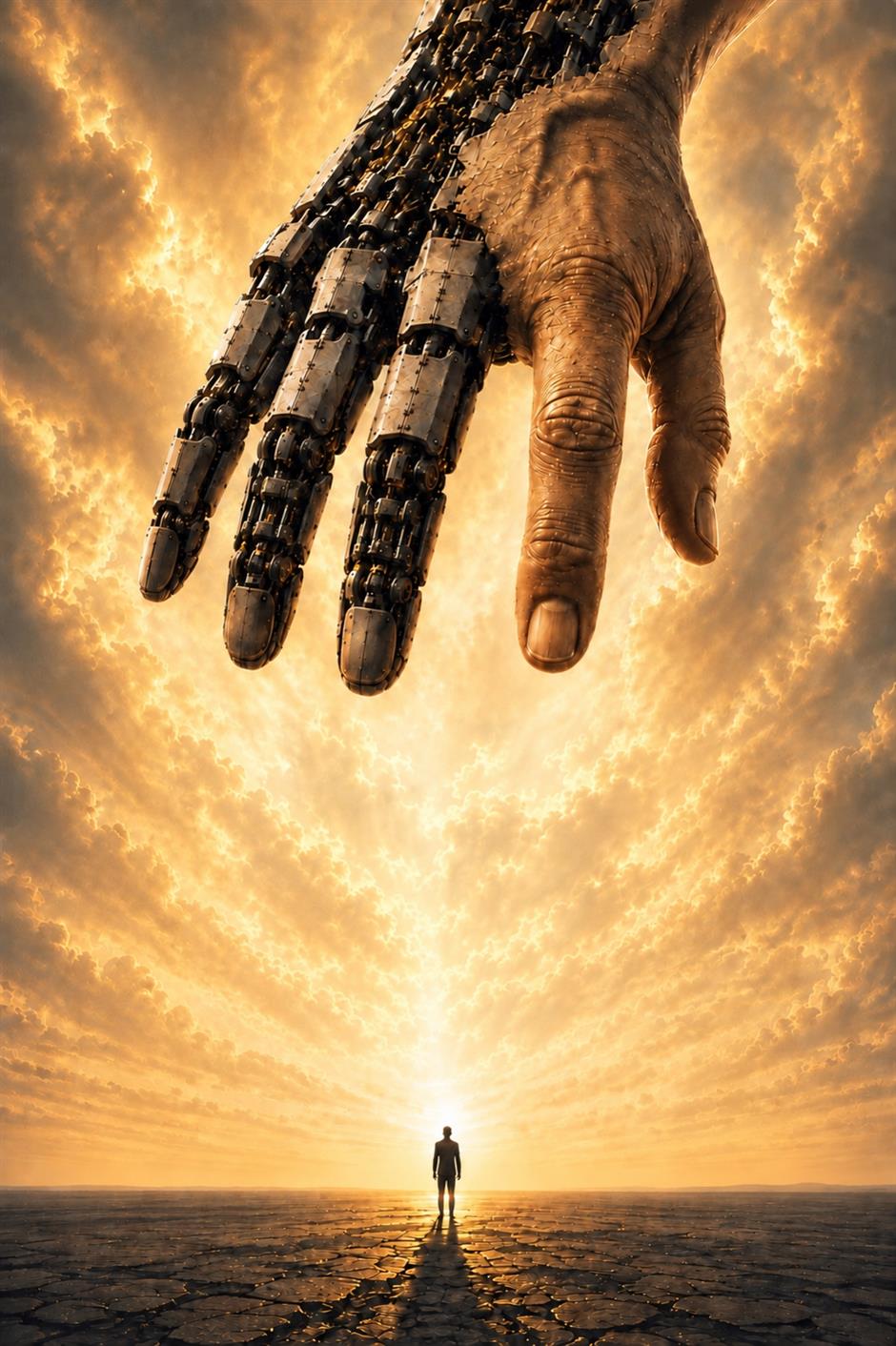
It is tempting to file this discrepancy under "bias." But bias is too small a word for what is happening. A generative model is not a window onto reality. It is a compressed settlement among millions of documents, countless human judgments and a handful of institutional decisions about what the system should say. Increasingly, the result is becoming the first answer people encounter.
A large language model does not visit the world. It predicts what should come next in a sequence, drawing on material that has been collected, filtered and weighted. Its behavior is then shaped by fine-tuning, safety rules, search rankings and product design. At every stage, somebody decides what counts as authoritative, harmful, relevant or helpful. By the time the answer reaches a screen, this long editorial chain has disappeared behind a blinking cursor.
The effect is subtle. The machine speaks without footnotes unless asked, resolves ambiguities that a careful historian would preserve and gives statistical likelihood the cadence of common sense. It can be wrong, of course. More consequentially, it can be incomplete in consistent ways. What appears often in the data becomes familiar, what is familiar becomes normal and what is normal becomes difficult to see as a choice.
The power to make those choices is unusually concentrated. According to Stanford's 2025 AI Index, industry produced nearly 90 percent of the notable AI models released in 2024. American institutions produced 40, compared with 15 from China and three from Europe. These numbers describe more than a technology race. They map the places where the infrastructure for machine-readable reality is being built.
Governments have responded with calls for "sovereign AI" – domestic computing capacity, local-language models and control over national data. The appeal is understandable. A country should not need a foreign company to make its history or public services intelligible to machines. For communities neglected by English-heavy systems, a local model can be an archive, translator and instrument of cultural survival.
There is another border, less visible but just as powerful – the line between cultures that generate abundant digital traces and those that do not. Oral knowledge, endangered languages and traditions governed by collective custodianship fit poorly into the scrape-and-scale logic of machine learning. UNESCO's AI governance observatory reports that only 13 percent of its country recommendations address indigenous or local languages. It found online training data in indigenous languages in only 15 percent of the countries assessed.
Digitization may help a language survive. Yet a culture forced to become legible to a model must decide what to reveal, who may encode it and whether sacred or communal knowledge should become training material at all. Inclusion cannot simply mean feeding more of the world into the same machine. Sometimes justice requires the right to remain outside it.
Synthetic media makes the problem more urgent. A convincing fake can deceive millions. Its deeper power is to make authentic evidence deniable. Once every recording is suspect, the liar gains two weapons: fabricated proof and permission to call real proof fabricated. A UNESCO analysis describes this as a crisis not merely of misinformation but of knowing itself.
Detection tools matter, but no watermark can repair a society that has outsourced judgment to systems it cannot question.
A human-centered response, therefore, needs more than accurate models. It needs a new epistemology, one that treats an answer as a claim with provenance, uncertainty and avenues for dispute. It needs a new ontology – one that recognizes AI neither as a neutral mirror nor as an autonomous oracle, but as an institutional actor participating in the construction of public reality. And it needs a new ethics. People should know when a machine has mediated what they see, be able to challenge its account of them and retain the right not to be converted into data.
This leads not to one perfected reality, but to realities. The plural is not an alibi for post-truth. A bomb falls or it does not, the climate warms or not, a body feels pain or not. Shared facts remain the ground beneath politics. But facts do not exhaust reality. Memory, meaning and moral responsibility vary across histories and cultures, and no training set can legitimately collapse them into a single default view.
The task ahead is not to build a machine that defines reality for everyone. It is to build institutions in which no machine, company or state can alone define it.
Hope may begin there. Before rival systems harden into isolated realities, nations, companies, researchers and cultural communities can still come to the same table to decide which facts must be shared, which differences deserve protection and which boundaries no power should be allowed to cross.
(The author is an award-winning science-fiction writer and co-author of AI 2041.)
Editor: Liu Qi
In Case You Missed It...
 Sep 9, 2026



![[Community] Say Bye, Say Hi: An Evening of Swapping, Sharing and Connecting](https://obj.shine.cn/files/2026/09/16/699fe833-2ba8-4118-b51a-6cee96e14a30_0.jpg)