Chinese Stocks Tumble as Rising Global Bond Yields Nip Market Rallies
China stock markets stumbled at the end of the week as rising bond yields nipped earlier rallies across the world.
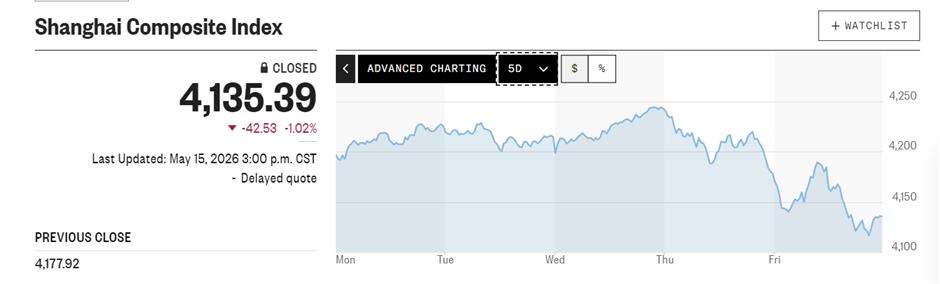
The benchmark Shanghai Composite Index lost more than 1 percent both Thursday and Friday, wrapping up the week with a decrease of 1.1 percent to end at 4,135. The decline, led by the energy sector, precious metals and solar panels, followed decade-high closes earlier in the week.
The Shenzhen Component Index narrowed its weekly loss to 0.02 percent, and the tech-focused ChiNext, rose 3.5 percent on strong resilience of some technology stocks.
The summit between Chinese President Xi Jinping and US President Donald Trump, which ended on Friday, produced warm exchanges for improved bilateral relations but no major deals were announced yet. Xi said China and the US both stand to gain from cooperation and lose from confrontation.
"The performance this week is a bit unexpected, when the leaders of the world's two biggest economies meet to address issues of concern," said Zhou Peng, an analyst with China International Capital Corp. "The market response may lag behind the influence of Xi-Trump summit, while the whole world is watching to see what happens next."
Global markets were more focused on the threat of inflation from the Iran war than geopolitical pleasantries. Fears about higher oil and commodity prices rippling through the global economy drove bond yields higher. Wall Street markets fell after US Treasury yields spiked to one-year highs amid bets that the US Federal Reserve will have to raise rates this year after disappointing consumer and producer price data this week.
The Nikkei index in Japan plummeted 2 percent after figures released on Friday showed wholesale inflation up 4.9 percent in April, its fastest pace in three years, sending Japanese bond yields to multi-year highs. The central bank is expected to lift interest rates next month from near zero. Bond markets in the UK remained skittish over the continuing parliamentary tug-of-war to oust Prime Minister Keir Starmer. The FTSE index in London fell 1.7 percent.
Rising debt yields signal higher corporate borrowing costs, which normally temper stock market investment. South Korea's Kospi index turned from recent historic highs to a downturn of 6 percent on concerns about a workers' strike at Samsung Electronics. The Hang Seng in Hong Kong lost 1.6 percent. Global benchmark Brent crude futures rose more than 3 percent to close at US$109.26 a barrel in New York after President Donald Trump said he is losing patience over attempts to end the Iran war.
On the corporate earnings front, shares in Chinese e-commerce and technology conglomerate Alibaba fell 4 percent on Friday after rising earlier in the week on its positive comments about AI development. The company reported an 848 million yuan (US$124.7 million) operating loss for its fiscal fourth quarter – its first since 2021 – on higher spending for AI and its fast food-delivery service. Tencent shares closed Friday up 0.3 percent after missing analysts' forecasts earlier in the week with a 9.1-percent rise in first-quarter revenue of 196.5 billion yuan. Its revenue from domestic games slowed to a 6-percent increase from a 24-percent jump a year earlier.
Shanghai-based Semiconductor Manufacturing International Corp, the Chinese mainland's largest chip foundry, reported its first-quarter net profit edged up 0.4 percent to 1.4 billion yuan, missing market expectations. Its Shanghai-listed shares closed down 3.25 percent on Thursday but up 0.95 percent on Friday. Hong Kong shares in Hua Hong, China's second-largest foundry, crashed 8.7 percent on Friday despite reporting first-quarter net profit surged 485 percent to US$21 million from a year earlier on a 22 percent revenue increase to US$662 million.
Air China shares fell 3.8 percent after the flagship carrier and three other Chinese mainland airlines announced increases in domestic ticket fuel surcharges to counter surging jet-fuel costs resulting from the oil blockade in the Gulf. Rising ticket prices are curtailing some consumer interest in air travel.
Looking ahead, two global investment banks were upbeat on prospects for Chinese stocks. UBS Securities chief China equity strategist Meng Lei said China's economic structure makes it less vulnerable to global energy price shocks, and Fang Dongming, head of UBS global markets for China, said he sees growing interest in Chinese markets from global funds. "Many institutional investors even regard Chinese assets as a safe haven among global risk assets," he added.
Morgan Stanley in a new report said China's AI industry is moving from a phase of technology catch-up to realizing commercial value. The nation's self-sufficiency in semiconductors, a key government policy, could raise economic growth by about 3.5 points by 2035, it said.
Losses in Asian markets rippled across the world on Friday. The Stoxx600 index in Europe fell 1.5 percent. On Wall Street, the broad S&P 500 index lost 1.2 percent and the Nasdaq was down 1.5 percent.
Editor: Yao Minji