Faculty Payments in China's E-Yuan Advance Mainstream Use
Starting this month, faculties of at least two colleges in China's Jiangsu Province will receive their salaries in e-yuan, the digital currency issued by the People's Bank of China.
The move doesn't come as a complete surprise. The e-yuan, officially known as E-CNY, has been available in various forms of consumption coupons and special allowances since 2019, after the central bank began experimenting with its use.
Central Bank Governor Pan Gongsheng said last month that the transformation to digital currency has been gradually upgraded to pave the way for more widespread use in the economy. Those improvements are reflected in issuance management, both retail and wholesale, and in blockchain, cross-border transactions and smart contracts. In 2023, Jiangsu was picked as a major site for pushing the e-yuan into the mainstream economy.
For individual users, there won't be any trouble when they conduct purchases with e-yuan, which equals to cash issued by the central bank except that it's digital. The money can be used via all popular distribution channels, including AliPay, WeChat Pay, UnionPay and bank cards. Use of the digital currency can't be refused by merchants. And better than cash, users are also guaranteed a fair interest income for keeping it in eligible real-name wallets.
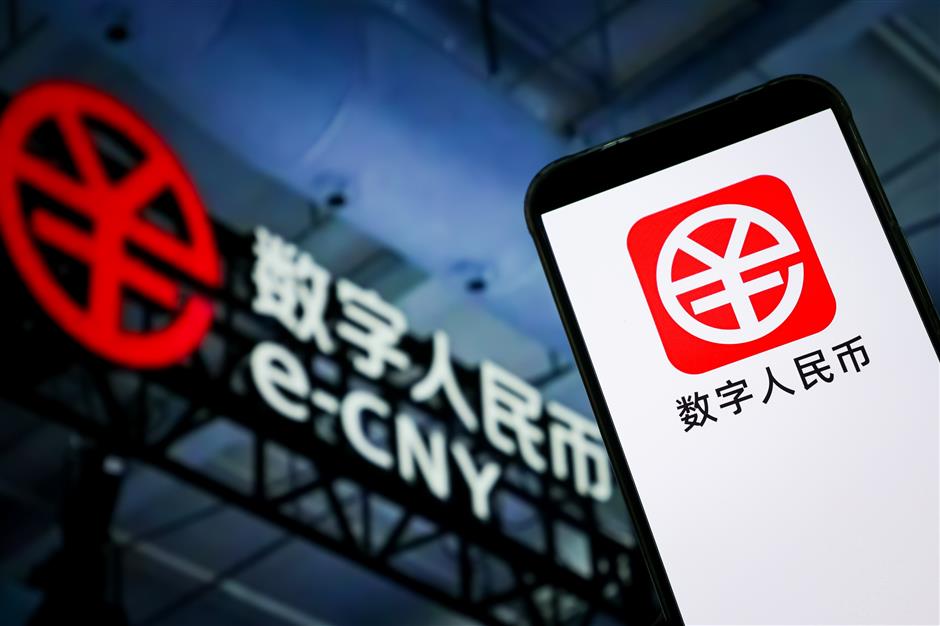
Financial institutions, including commercial banks and other payment channels, can rest easy amid concerns that e-yuan will draw clients away from them. The central bank confirms that the current two-tier model for payment will remain the same for e-yuan. That is, e-yuan holdings are on the balance sheets of commercial banks that offer digital wallets.
"The central bank will continue to pay interest to commercial banks at the required reserve rate, and in turn, commercial banks can pay interest to people who hold e-yuan in their bank wallets at standard deposit rates," said Lu Lei, deputy central bank governor.
Under the two-tier model, the central bank is responsible for formulating the business rules and technical standards for e-yuan, and participating operators, commercial banks and non-bank payment institutions that provide use of e-yuan wallets are responsible for the security of digital balances.
Since its birth in 2014, the central bank's digital currency has undergone a cautious, even slow, expansion. In the past two years, the once high-profile introduction almost ground to a halt as regulators paused to map out a clearer role for its use in the overall financial system and clarify the differences with other digital currencies, which are banned in China.
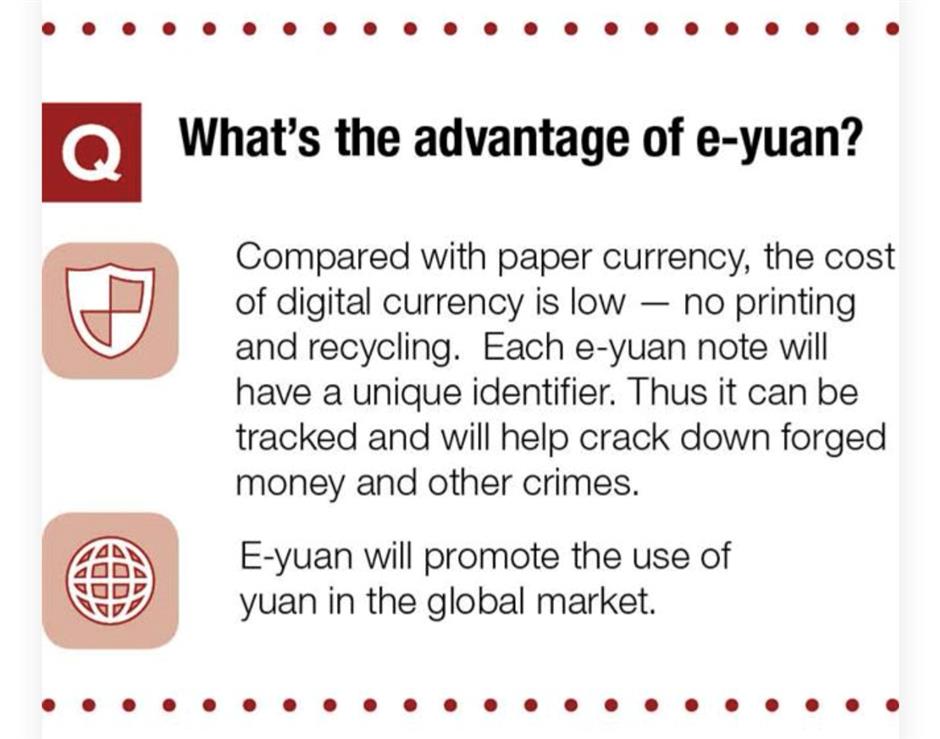
The differences are now evident. The e-yuan is not the same as bitcoin, and indeed is quite the opposite in terms of traceability. For the regulators, the e-yuan is a tool to monitor money laundering and tax evasion. It also helps policy implementation for designated money to end up where it should.
Also, it bypasses SWIFT, the global telecommunications platform that facilitates international transfers between banks.
Several countries already doing digital transactions with China through e-yuan as a bridge. China recently expanded its digital currency network to offshore institutions that offer e-yuan wallets for foreign firms and individual clients.
"We currently have 30 domestic banks as e-yuan operators," Lu told a fintech panel discussion in Hong Kong recently. "Now we're working to extend this capability to offshore banks."
The e-yuan has been called a tool to decrease the dominance of the US dollar. It may be one response to stablecoins – cryptocurrencies designed to keep steady market values by pegging to a specific reference asset, like the US dollar. US President Donald Trump has been an outspoken supporter of stablecoins. Unlike stablecoins, however, the e-yuan is issued by a central bank and has national credit behind it.
China includes broader adoption of e-yuan in its 15th Five-Year Plan (2026-2030).
The central bank said such arrangements afford the digital currency the same protection as conventional bank deposits.
"Serving as a unit of account, a store of value and a medium for domestic and cross-border payments, e-yuan can play a leading role in missions of national concerns, such as anti-money laundering, counter-terrorist financing and anti-tax evasion … on the condition that it grows into a major choice for transactions," said Liu Xiaochun, vice chairman of the Shanghai Finance Institute.
One distinguishing feature of digital currencies is that coded money can be recognized and traced. Users need not fear their money will disappear.
However, the e-yuan remains in an early stage of development. By the end of September, the cumulative digital yuan transactions in selected regions where it's in use reached 4.3 billion yuan (US$645 million), with a total value of about 31 trillion yuan, according to the central bank. In September alone, 99 million transactions valued at 1.9 trillion yuan were processed, up 12 percent from a year earlier.
Of course, there are two sides to the coin. On the plus side, e-yuan is safer than cash. However, it's possible for coded money to intrude on personal privacy, even though it is completely legal. There are also worries about how to integrate the digital currency into the existing global financial system, which is still debating legitimate use of digital money.
"Looking ahead, the choice of business and technological models for e-yuan will continue to be guided by the fundamental objective of serving the real economy," said the central bank's Lu. "We will adopt a principle of inclusive absorption and prudent selection for the development of account-based and token-based digital fiat currencies."
Editor: Liu Qi
In Case You Missed It...

 Nov 17, 2026