Global Tech Selloff Snares Chinese Stocks Amid Doubts About the AI Boom
Chinese stock markets took a beating on Friday in a sixth straight day losses, even before a selloff of tech shares on Wall Street accelerated in overnight trading. Around the world, investors are questioning the valuation of tech shares against profit prospects and the massive spending on AI infrastructure.
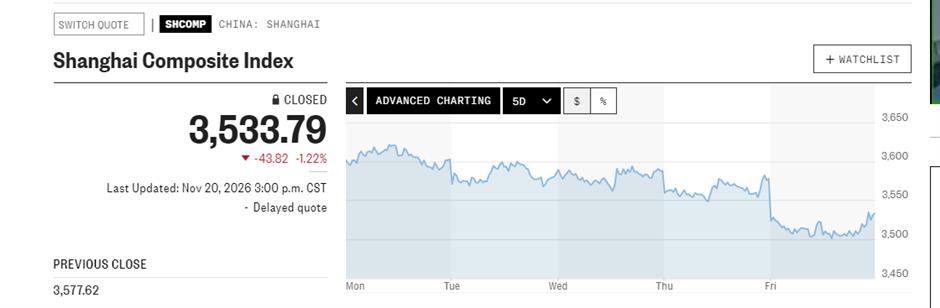
The benchmark Shanghai Composite Index declined 1.2 percent on Friday, ending the week with a drop of 2.8 percent. Its tech-focused STAR Market 50 index tanked 3.8 percent this week, with a slump of 11 percent in the STAR Market Composite Index. The Shenzhen Composite Index fell 3.1 percent on Friday, wrapping up the week with a loss of 6.5 percent, and its tech-heavy ChiNext board plunged 8.8 percent in five trading days.
Hong Kong's Hang Seng Index retreated 5.2 percent this week following a drop of 1.9 percent on Friday. Its tech index lost 3.8 percent alone.
"Tech shares continued to be targeted despite repeated expressions of support by Chinese authorities and corporate moves to buy back their shares," said Miao Yanliang, an analyst at the Citic Securities. "Investors are still beset by bearish sentiment, compounded with poor performances of tech shares in overseas markets."
High-profile tech shares led declines. ChangXin Memory Technologies (CXMT), China's top memory chipmaker, lost 6.2 percent on Friday, while Moore Threads, a designer of graphics processing units, dived 11 percent. Zhongji Innolight, a maker of high-speed optical modules, fell 3.7 percent, and Unitree, China's highest-profile robot maker, slipped 1 percent.
It was the same story in Hong Kong on Friday. Shares in Tencent, a conglomerate with businesses in AI platforms, cloud services and financial technology, fell 1.3 percent after third-quarter revenue missed market forecasts. Z.ai lost 7.2 percent, Minimax plunged 10.8 percent and Kuaishou tanked 11.4 percent. NetEase dived 19 percent after the company reported a decline in third-quarter profit and revenue. Shares of SenseTime, a Chinese AI model and infrastructure firm, were down 3.3 percent even after reporting higher revenue and profit.
There were some bright spots. Chinese tech and e-commerce titan Alibaba Group rose 3.5 percent on Friday after reporting that net income in its fiscal second quarter ended September 30 tripled to 64.4 billion yuan, with revenue beating forecasts with a 10 percent increase in revenue. Shares in Beijing-based Lenovo, the world's largest maker of personal computers, edged up 0.6 percent after the company reported that quarterly profit, excluding a one-time loss on warrant valuation, surged 166 percent to a record.
There were signs that some high-profile Chinese mainland fund managers were buying tech shares this week.
"Such fund managers usually don't make decisions on stories but on reality, and their action can be translated into a possible end to sharp market volatility, at least in a short term," Miao said.
Across Asia, the plunge in tech share prices drove South Korea's Kospi to a 7.9 percent loss this week and sent Japan's Nikkei down 7.7 percent.
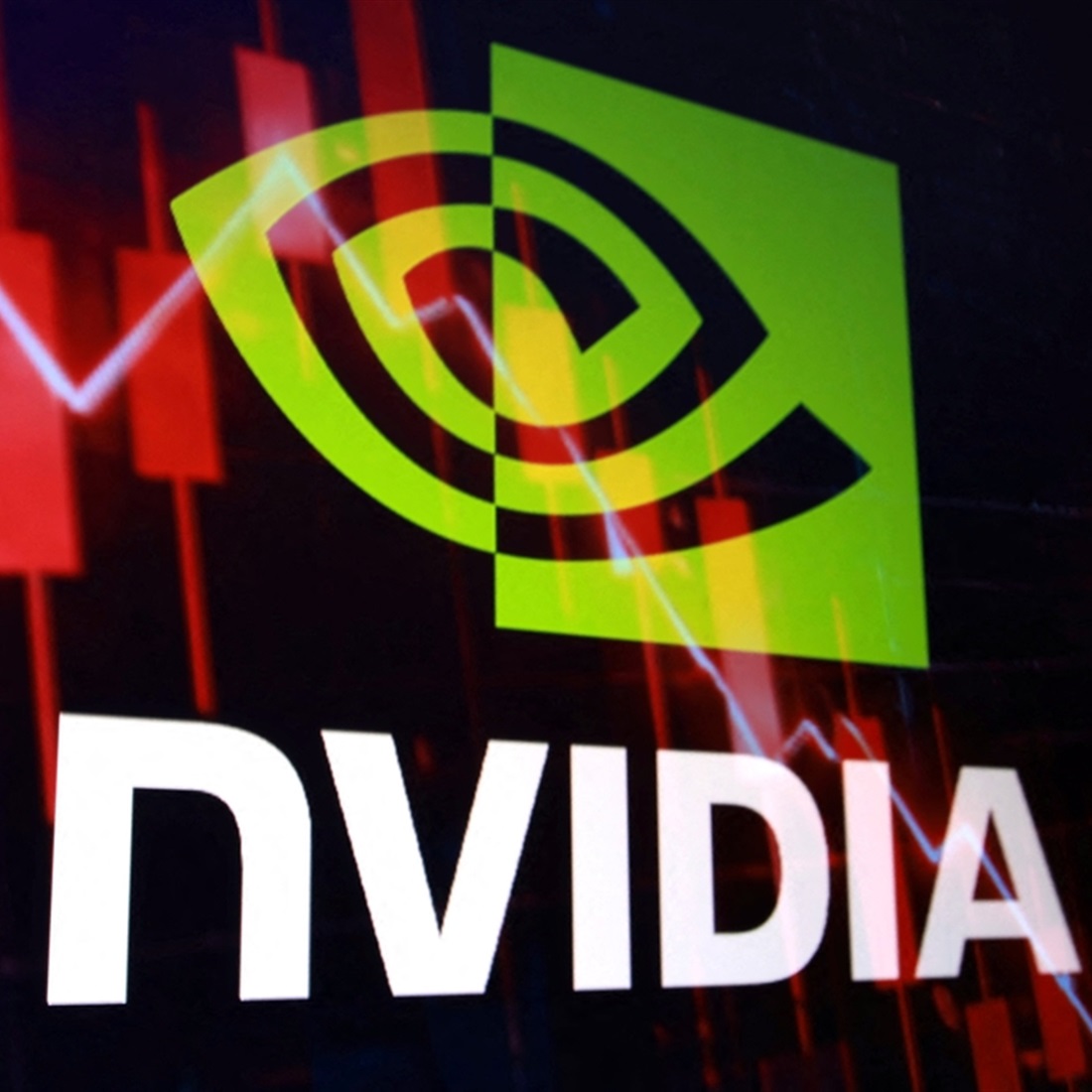
But the big news leading into the resumption of trading next week was an accelerating selloff in tech shares on Wall Street on Friday. The tech-heavy Nasdaq dived 5.3 percent, losing all its 2026 gains and chalking up its worst weekly loss in six years. The broad S&P 500 index and the Dow Industrials average both fell into correction territory. The tech meltdown was led by Anthropic and Nvidia. Anthropic shares tumbled almost 9 percent, after a 17 percent rise a day earlier in their market debut following a world record IPO. Nvidia shares dived 14 percent, continuing a steep decline that started last week after longtime chief executive Jensen Huang resigned under a cloud of scandal.
Editor: Chen Jie
In Case You Missed It...

 Nov 19, 2026

Popular Reads

Global Tech Selloff Snares Chinese Stocks Amid Doubts About the AI Boom
Shanghai, Singapore Ink 16 Deals, Advancing Cross-border Finance, Innovation and Cultural Ties

Viral Beijing Photo Brings Couple Back to Tie the Knot