As the Cost of Building AI Soars, Anxieties about Profit Payback Also Mount

The AI arms race looks unstoppable, but is it just the inflation of a trillion-dollar bubble? That's the question everyone is asking, and the latest quarterly earnings from China's top internet giants compared – with their counterparts in Silicon Valley – offer a sobering answer.
The costly bill for infrastructure buildout has arrived, and it is squeezing cash flows long before commercial returns fully materialize.
Third-quarter financial results from Chinese tech titans Alibaba Group and Tencent Holdings reveal that colossal investments in artificial intelligence are beginning to weigh heavily on liquidity and profit margins. Yet, neither company is hitting the brakes.
"It is a long tunnel," said Bian Fengwei, chief investment advisor at Aijian Securities. "Although there is light at the end of the tunnel, nobody knows just how long that tunnel will be."
For Alibaba and Tencent, the scale of capital expenditure required to stay competitive in AI computing has reached historic levels, turning healthy operating cash flows into steep deficits.
In the quarter ended on September 30, Alibaba reported revenue rose 10 percent from a year earlier to 271.5 billion yuan (US$38.1 billion), beating forecasts. Adjusted profit, excluding investment gains and other one-time items, rose 92 percent to 19.9 billion yuan, missing market expectations. Behind the numbers was a 60 percent surge in capital expenditure to 50.5 billion yuan, driven by AI infrastructure buildouts that pushed the company into a negative free cash flow of 34.5 billion yuan.
Tencent's spending spree was even more aggressive. The Shenzhen-based conglomerate reported third-quarter revenue of 207.3 billion yuan, crossing the 200-billion-yuan quarterly milestone for the first time, though growth slowed to 8 percent from 11 percent in the previous quarter as overseas gaming sales dipped 9 percent. Net profit edged up just 0.8 percent to 63.6 billion yuan.
What startled analysts was Tencent's capital outlay. Spending jumped to 81.4 billion yuan in the third quarter alone–surpassing the 79 billion yuan it spent across all of 2025. Upfront prepayments for computing power pushed Tencent's free cash flow to negative 69 billion yuan.
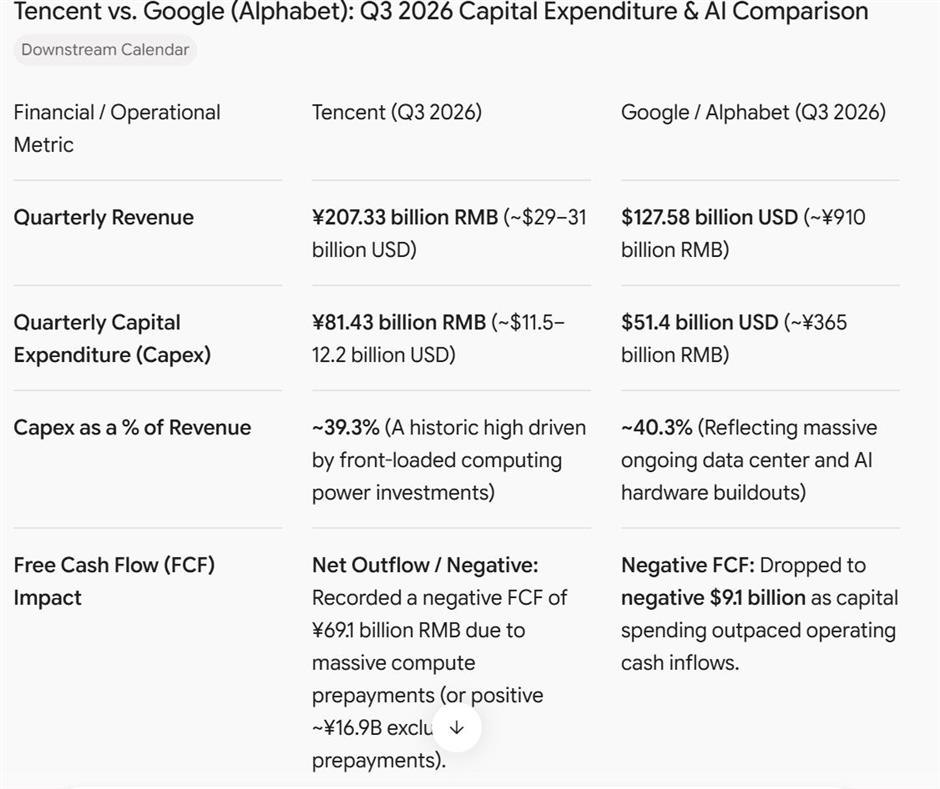
The financial strain is not unique to China. Comparing Q3 figures across the Pacific shows that Chinese and US tech titans are locked in symmetric capital intensity. Both Tencent and Google plowed roughly 40 percent of their quarterly revenue directly into AI infrastructure. Like Tencent, Google saw its free cash flow slip into negative territory of US$9.1 billion as data center and hardware investments outpaced operating inflows.
The mismatch between soaring infrastructure costs and nascent monetization is fueling growing anxiety among founders and public market investors alike.
Lei Jun, founder and chief executive of smartphone and electric carmaker Xiaomi, told the Asia-Pacific Economic Cooperation business summit earlier this month that the AI industry is suffering commercial growing pains. While large language models have advanced rapidly over the past four years, he said, real-world deployment scenarios remain limited, and relatively few companies have achieved a profitable commercial closed loop.
"As an AI practitioner, I also feel a sense of anxiety," Lei admitted.
Public markets have already begun repricing pure-play AI developers. In Hong Kong, shares of prominent Chinese foundation model firms MiniMax and Zhipu AI have plunged to roughly one-tenth of their previous highs despite a brief rebound this week. In the US, AI heavyweight Anthropic saw its stock pop on its market debut after a record-setting IPO, only to watch it fall below its offer price in subsequent days.
According to a recent research note from JPMorgan, global AI giants are expected to tap public investment-grade debt markets for US$450 billion next year, up from US$368 billion this year. Total global AI-related capex is projected to nearly double to US$1.4 trillion in 2027 before quarterly spending growth sharply decelerates–and potentially flattens–by early 2028.
Despite the near-term financial friction, tech executives argue that the foundations for long-term monetization are rapidly taking shape, particularly in cloud computing and workplace productivity tools.
Alibaba Chief Executive Eddie Wu reaffirmed Alibaba's target of reaching US$100 billion in external cloud revenue by 2030, though he cautioned that new US chip export controls could affect products and services next year as the company continues investing in in-house silicon.
Tencent saw similar momentum in enterprise services. On the consumer and workplace front, Tencent announced that its WorkBuddy has become China's most widely used workspace AI application, boasting over 10 million daily active users consuming more than 100 trillion tokens per day.
"We have achieved a series of important breakthroughs in both models and applications, accelerating Tencent's evolution toward the new AI era," said Chairman and Chief Executive Pony Ma.
Meanwhile, rival firms are aggressively embedding AI agents into core commercial ecosystems. Alibaba leveraged its e-commerce dominance during the recent Singles' Day shopping festival to sell significant volumes of its proprietary workplace AI agents.
Elsewhere in the sector, companies are shifting from broad model exploration to targeted vertical integration.
Shanghai-based gaming company Giant Network recently restructured its AI lab to bind self-developed models and audio-video generation tools directly to game development workflows, emphasizing that future AI investments must translate directly into tangible business value.
For China's tech leaders, the strategy is clear: endure the cash burn today to own the infrastructure of tomorrow -- even if the exit from the tunnel remains out of sight.
Editor: Lu Feiran
In Case You Missed It...
 Nov 28, 2026