Heavy R&D Investment Fuels Huawei's Global Patent Power and AI Chip Breakthroughs
Huawei is pivoting from foundational research to full-scale commercialization with an AI chip architecture inspired by ancient Chinese carpentry. It is backed by a massive intellectual property portfolio that has generated more than US$6.9 billion in cumulative licensing revenue.
At the 2026 Huawei Forum on Innovation and IP, the Chinese tech giant said openness drives industrial innovation while strong IP protection protects next-generation AI infrastructure and 6G standards.
Intellectual Property and R&D Engine
Huawei made US$800 million in patent licensing in 2025. By the end of last year, Huawei's patents had been licensed for use in over 3.2 billion 5G devices, 1.6 billion Wi-Fi consumer electronics terminals, and 4.1 billion multimedia devices, said Alan Fan, vice president and chief intellectual property officer.
The tech giant's patents cover network communications, consumer electronics, IoT, automotive, streaming media, and semiconductors. Wireless communications make up 41 percent of its valid granted patents, terminal devices 16 percent, and AI and computing 13 percent. Huawei ranks first among Chinese companies in cumulative invention patents, second in European patent applications, and fourth in US patent grants for 2025.
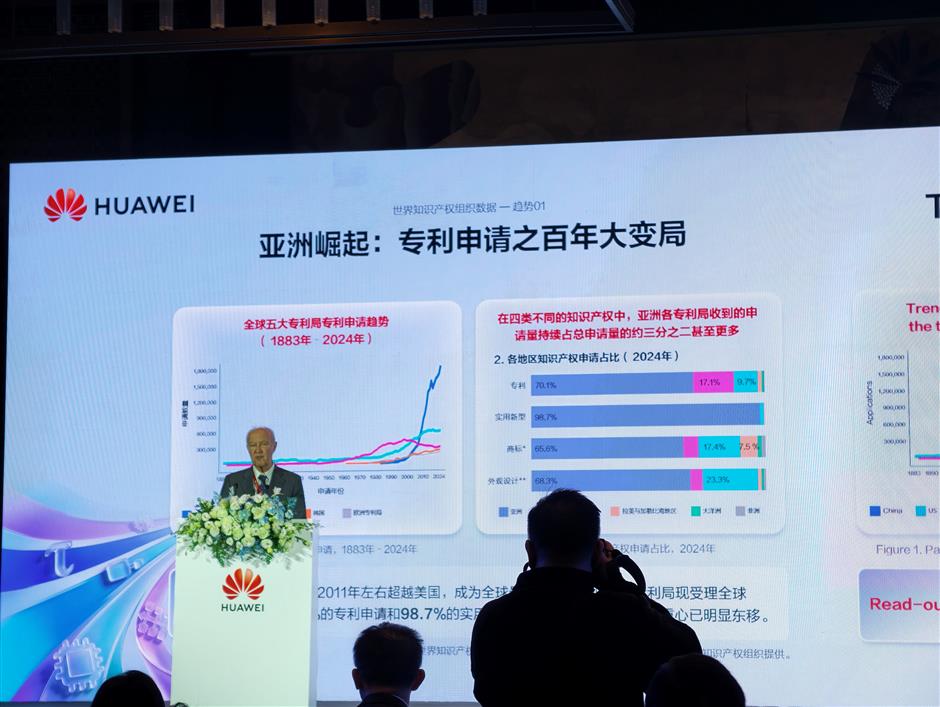
Francis Gurry, former director general of the World Intellectual Property Organization (WIPO), noted at the forum that Huawei's trajectory mirrors a broader "Rise of Asia" in global innovation, with Asian patent offices receiving 70 percent of worldwide filings in 2024 after China overtook the United States as the world's top patent office around 2021.
This patent output is underpinned by aggressive research and development spending. In 2025, Huawei invested 192.3 billion yuan (US$26.6 billion), which is 21.8 percent of its annual revenue, into research and development, supported by roughly 114,000 R&D personnel who make up 53.7 percent of its workforce.
Huawei's commitment to foundational science dates back to 2011, when Huawei established the 2012 Laboratories. The labs focus on medium- and long-term breakthroughs in ICT network architectures, standards, and materials rather than immediate commercial product cycles.
The company also built Chaspark (Huang Danian Tea House), a non-profit online platform where scholars across disciplines exchange ideas, access global scientific literature for free, and collaborate with universities on basic research.
Huawei's founder Ren Zhengfei has long championed this patient approach to innovation. "These are strategic investments that are not evaluated against short-term returns," Ren insisted, noting that forming a single foundational theory can take decades.
Commercializing the 'Tau (τ) Law' Ecosystem
To overcome physical bottlenecks in AI computing, Huawei and its industry partners detailed the commercial rollout of an AI architecture centered on the "Tau (τ) Law."
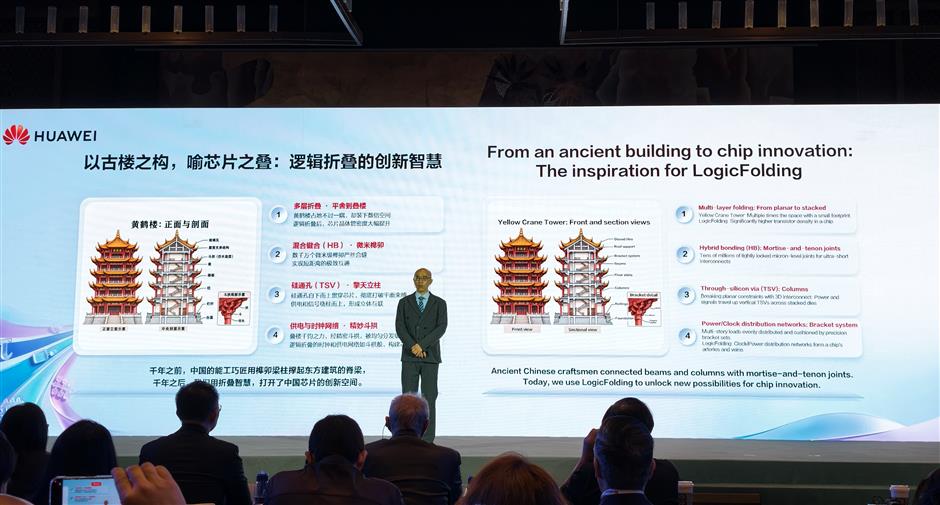
The architecture's core breakthrough, known as "logic folding," draws inspiration from traditional Chinese sunmao (mortise-and-tenon) joinery to achieve near-zero-distance interconnects. Rather than remaining a theoretical concept, the Tau Law ecosystem is moving into commercial deployment across Kirin chips, interconnect protocols, optical engines and electronic design automation (EDA) software.
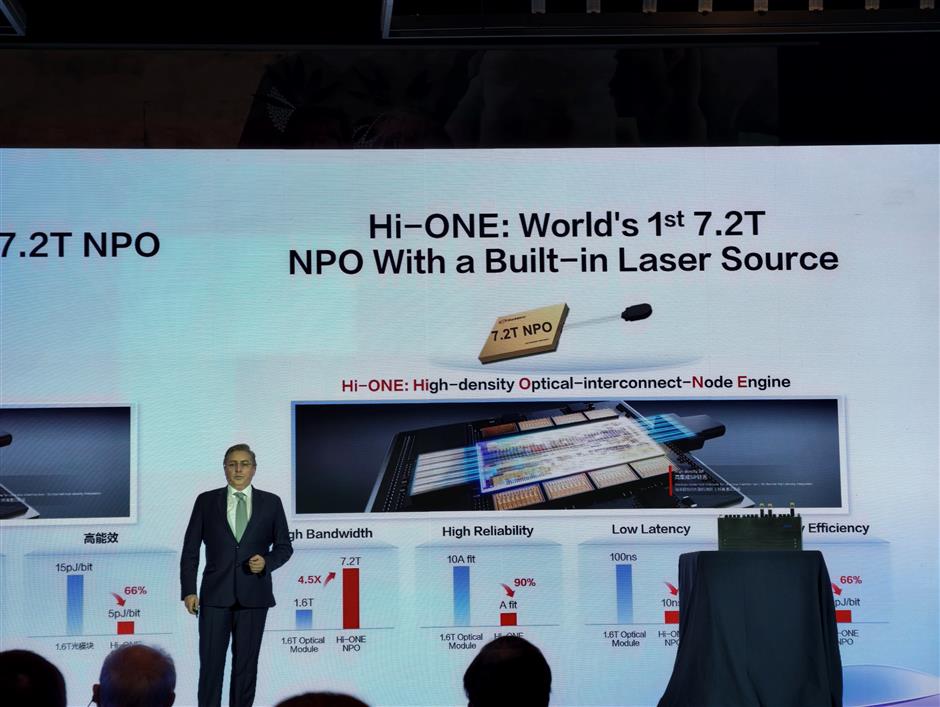
Among these innovations is UnifiedBus (UB), Huawei's interconnect technology that enables compute, memory, and storage resources within an entire data center to work together seamlessly on a single, large-scale computing bus. Additionally, Hi-ONE, Huawei's Near-Packaged Optics (NPO) solution, integrates lasers, silicon photonics, advanced packaging, and high-performance integrated circuits for AI clusters.
He Qing, chairman of Hangzhou PhileXing Technology, noted that while traditional EDA tools have focused on single-process nodes for decades, "Tau EDA" requires integrating and deconstructing multiple manufacturing processes simultaneously. Through deep collaboration with Huawei on high-performance computing libraries and cluster testing, PhileXing plans to release a new generation of EDA products supporting over 30 new features in 2027.
Editor: Lu Feiran
In Case You Missed It...

 Nov 25, 2026