Rapid Growth in Rail Transit, Drones Creates Need for Advanced Technical Skillsets
The 48th WorldSkills Competition now underway in Shanghai has added two new job categories: rail vehicle technology and drone systems, reflecting rapid growth in both sectors.
Fan Haobin, a researcher with the Institute of Urban and Demographic Studies of Shanghai Academy of Social Sciences, said the new events show that increasingly complex tasks like software testing and equipment diagnosis are no longer secondary or marginal but have become an indispensable part of core production processes.
"They represent a broad trend of economic transition, shifting from simply manufacturing products to operating complex systems, and from replacing labor with machines to redesigning human tasks," Fan told China Biz Buzz.
The rail vehicle technology competition was customized directly from China's own rail maintenance practices. The test for participants focuses heavily on troubleshooting train operations. Contestants must demonstrate maintenance skills for both mechanical and electrical systems, as well as diagnosis and resolution for vehicle faults. Tasks range from installing and testing passenger cabin doors to performing comprehensive vehicle diagnostics and repairs.
Liu Xirui, a student at the Shanghai Communications Polytechnic, is a competitor in this category. Having grown up near Shanghai's Metro Line 3, he was often taken by his grandmother to the line's terminus before they walked back together alongside the tracks. Memories of those excursions played a large part in Liu's developing interest in train system operations.
"While preparing for the skills competition, I felt my problem-solving abilities and logical reasoning will stead me well for a future in vehicle maintenance," he said.
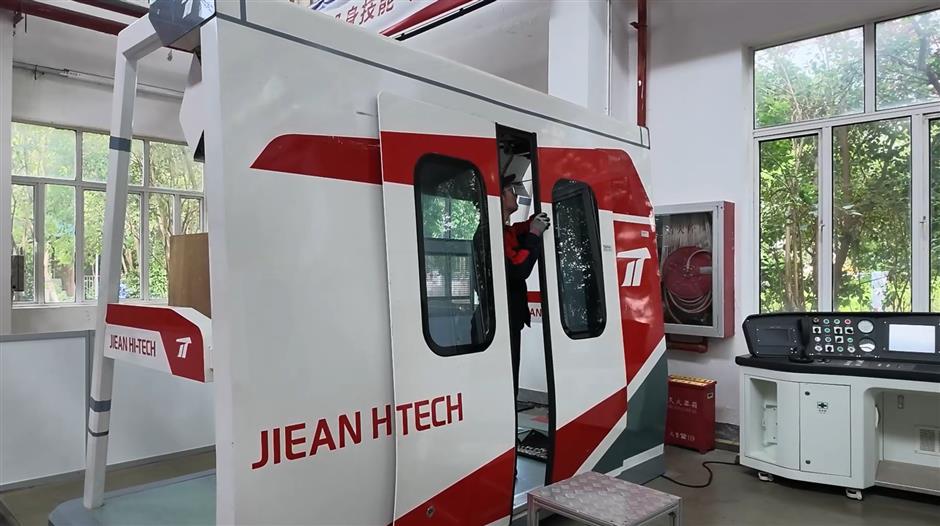
China has the longest rail system in the world, exceeding 11,000 kilometers. Its size drives strong demand for skilled talent.
As the only vocational college in Shanghai with courses in urban rail transit skills, the Shanghai Communications Polytechnic has trained more than 2,000 rail vehicle technicians in the past five years. The students have quickly transitioned into frontline jobs immediately after graduation, maintaining an annual employment rate of 95 percent.
"Through the WorldSkills platform, standardized operational procedures can be fed back into daily vocational teaching," said Yang Danhao, the rail vehicle technology coach at the polytechnic. "This allows more students to master high-standard skills, quickly integrate into the industry upon graduation and ultimately secure quality employment."
Much like rail transit, the applications for drone systems are experiencing an unprecedented expansion from traditional agricultural crop services to logistics delivery and specialized operations like high-voltage power line inspections and disaster rescues. As use of low-altitude drones expands, demand for talent is soaring.
Aside from pilots, there is a severe shortage of research and development talent, particularly in fields like visual algorithms and radar positioning, which help drones "see" their surroundings and navigate accurately.
Over the past year, new jobs in the low-altitude aerial sector have grown by two-thirds from a year earlier. Among them, drone pilot positions surged by nearly 190 percent, and maintenance jobs increased by 147 percent. The industry is now facing a shortage of roughly 1 million pilots, and the demand for drone assembly and maintenance workers is expected to hit about 3.5 million over the next five years.
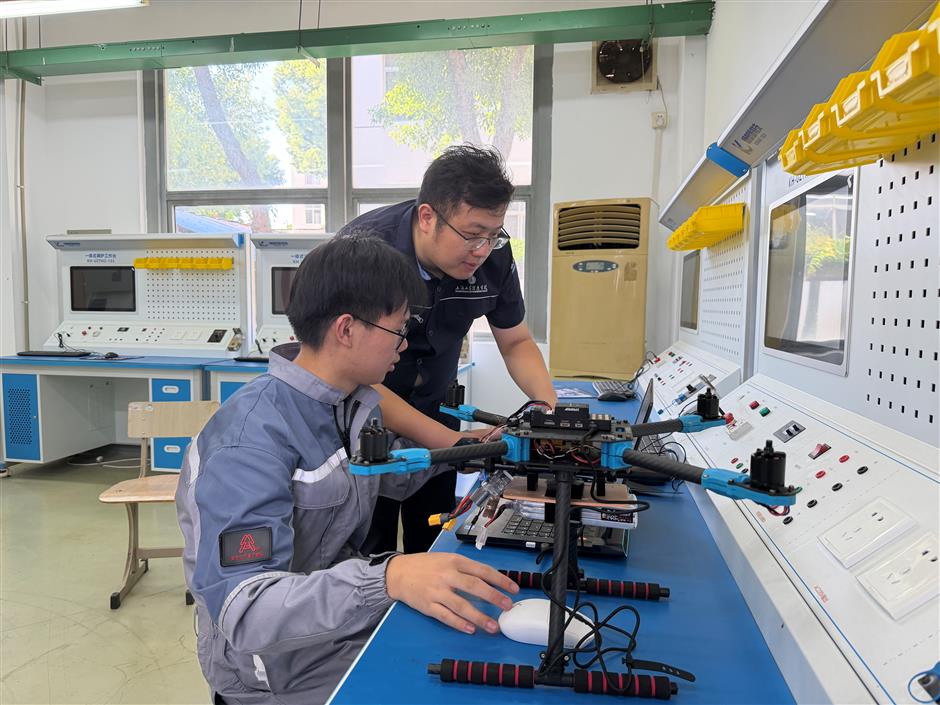
During this week's WorldSkills competition, contestants in this category must demonstrate skills as engineers, programmers and pilots. They are required to build and test a drone entirely from scratch, and show proficiency in integrating advanced sensor systems, utilizing machine vision technology for autonomous flying and using 3D printing to manufacture prototype parts.
Guo Qicheng, a contestant from the Shanghai Technical School of Industry, Commerce and Information, said he has studied various drone systems and learned how to use AI tools to generate flight control code for the competition.
"The biggest headache during training is a drone crash," he said. "It can be incredibly frustrating, but I learned how to keep a steady mindset."
Editor: Yao Minji
In Case You Missed It...
![[Try This] Shanghai Bakery Pairs Stinky Tofu With Pork in a Mooncake](https://obj.shine.cn/files/2026/09/24/9cc9893c-9114-4b61-bbfa-e3b83a3c9f5e_0.png)
 Sep 24, 2026