Ken Loach's Humanism at the Heart of the Shanghai Film Festival
The Tribute to Masters segment at this year’s Shanghai International Film Festival features retrospectives of the Austrian-born American film director Billy Wilder and the very sensual, sensitive and enigmatic Marilyn Monroe.
It is also paying tribute to Ken Loach on his 90th birthday, celebrating one of Britain’s most compassionate and uncompromising filmmakers.

Loach’s cinema has long chronicled the lives of individuals pushed to the edges by politics and economics for decades. From “Cathy Come Home” (1966), which exposed Britain’s housing crisis, to “Kes” (1969), his tender examination of working-class youth, and “I, Daniel Blake” (2016), his scathing critique of welfare bureaucracy, Loach has always held that cinema should illuminate the lives of ordinary people.
Curiously, my own encounter with Loach came relatively late. It was not until “Sorry We Missed You” (2019) that I discovered the humanism in his films, connecting with him deeply on a personal and emotional level.
"Sorry" centers on Ricky Turner, who is hoping that taking up self-employed delivery driving will finally provide his family with a financial footing. His wife, Abby, is a home-care aide, running from one client to the next with little time to catch her breath. Together, they struggle to hold their family together as they navigate the unforgiving realities of Britain’s gig economy.
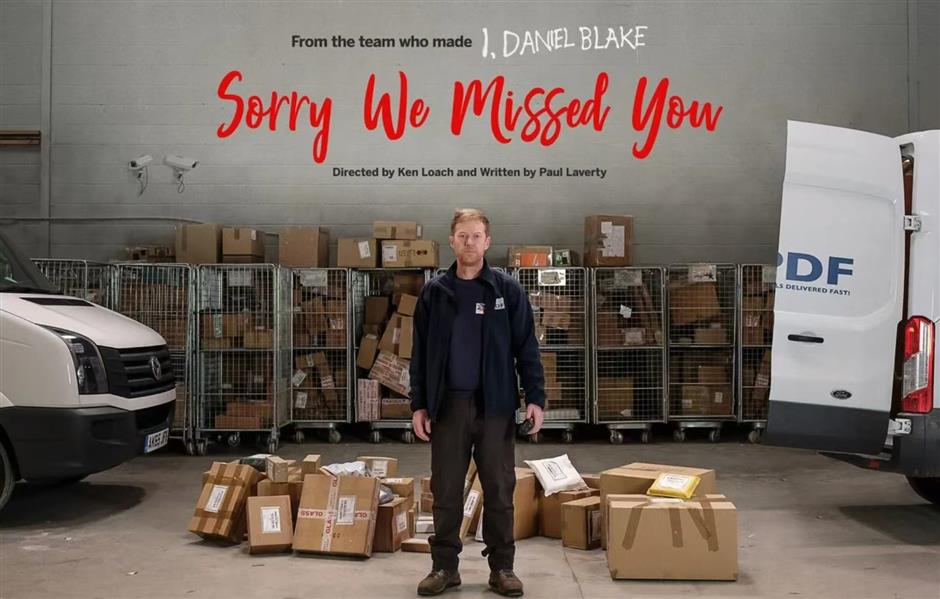
What makes the film so devastating is that Loach never raises his voice. There are no major speeches, no villains, no melodramatic flourishes. Rather, he exposes how the rhetoric of flexibility and entrepreneurship may cover exploitation.
Ricky is informed over and over again that he is “his own boss,” but every minute of his day is surveilled and every mistake has a financial cost. The promise of freedom is slowly revealed as another type of enslavement.
There are several moments in the film that are emotionally overwhelming. Physically fatigued and emotionally exhausted, Abby treats an elderly customer with the same gentleness and tolerance she’d give to a family member. Her compassion is touching, but it also reveals a bitter contradiction: The people who do the most loving work in society are typically the ones stretched to the limit.
And then near the end of the film, Ricky faces a brutal assault at work. He is physically battered and mentally weary, but has no choice but to get back to work. It is almost uncomfortable to watch him get into the delivery van with his injuries. There’s no victorious music, no reassuring conclusion. Only the stark sadness of a guy who just can’t afford to stop.
That is Loach’s gift. He never politicizes his characters. He makes them feel like neighbors, friends, even us possibly. His societal criticism is neither ideological but empathetic in its strength.
Loach, born in 1936, has spent more than half a century making films anchored in his left-wing ideas and his deep belief in human dignity. Remarkably, he has managed to hold onto that vision in a commercial cinema industry typically driven by market needs and spectacle. His films have never been interested in blockbusters, but have won international praise for their honesty.
Six years after it came out, “Sorry We Missed You” feels even more urgent. As the spread of app-based labor and gig employment continues around the world, the questions that Loach raises have become impossible to ignore. Behind each item delivered, each five-star rating and each finished work is a person whose worth is not evaluated by productivity alone.
As you follow the Turner family's struggles, you realize that Ken Loach isn’t against technology or efficiency itself, but against a system that places profit above people. His triumph lies in making their hardships vivid and personal rather than reducing them to a political argument.
It’s the emotional connection that gives his social criticism its muscle.
Editor: Zhang Liuhao
In Case You Missed It...

 Nov 22, 2026


Popular Reads

Global Tech Selloff Snares Chinese Stocks Amid Doubts About the AI Boom

Shanghai, Singapore Ink 16 Deals, Advancing Cross-border Finance, Innovation and Cultural Ties

Viral Beijing Photo Brings Couple Back to Tie the Knot