Regong Arts: A Golden Valley of Tibetan Faith and Color
Editor's note:
The United Nations has officially designated 45 Chinese traditions as world cultural heritage. This series examines how each of them defines what it means to be Chinese.
Regong, the name for today's Tongren City in northwest China's Qinghai Province, is a word rich with poetry in the Tibetan language, meaning a golden valley where dreams come true.
This highland region, where art and belief have grown side by side, has earned a lasting reputation as the "home of Tibetan painters" through centuries of lived artistic practice.
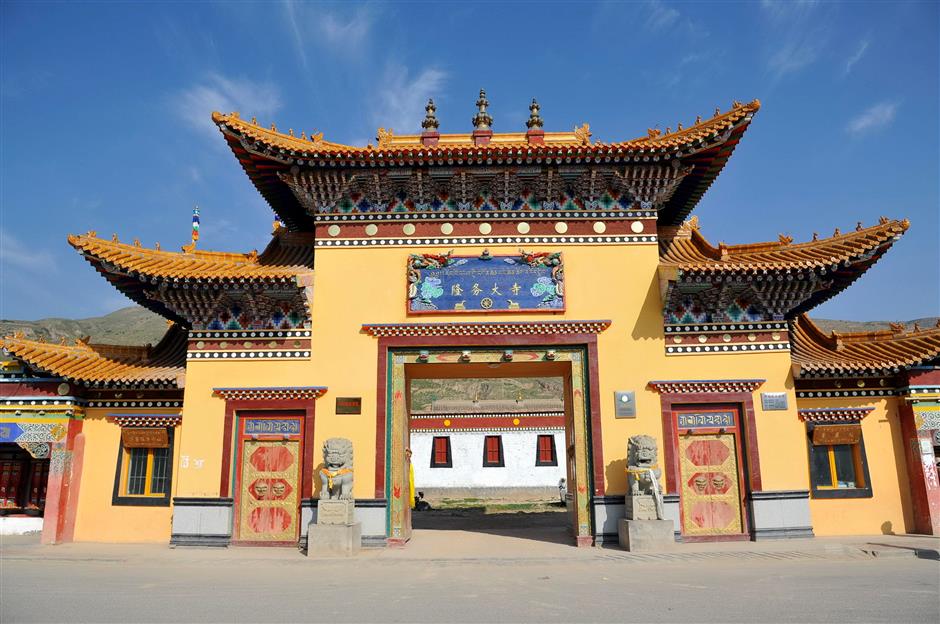
Once a strategic frontier contested by armies, Regong found its cultural turning point several hundred years ago with the construction of Longwu Temple. As prayer flags rose and the rhythm of chanting echoed through the valley, painting, sculpture, embroidery and architectural ornamentation began to flourish alongside religious life. These practices gradually took shape into what is now known collectively as Regong arts.
Regong arts encompass a wide range of forms, including thangka painting, murals, clay and wood sculpture, appliqué embroidery, architectural color painting, sand mandala, butter sculpture and decorative patterns.
In 2009, the United Nations Educational, Scientific and Cultural Organization inscribed Regong arts on the Representative List of the Intangible Cultural Heritage of Humanity, recognizing it not only as a regional tradition but as a cultural legacy shared by all humankind.
Local legend offers a vivid story of its origin. Long ago, it is said that Regong was a barren land where people struggled to survive. Moved by their hardship, the gods sent an eagle carrying a divine brush. When the brush fell into human hands, painting became a way of life, bringing color, skill and prosperity to the valley.
The Regong region, in today's Huangnan Tibetan Autonomous Prefecture in Qinghai, came under direct central administration in the 13th century, after the Yuan Dynasty (1271-1368) established a bureau of Buddhist and Tibetan affairs. During this period, the Imperial Preceptor Phagpa sent monks and artisans from Xizang to Regong to spread Buddhist teachings. Among them were accomplished painters who introduced religious imagery and techniques, embedding Regong arts within the development of Buddhist culture.
By the 14th century, following the completion of Longwu Temple, religious life in Regong flourished. Local monks who had learned painting and sculpture from Tibetan craftsmen found growing opportunities to apply and refine their skills.
In the 15th century, as the Gelug school of Tibetan Buddhism rose to prominence, a monk from Regong was granted the title of Great Imperial Preceptor by the Ming Dynasty (1368-1644) court. The region soon became an important center of Buddhist learning and practice.
Temples multiplied across surrounding villages, driving a surge in demand for murals, statues and ritual objects. Through collective creation, Regong arts gradually matured, developing a distinctive style.
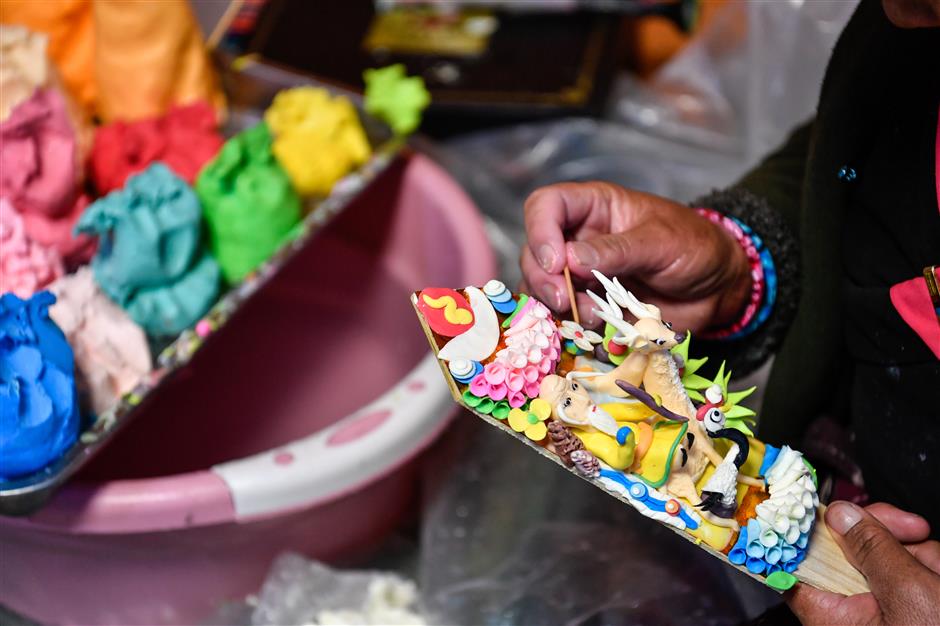
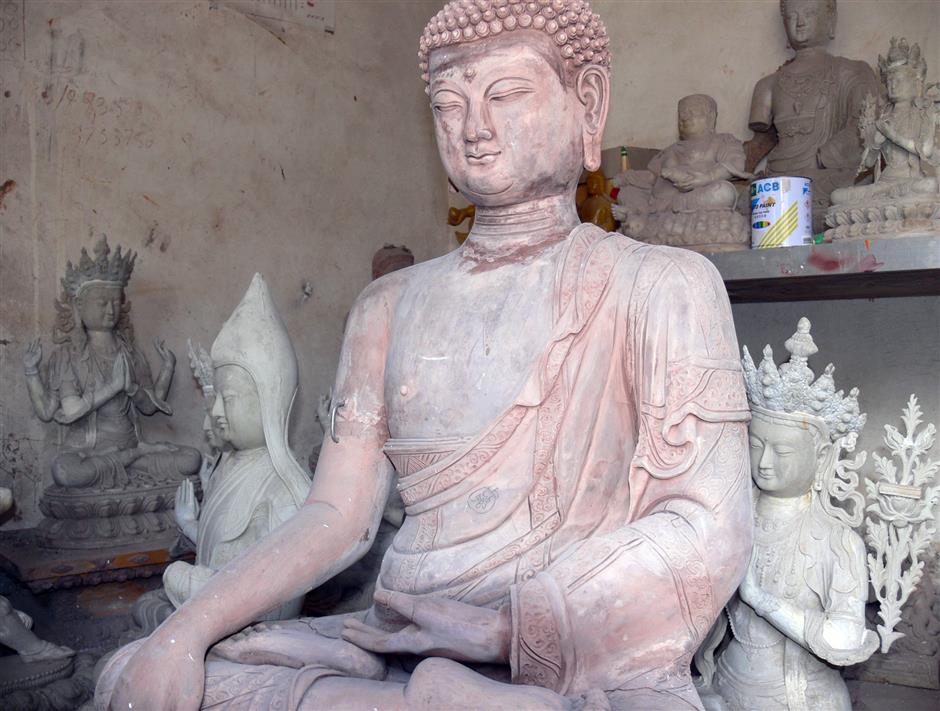
What sets Regong arts apart is the broad social base. Unlike many traditional arts practiced only by professional craftsmen or passed down within families, such art was created largely by farmers and monks rooted in local life.
Oral histories recount how a high lama of Longwu Temple once gathered villagers, distributing brushes and carving tools so they could study Buddhist arts alongside religious scriptures. In some villages, nearly every household produced thangkas, and most men could paint or carve. Art was not a specialized occupation, it was a shared cultural skill woven into everyday existence.
This openness also allowed Regong arts to absorb outside influences. In the early Ming Dynasty, Han Chinese soldiers and settlers arrived under military farming policies and settled in nearby villages. During peacetime, they farmed, worked and exchanged techniques with local communities. In Nianduhu Village, a Ming-era stele bearing the inscription "painter Liang Dazhi" documents the participation of Han artisans in temple decoration, offering tangible evidence of artistic collaboration.
From the 18th century onward, cultural exchanges expanded even further. Many Regong artists traveled widely, visiting India, Nepal, Mongolia and other regions. Along the way, they encountered Gandhara sculpture and the visual legacy of Dunhuang, both of which were absorbed into Regong arts, enriching its visual language.
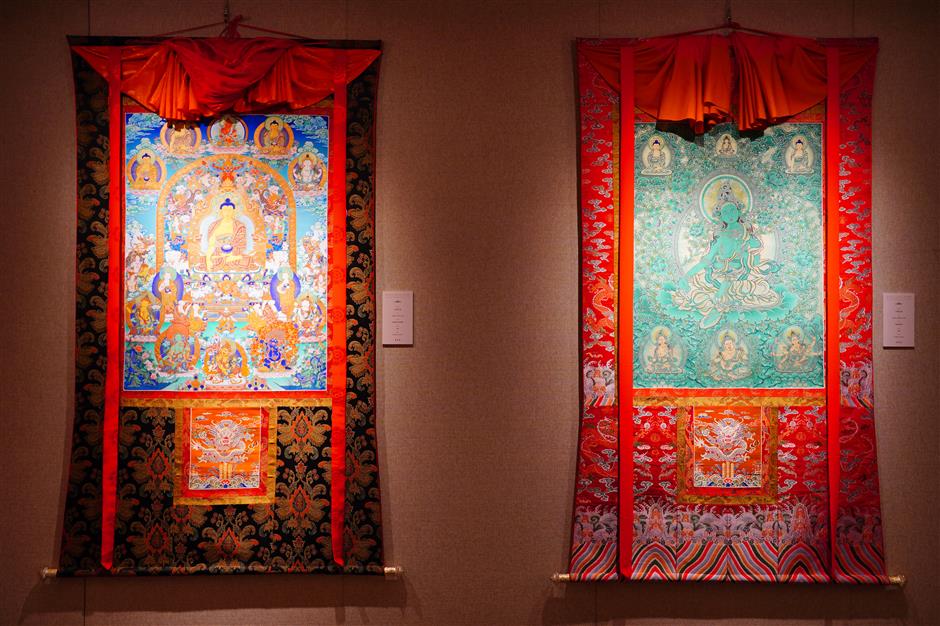
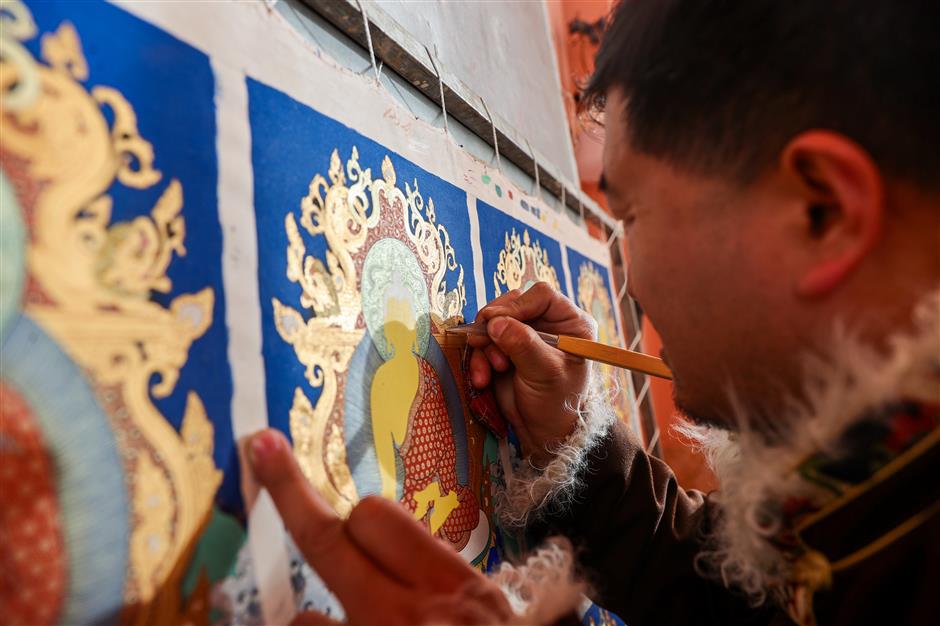
Among the many forms of Regong arts, thangka painting stands at its core. Often called the "king of Regong arts," thangkas are scroll paintings that evolved from wall murals. Mounted with silk brocade and sometimes adorned with silver or jade finials, they are designed to be displayed or rolled away, combining ritual function with visual splendor.
Regong thangkas are renowned for their use of natural mineral and botanical pigments — gold, silver, copper, turquoise, malachite, cinnabar and saffron among them. These materials give the paintings extraordinary durability, allowing colors to remain vivid for centuries. Gold powder, refined through painstaking processes, is used to trace halos, robes and ornaments, creating a luminous, sacred glow.
Colors in thangka painting carry symbolic meaning. Yellow symbolizes nirvana, red signifies power, and green conveys abundance and prosperity.
The most solemn moment in the creation of a thangka comes during the consecration ceremony, particularly the ritual known as the "opening of the eyes." When the final details of the deity's gaze are painted, the image is believed to transform from a painted representation into a living presence imbued with spiritual power.
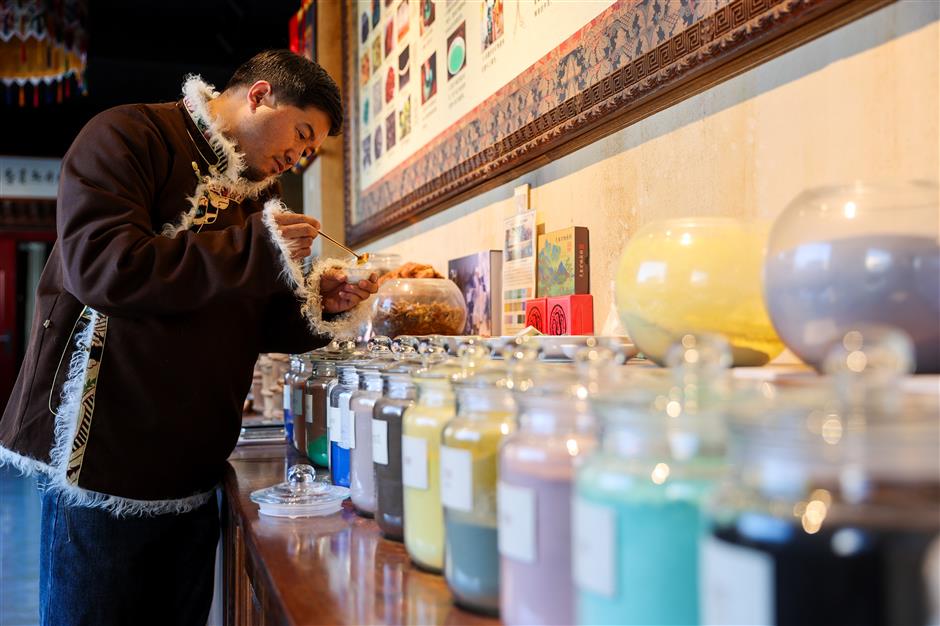
After the founding of the People's Republic of China, Regong arts entered a new phase of revival and renewal. In 1986, the Regong Arts Research Institute was established, bringing together scattered folk artists, offering systematic training and providing new platforms for creation and preservation.
While deeply rooted in tradition, Regong arts continue to evolve. Contemporary artists have expanded their subjects beyond religious narratives to include landscapes, historical figures and literary classics.
In Case You Missed It...
 Apr 2, 2026
![[China Tech] Breakthrough study on robot-assisted esophagus cancer surgery](https://obj.shine.cn/files/2026/04/01/d6ccf1c9-98a4-48c8-8d50-afe37a835352_0.jpg)