Rebuilt 'mother of cable-stayed bridge' opens to traffic
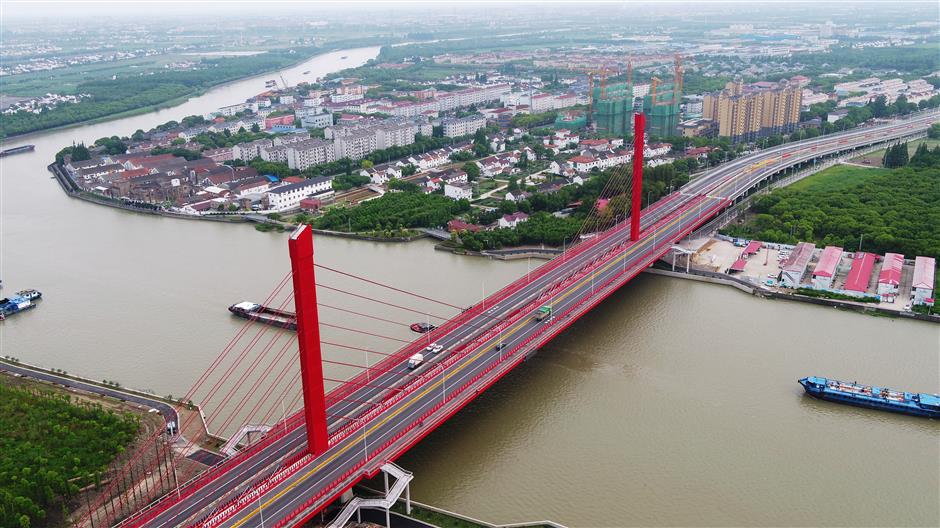
Retrofitting on what was once China's longest cable-stayed bridge on the outskirts of Songjiang District has wrapped up, and it reopened to the public today.
The new Maogang Bridge has a main 225-meter span over the Pingshen Channel, a tributary of the Huangpu River. The deck has been widened with three lanes of traffic in each direction, bicycle lanes and pedestrian footpaths.
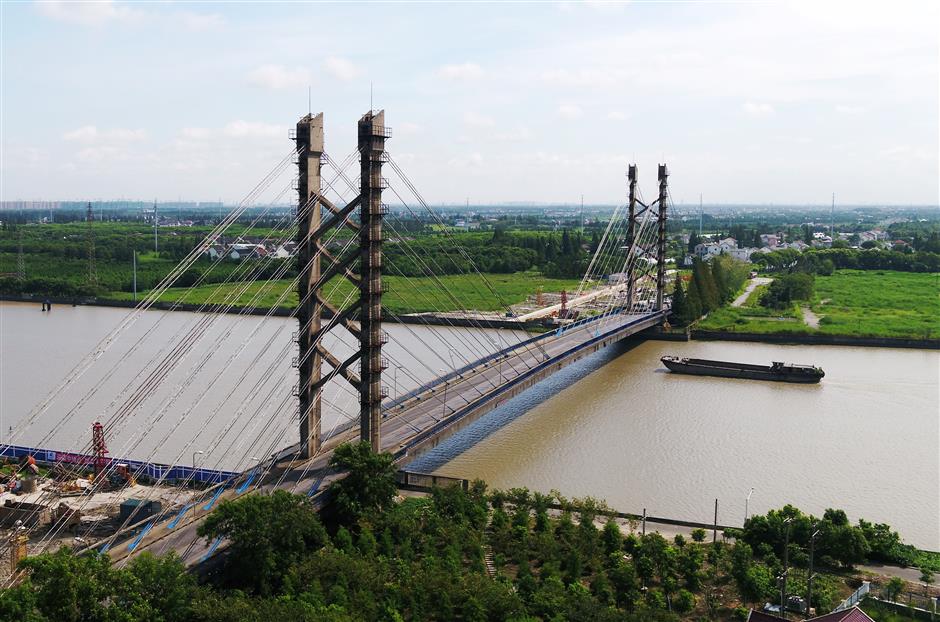
The new bridge has a similar shape to the old one but is more resistant to earthquakes, and the bridge's main towers have retained the appearance of the original, according to Shanghai Chengtou Highway Investment Group, the project's main builder.
The bridge's color has been changed from blue to red to resemble a torch standing on the upstream of the Huangpu River, the investment group said.
Completed in 1982, the original bridge was the first cable-stayed bridge in Shanghai, with a 200-meter main span. The bridge was nicknamed the "mother of Shanghai's cable-stayed bridges."
After nearly four decades of service, it no longer met the needs of traffic on land or water. The cables were rusting and the structure was deteriorating.
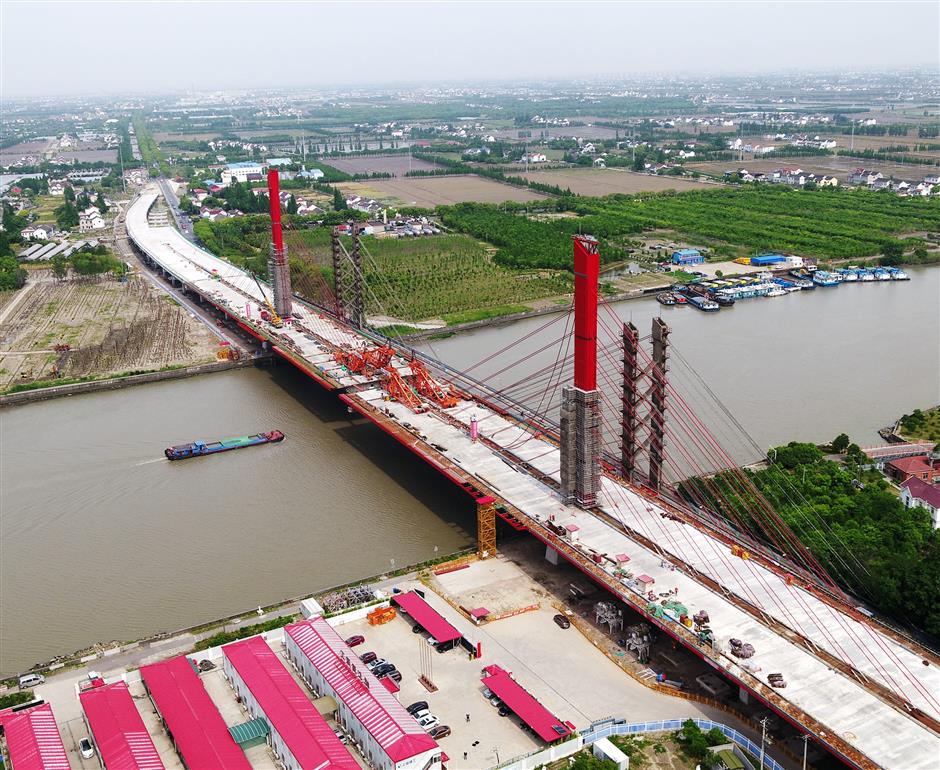
The old bridge was only 4 meters above water, so larger vessels couldn't pass under it. Pingshen Channel has become an important transport corridor between Shanghai and neighboring Zhejiang Province as the integration of Yangtze River Delta deepens.
The deck of the new bridge is 7 meters above water, which will allow most cargo vessels to pass under.
Demolition on the old bridge began on September 22, 2020. The bridge deck was cut into four pieces to be dismantled, and a floating platform prevented construction waste from falling into the water. It was fully torn down in January.
The steel structure of the new bridge was manufactured in Wuhan, in central China's Hubei Province, and transported to the site through the Yangtze and Huangpu rivers. Manufacturing and transport had to be suspended after the COVID-19 outbreak in early 2020. As the pandemic was brought under control, construction was accelerated and brought back on schedule. The structure was completed in May of 2020.
Meanwhile, a commemorative envelope, postcard and stamp were released today to mark the rebirth of the landmark bridge and remember the old structure.
In Case You Missed It...

 Apr 2, 2026

![[China Tech] Breakthrough study on robot-assisted esophagus cancer surgery](https://obj.shine.cn/files/2026/04/01/d6ccf1c9-98a4-48c8-8d50-afe37a835352_0.jpg)


![[Explainer] Your Guide to Applying for A 5-Star Card in Shanghai](https://obj.shine.cn/files/2026/03/25/abba9cd8-a391-4d52-89cc-78e198e96628_0.jpg)
