Shenzhen Warns Against Washing Dishes With Melamine Sponges
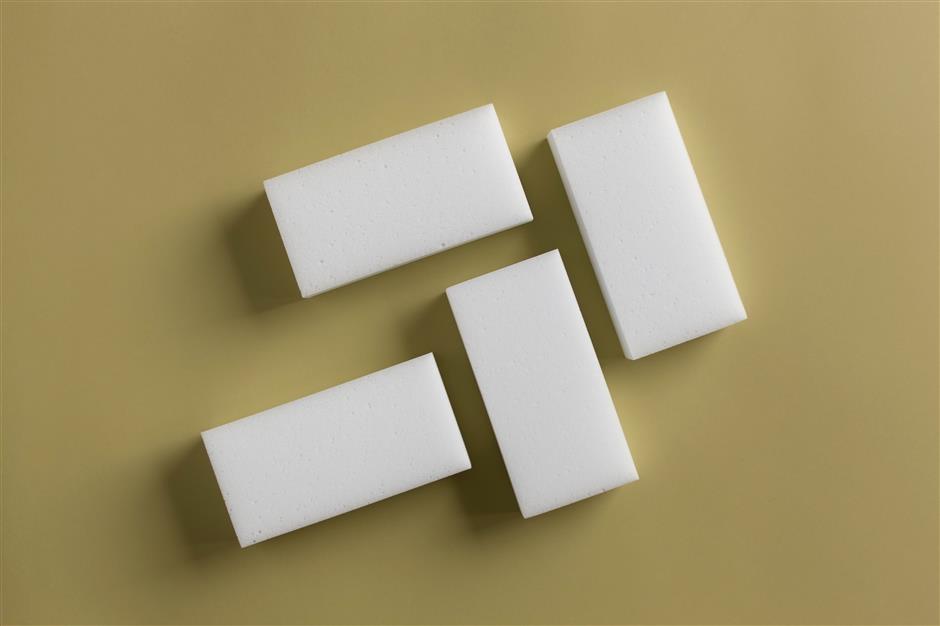
Melamine cleaning sponges should not be used to wash dishes, Shenzhen health authorities have warned recently, citing concerns about plastic particles released during use and formaldehyde residues in some products.
Often marketed as magic erasers or nano sponges, the products can remove stubborn stains with water alone. Social media users have recommended them as convenient household cleaning tools.
The Shenzhen health commission's warning highlighted how their cleaning action can also cause the material to break down. Made by foaming a melamine-formaldehyde polymer, the rigid plastic sponges have a honeycomb-like structure that helps lift dirt as they rub against surfaces.
A 2024 study by researchers at Nanjing University and Southeast University found that wearing away 1 gram of the sponge material released approximately 6.5 million plastic particles. The researchers used laser scanning confocal microscopy to examine the material.
The warning also raised concerns about poorly manufactured sponges, which can retain unreacted, free formaldehyde. It said inadequate rinsing and soaking before use, or insufficient rinsing of cleaned objects afterward, could leave residues.
In one experiment cited in the warning, researchers simulated cleaning a teacup with a magic eraser. Formaldehyde remained detectable in a drinking-water simulant after the cup was rinsed once or twice. After three rinses, the level was broadly comparable with that in uncontaminated tap water.
The advice was to rinse objects cleaned with the sponges thoroughly with clean water at least three times, rather than treating the products like ordinary cleaning cloths.
It also recommended wearing gloves and avoiding prolonged bare-hand contact. A study cited in the warning found free formaldehyde levels of 417 to 974 milligrams per kilogram in sponges that had already been used 20 times.
Consumers were also advised against stockpiling the products at home. The warning said storing sponges in poorly ventilated spaces could raise indoor formaldehyde levels and urged households to avoid keeping large quantities.
Editor: Wang Qingchu
In Case You Missed It...

 Nov 22, 2026