World's First 'Offshore Wind Direct-Linked' Underwater Data Center Goes Online in Shanghai
The world's first underwater data center directly connected to offshore wind power has started operation in Shanghai's Lingang Special Area.
Built by CCCC Third Harbor Engineering Co, the project marks a major step forward in China's integration of AI infrastructure, marine energy use and ocean engineering.
The total investment is 1.6 billion yuan. The overall planned capacity is 24 megawatts, to be built in two phases.
The first phase, now in operation, has a capacity of 2.3 megawatts. It includes a rebuilt onshore control center, one vertical data module installed under the sea, and two 35-kilovolt main submarine cables.
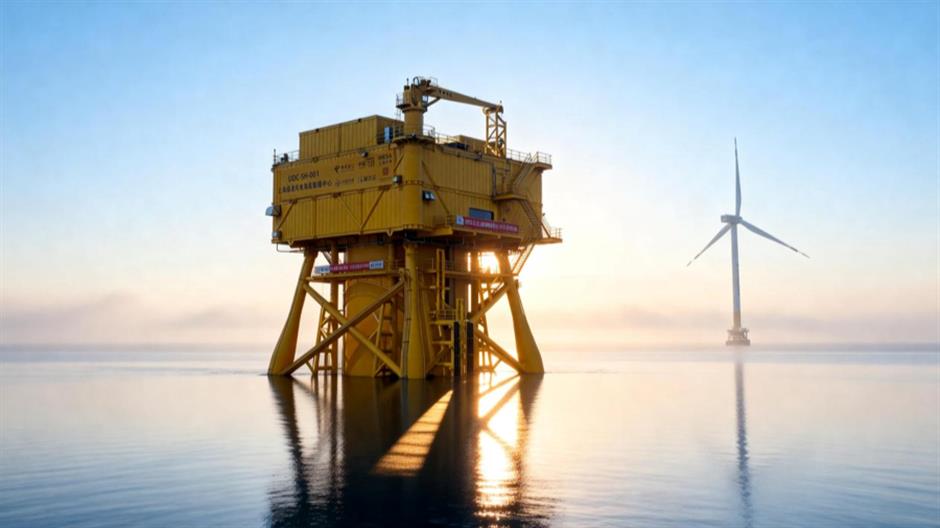
Powered by wind, cooled by the sea
The project combines two key technologies: direct connection to offshore wind power and natural seawater cooling.
It integrates marine cooling, green electricity supply, modular construction and smart operation.
The design PUE (Power Usage Effectiveness) is no higher than 1.15. More than 95 percent of the electricity comes from renewable sources.
This offers a practical solution to the growing tension between soaring AI computing demand and energy shortages.
A new deep-sea structure
There was no blueprint to follow.
As the first project of its kind in China, the data center had to withstand strong winds, heavy waves and high sediment levels in the Lingang waters.
Engineers designed a brand-new integrated structure. It combines four main parts: the upper module, jacket frame, data cabin and steel pipe piles.
The data cabin uses a vertical cylindrical design. The round shape increases internal space. It also reduces wave impact and improves overall stability.
Precision installation at sea
The data cabin traveled 220 kilometers from Qidong to the Lingang offshore wind farm.
The team used a saddle-shaped support base, thick rubber pads and eight stabilizing cables to secure the structure during transport.
The most challenging moment came during offshore lifting.
The gap between the jacket legs and the seabed steel piles was only 0.18 meters. The deviation had to be controlled within 10 centimeters.
Guided by GPS and positioning software, and using the crane vessel "Sanhang Fengfan," the team lowered the structure at a speed of just 0.1 meters per minute.
The cabin was inserted precisely into the seabed piles with zero deviation.
Now, offshore wind turbines spin above the East China Sea. Electricity flows directly to the underwater data center.
A new cycle of green computing power is taking shape along Shanghai's coast.
In Case You Missed It...
 Oct 3, 2026